Haplogroup R1b1a1b1a1a2c1b

– 6 min read


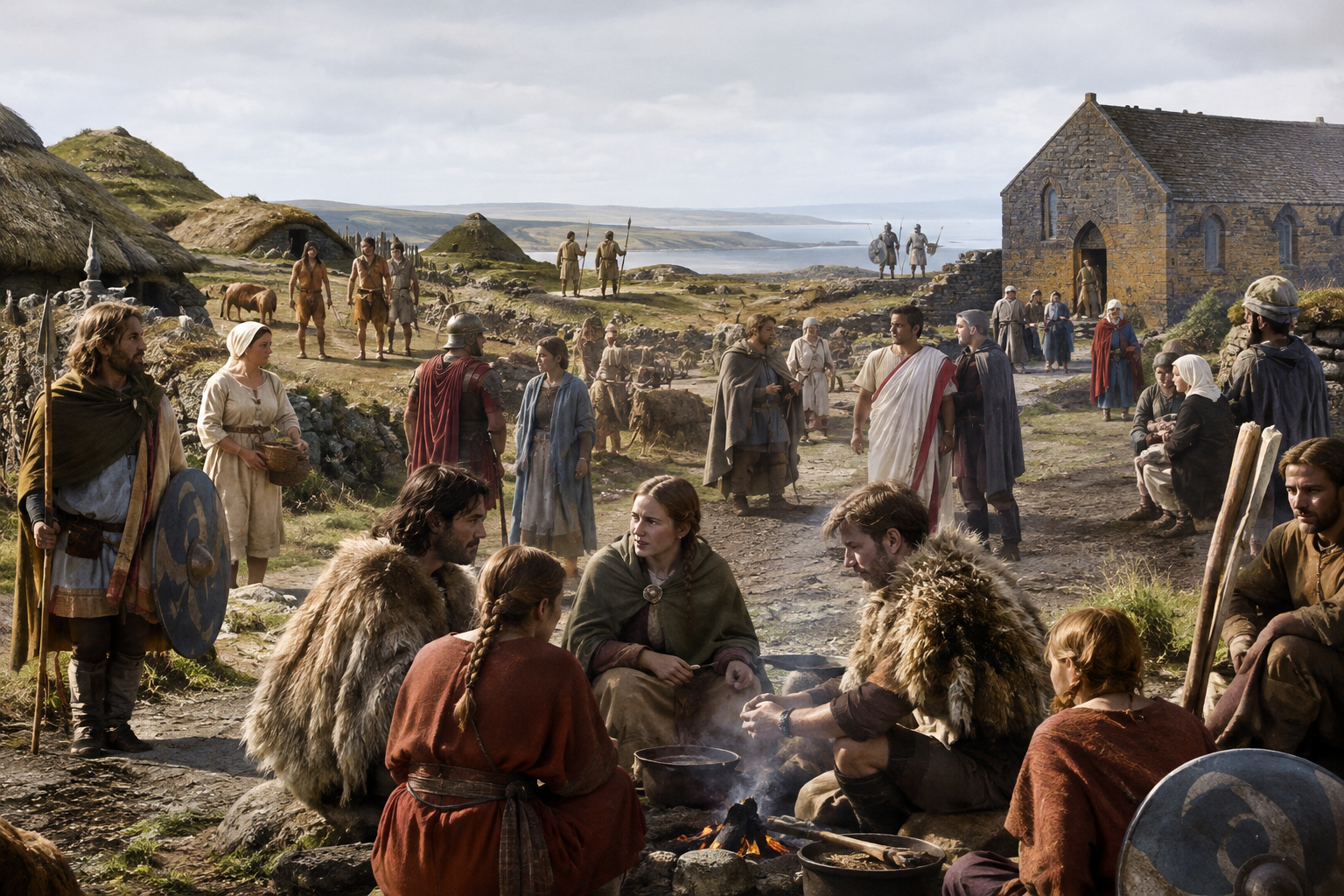
Some Y-chromosome lineages announce themselves with a trumpet blast. Others appear more like a trail of footprints across damp ground: here in an Early Bronze Age grave, there in a Roman cemetery, then unexpectedly in a medieval hilltop stronghold. Haplogroup R1b1a1b1a1a2c1b belongs to that second sort of story. It is a very specific paternal branch, one tiny twig on the much larger R1b tree, and that is exactly what makes it interesting. Narrow branches often let us watch history at human scale.
As ever with Y-DNA, a note of caution matters. A Y haplogroup traces only one direct paternal line - father to father to father - and not a person's full ancestry. Nor does sharing a haplogroup automatically mean two men were close relatives in any genealogical sense. But when a branch turns up repeatedly in ancient burials across time, it can help illuminate where paternal lines traveled, where they persisted, and how archaeology and history sometimes meet in the same landscape.
The deeper ancestry of this branch lies within the broad and historically important haplogroup R1b, a major paternal lineage in much of western Europe today. For a branch as specific as R1b1a1b1a1a2c1b, we should be careful not to lazily pour the whole history of R1b into it. Still, the wider family context matters. One of the supplied anchor points is I3525, an Early Bronze Age Hungary Yamnaya Sarretudvari-Orhalom individual dated to 2450 BC. That does not prove this exact narrow branch began with Yamnaya groups, but it places closely related paternal ancestry in the world of steppe-derived Bronze Age expansion.
From there, the picture becomes unmistakably western. The sample list is crowded with Bronze Age and Iron Age men from Britain, along with finds from Gaul, Italy, Iberia, Scandinavia, and the early medieval North Atlantic world. That pattern suggests not a single dramatic conquest by one family line, but a paternal lineage that became established in multiple western European populations over a very long span.
Readers interested in the broader backdrop to those early movements may enjoy this community article on steppe and frontier population history:
Explore Steppe Migration History
Britain is where this haplogroup becomes especially vivid in the ancient DNA record provided here. It appears in an impressive run of prehistoric burials: I2565 from Bronze Age Amesbury Down Wiltshire England dated to 2287 BC; I27380 from Early Bronze Age West Sussex England at 2300 BC; I12935 and I12786 from Bronze Age Lechlade-on-Thames Gloucestershire England at 2170 BC; and KD041 with related entries KD041_1, KD041_2, KD041_3, and KD041_4 from Bronze Age North Yorkshire Britain West Heslerton at 1800 BC.
That is already enough to show substantial time depth in Britain. But then the line carries on into the Iron Age with remarkable density. Wetwang Slack in East Yorkshire is particularly striking: samples such as I36888, I36875, I36872, I36873, I36847, I36840, I36809, I36757, I36763, I36770, I31507, I31005, I36908, I30967, and I36904, all around 225 BC, place this paternal lineage among the Celtic Parisi and Arras Culture setting of Iron Age Yorkshire. Add the famous I5511, the Elite Charioteer Briton Pocklington Yorkshire England at 225 BC, and one begins to see a lineage not merely present but embedded in local societies that buried their dead with distinct regional customs.
The same branch or closely related paternal lineages also appear in Scotland and the islands: KD004 and associated entries from Pict Era Orkney Knowe of Skea Westray at 205 BC, CGG018915 and CGG018915x from Pict Era Scotland Orkney Mine Howe at 115 AD, and I2859x from Late Bronze Age Covesea Caves Moray Scotland at 860 BC. These are not proofs of ethnic identity in any simplistic sense, but they do show paternal continuity across regions often treated as historically distinct.
For readers who want a wider look at how these burials fit into larger British population history, this article is an excellent companion:
Read Roman and Early Medieval Britain DNA
This lineage is not confined to Britain. On the continent, CGG022427 from the Belgic Suessiones Tribe France Bucy-le-Long dated to 390 BC places it in Iron Age northern Gaul. In northern Italy, 3214 and 3214s from Gallic Cenomani Tribe Italy Verona Seminario Vescovile at 300 BC show it in a Cisalpine Celtic context. That matters because it hints at a paternal branch moving through, or persisting across, the same broad western European zone where Celtic-speaking communities are historically visible.
The Roman world then adds mobility rather than neat replacement. In Britain we find DUX019 from Roman Era Cambridgeshire Duxford at 112 AD and VIC016 from Roman Era Cambridge Vicars Farm at 200 AD. In Iberia there is I6492 from Roman Villa Tarragona at 350 AD and I23763 from Roman Iberia Merida Necropolis Blanes at 450 AD. None of these men can be tied to one another by documented genealogy, of course, but together they reveal something the written sources often blur: Roman provinces were full of old local lines that continued through imperial rule, alongside newcomers who crossed the empire's roads and sea lanes.
That western Mediterranean angle becomes even more interesting when we reach post-Roman and medieval Iberia. The Las Gobas cave-habitation and burial complex in northern Spain gives us ldo039 at 650 AD and ldo052 and ldo242 at 1000 AD. Here the branch survives into the Dark Ages and medieval period in a region shaped by Visigothic, local Hispano-Roman, and later frontier dynamics.
If Iberia catches your eye, this is a natural next read:
Discover Roman Hispania's Genetic Legacy
How does a lineage like this connect to medieval history without drifting into fantasy? Not by pretending that an Iron Age burial in Yorkshire is the direct ancestor of a proven noble house in Provence. Rather, by noticing how paternal lines can endure in regions whose political identities change again and again.
The supplied noble association is the House of Bertrand, linked with Venasque in Provence. Venasque is one of those places that historians love because it refuses to belong to a single century. It is a hilltop village in southern France with roots reaching back to Roman times and perhaps earlier. Later it became an important fortified center in the early Middle Ages and, for a time, the seat of the bishops of Carpentras. Its position on rock mattered; so did its walls, baptistery, and cramped streets, all reminders that power, worship, and defense were bundled together in medieval life.
In the medieval period Venasque belonged to the Comtat Venaissin, a territory tied to papal rule. That gives the House of Bertrand a setting larger than family biography alone. This was Provence connected to Rome, bishops, lordship, and the politics of southern France. If a paternal branch such as R1b1a1b1a1a2c1b appears repeatedly across Gaul, Britain, and Iberia in ancient and medieval samples, Venasque sits in exactly the kind of western European landscape where such lineages could have long local histories.
That is context, not proof. A historical association between a house and a haplogroup should never be mistaken for confirmation that every Bertrand male carried this exact branch. Still, Venasque offers a useful reminder: castles, fortified villages, and episcopal seats preserve the memory of lines of authority, even when genetics cannot name every father in the chain.
For more on the family itself, readers can continue with:
What makes R1b1a1b1a1a2c1b so compelling is not a single royal claim or one glamorous burial. It is the long, stubborn spread of evidence. From I3525 in Early Bronze Age Hungary to Bronze Age Britain, from Iron Age Yorkshire chariot burials to Roman Cambridge, from the Gallic Cenomani in Verona to Las Gobas in medieval Spain, the branch appears across centuries of upheaval without vanishing from view.
That is exactly what Y-DNA can do well. It does not tell the whole story of a people, a kingdom, or a family. But it can expose continuity where written history is silent, and mobility where later tradition imagines fixed roots. A paternal lineage may pass through steppe-connected Bronze Age expansions, settle into local Iron Age communities, survive Roman government, and still be present in medieval Christian societies. History, in other words, is rarely a sequence of clean replacements.
If you would like to explore another French noble context shaped by regional power and lineage, this community article makes an excellent companion piece:
Read About the House of Villeneuve
And that is part of the pleasure of ancient DNA. It lets us set a hilltop village like Venasque beside a cemetery in Roman Cambridge or an Iron Age grave in Yorkshire and ask better questions about continuity, movement, and memory. Not "who was my exact ancestor in 225 BC?" - ancient DNA rarely allows that - but "what sort of paternal histories shaped the world my ancestors later inhabited?"
Upload your DNA to MyTrueAncestry and explore whether your results show connections to ancient individuals like I3525, I2565, I5511, or the men of Las Gobas. Those matches cannot by themselves prove direct descent or noble status, but they can offer an extraordinary new view of the deep past behind your family story.






Comments