Haplogroup R1b1a1b1a1a2c1a6c

– 6 min read


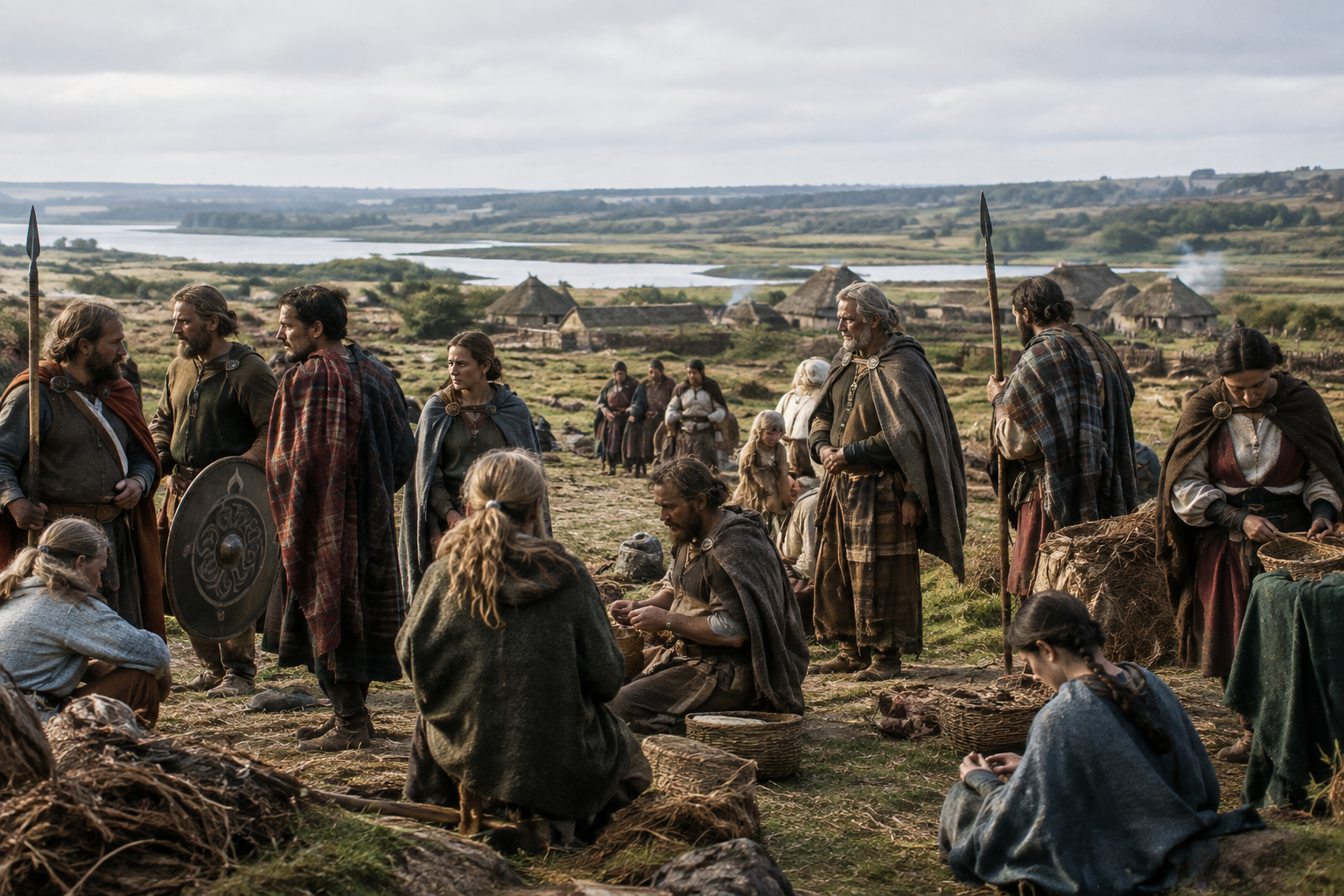
Some Y-chromosome branches are famous because they are broad and common. Others are interesting for the opposite reason: they become visible only when ancient DNA begins turning up in graves, barrows, hillforts, Roman towns, and medieval churchyards. Haplogroup R1b1a1b1a1a2c1a6c belongs to that second category. It sits inside the large and historically important R1b family of paternal lineages, but as a much narrower branch it is best understood not as a label for an entire people, but as one thread within the long male-line history of western Europe.
That matters because Y-DNA tracks only one line of ancestry: father to son to son. It does not describe a person's whole background, and it certainly does not assign anyone neatly to a tribe, kingdom, or noble house. What it can do, though, is something rather thrilling. It can show that a paternal line now found in living testers also appears in ancient men from Iron Age Britain, Roman-era contexts, and medieval northwestern Europe. In other words, it can put a narrow male-line branch back into the landscapes where history happened.
This haplogroup is a downstream branch within the wider R1b tree, a major Y-DNA family strongly represented in much of western Europe. For a very specific subclade such as R1b1a1b1a1a2c1a6c, caution is essential. We should not simply pour the entire history of broad R1b into this one terminal branch as if nothing changed over thousands of years. But the supplied ancient samples do give us a useful frame: this lineage, or closely related paternal lines within its immediate neighborhood, appears repeatedly in Britain from the Bronze Age into the Iron Age and beyond, while also showing up in parts of continental Europe.
The pattern is especially striking in Britain. From Bell Beaker and Bronze Age contexts through Iron Age communities such as the Parisi of East Yorkshire and the Durotriges of Dorset, the evidence suggests a paternal line embedded in local populations over a long period. That does not prove uninterrupted descent from any single ancient man to any modern tester. It does suggest that the branch belongs to a deeply rooted western European story, one that later written history only catches at the very end.
Explore Celtic origins through ancient DNA
If you want to see this haplogroup come alive, the archaeology of Britain is the place to start. One of the earliest supplied markers is I4950, a Bell Beaker individual from Wiltshire Upavon England dated to 2300 BC. Nearby in time are I2417 from Bronze Age Amesbury Down Wiltshire England, also 2300 BC, and I3256 from Bronze Age Trumpington Meadows Cambridge England dated 2100 BC. Add I5377 from Early Bronze Age England Thames at 1800 BC, dfb002 from Cranborne Chase Down Farm Pond Barrow in Dorset at 1900 BC, and Rathlin2B from Ireland Copper Age at 1880 BC, and a broad picture emerges: related paternal lines were present around Britain and Ireland very early indeed.
Then the evidence becomes almost wonderfully crowded in East Yorkshire. The cemetery zone around Wetwang Slack, Pocklington, Melton, and Burton Fleming produces a remarkable cluster of Iron Age males. Among them are I36889, I36880, I36885, I36974, I37335, I37336, I37342, and I37344, all described as Celtic Parisi Iron Age England East Yorkshire Wetwang Slack Burial Year:225 BC. There are also I36843 and I36844 from the Arras Culture, I36972 from an Arras Culture Primary Barrow Burial, and the especially evocative I36995, an Elite Celtic Parisi Chariot Burial Iron Age England East Yorkshire Wetwang Slack Year:225 BC.
This does not mean every Parisi man carried the same exact terminal subclade, nor that elite status equalled one Y-DNA line. But such a concentration is hard to ignore. It points to a paternal lineage well established in an Iron Age society famous for its chariot burials and distinctive eastern Yorkshire burial customs. These are not abstract mutations on a chart. They are men buried with the rituals of their community, now helping us glimpse how a male line could persist locally while social worlds changed around it.
Read more on Iron Age Britain and kinship
The branch does not vanish when Rome arrives. In southern Britain, the Durotriges provide another dense cluster: WBK12, WBK20, WBK29, WBK41, WBK05, WBK30, WBK43, WBK06, WBK08, WBK18, and WBK191, all listed as Celtic Durotriges England Duropolis Winterborne Kingston Year:125 AD. That is a splendid reminder that Roman Britain did not simply erase local populations. In Dorset, local communities carried on under imperial rule, and their paternal lines remained very much present.
Other British samples widen the map: I16592 from Celtic Dibbles Farm Somerset England Year:252 BC, I11991 from Iron Age Worlebury Somerset England Year:150 BC, I21309 from Iron Age Hillfort Battlesbury Bowl England Year:57 BC, and I11580 from Post Roman Era Worth Matravers Dorset England Year:600 AD. Together they suggest not a single dramatic migration event we can neatly draw with arrows, but a durable paternal presence in western and southern Britain across many centuries.
And then there is continental mobility. I26776 appears in Imperial Roman Era Zadar Croatia Year:200 AD. R10656 comes from Late Roman Era Klosterneuburg Lower Austria Year:407 AD. R10488 is from Late Roman Conimbriga Portugal Year:330 AD. IND013 belongs to a Merovingian Grave North Rhine-Westphalia Germany Year:600 AD. In Belgium, ST2025 from Early Medieval Belgium Sint-Truiden Groenmarkt Year:900 AD and ST1308 from Medieval Belgium Outsider Sint-Truiden Onze-Lieve-Vrouwekerk Year:900 AD show the lineage, or close paternal relatives, in yet another historical setting.
What do these scattered finds mean? Not that one family roamed from Yorkshire to Dalmatia and Hesse. Rather, they show that this paternal branch sat within populations connected by the movements of the Bronze Age, the spread of Iron Age communities, Roman military and civilian mobility, and the reshuffling of the early medieval world.
Discover Roman and early medieval Britain
By the Middle Ages, DNA and written history begin to sit side by side, though never perfectly overlapped. The noble families associated here belong to regions where this kind of paternal lineage appears in the ancient and medieval record, and that geographical continuity is itself interesting.
In Fife, Clan Oliphant is linked with Kellie Castle, begun around 1360 as a tower house for the Oliphants and later expanded into a courtyard castle rich in plasterwork and painted interiors. It later passed to the Erskines and, after decline, was revived in the nineteenth century by James Lorimer and Hannah Charteris. Not far away, Clan Baxter is associated with Kilmaron Castle near Cupar, a smaller medieval tower house now largely a ruin. These Fife sites matter because eastern Scotland is not remote from the earlier northern British world hinted at by samples such as KD061 from Bronze Age Orkney Westray Links of Noltland Year:1498 BC and I5473 from Bronze Age Boatbridge Quarry South Lanarkshire Scotland Year:2250 BC. The castles cannot prove haplogroups; they do preserve the later social world built on those older landscapes.
On the continent, Marburger Schloss in Hesse, seat of the House of Hesse, rose from an eleventh-century fortress into a major princely residence. It became linked with Saint Elisabeth of Hungary and later hosted the Marburg Colloquy of 1529, when Luther and Zwingli tried and failed to unite reformers. In Brussels, the buried remains of Coudenberg Palace, associated here with Belgian Royalty, recall the counts of Leuven, the dukes of Brabant, and later Habsburg rule; above those remains now stands the neoclassical city, while below lies a hidden court where Charles V abdicated in 1555. In Aveyron, Chateau du Bosc, associated with House DuBose, preserves a different kind of aristocratic memory: a fortified medieval house remade into a country chateau and later known as the childhood home of Henri de Toulouse-Lautrec.
None of these houses can be assigned this haplogroup on the basis of setting alone, and no responsible historian should pretend otherwise. But they belong to regions, power structures, and family traditions that sit on top of much older population histories now visible through ancient DNA. The virtue of genetics is that it shows us the deeper crowd behind the heraldry.
The strongest lesson from R1b1a1b1a1a2c1a6c is not that one can leap from an ancient grave to a medieval clan chief or royal courtier. It is that a direct paternal line can remain in a region for an astonishing length of time while languages, kingdoms, burial rites, and political loyalties change repeatedly. Bell Beaker Wiltshire, Iron Age Yorkshire, Roman Dorset, Merovingian Germany, and medieval Belgium are not the same world. Yet they are not disconnected worlds either.
That is why ancient DNA is so useful. Written genealogy usually begins late and privileges the literate and powerful. Y-DNA reaches into periods before surnames, before parish registers, before chroniclers bothered to name most people at all. It cannot by itself prove noble descent, but it can tell you that your paternal line belongs to a branch that has walked through some of the most important landscapes in European prehistory and history.
If you would like to follow more of these connections, the Belgian angle is especially worth pursuing through Sint-Truiden and the wider Low Countries.
Explore medieval Sint-Truiden DNA
If your Y-DNA falls under R1b1a1b1a1a2c1a6c, you may be looking at a paternal line with roots stretching back through Bronze Age Britain, Iron Age communities, Roman-era mobility, and medieval northwestern Europe. That does not make any ancient sample your documented ancestor, and it does not make you a member of any noble family discussed above. But it does place your direct male line inside a deeply historical map.
Upload your DNA to MyTrueAncestry and explore whether your results show links to ancient individuals, archaeological cultures, and historical populations connected with this remarkable branch.






Comments