Haplogroup R1b1a1b1a1a2c1a5d

– 7 min read


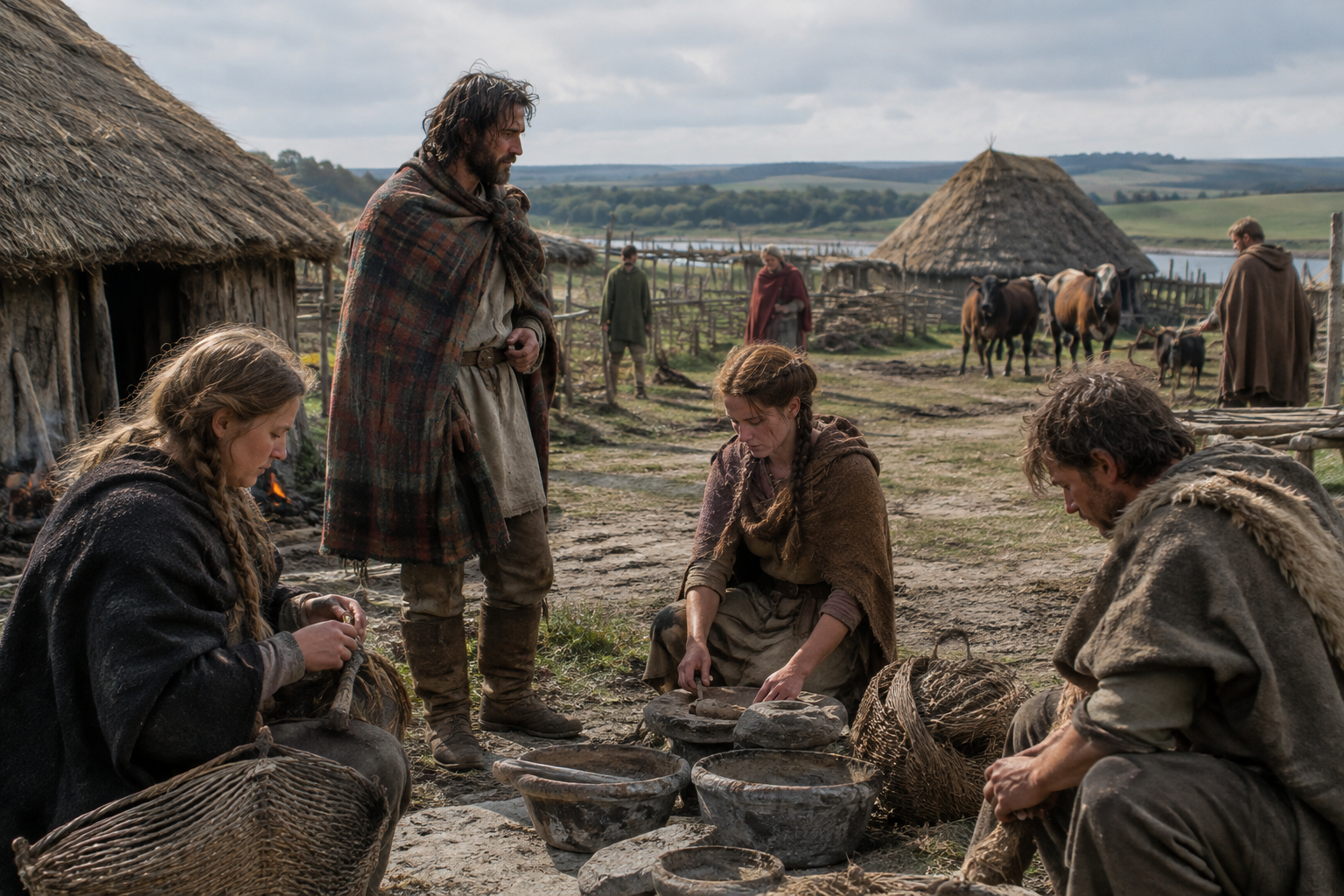
Some Y-chromosome lineages are easy to describe in broad strokes. This one is not. Haplogroup R1b1a1b1a1a2c1a5d sits deep inside the enormous R1b family tree, a paternal lineage whose wider branches are famous in the genetic history of western Europe. But when we move this far down the tree, the story becomes less about sweeping slogans and more about evidence: ancient graves, regional continuity, and the stubborn survival of male lines across many centuries.
That is precisely what makes this haplogroup interesting. Y-DNA traces one direct paternal line only - father to son, back through time - and it does not represent a person's whole ancestry. Still, as a historical tool it can be remarkably revealing. In the case of R1b1a1b1a1a2c1a5d, the ancient DNA record supplied here points especially toward Britain and Ireland, while also showing a wider presence across Atlantic and Roman-period Europe. The result is a story that moves from Bell Beaker and Bronze Age burials to Iron Age Britons, Roman-era mobility, and finally into the medieval landscapes of Gaelic lordship, where places such as Leap Castle kept the memory of old kindreds alive.
Any discussion of this haplogroup has to begin carefully. Its remote ancestry lies within the wider R1b tree, one of the major paternal lineages found in Europe today and in many ancient European remains. But it would be misleading to assign the entire history of R1b directly to this narrow downstream branch. What the evidence supports more safely is that this lineage belongs to a paternal tradition that became well established in later prehistoric western Europe and appears repeatedly in Britain and Ireland in the archaeological record associated with this branch and its close relatives.
The oldest clues in this dataset come from the later third and early second millennia BC. Bell Beaker Wiltshire Upavon England Year:2300 BC ID:I4950, Bronze Age Amesbury Down Wiltshire England Year:2300 BC ID:I2417, Early Bronze Age England Thames Year:1800 BC ID:I5377, and Bronze Age England Dorset Cranborne Chase Down Farm Pond Barrow Year:1900 BC ID:dfb002 all point toward the deep antiquity of related paternal lines in southern Britain. Farther north, Bronze Age Boatbridge Quarry South Lanarkshire Scotland Year:2250 BC ID:I5473 and Bronze Age Orkney Westray Links of Noltland Year:1498 BC ID:KD061 show that such lineages were not confined to one corner of the island.
Across the Irish Sea, the Copper Age Irish samples Rathlin1B and Rathlin2B, dated to 1950 BC and 1880 BC, are especially important. They remind us that paternal lines within the broader R1b world were present in Ireland long before medieval surnames, clans, or castles existed. That matters when later Irish family traditions are considered: genetics can illuminate a landscape of long-term settlement, but it does not turn prehistoric individuals into named ancestors.
Explore Celtic origins through ancient DNA
If the Bronze Age gives us the deep backdrop, the Iron Age gives us a crowd of actual communities. One striking feature of the evidence for this haplogroup is how densely it appears in Iron Age eastern and southern Britain. The Parisi and Arras culture burials of East Yorkshire are particularly rich. At Wetwang Slack alone, this lineage or very close paternal context appears in a remarkable series of individuals, including I36889, I36880, I36885, I36974, I37335, I37336, I37342, I37344, I36867, I36869, I36870, I36843, I36844, I36972, I36819, I36827, I36791, I36805, I36765, I31019, I31515, I31008, I37175, I30989, I30992, I30970, I36912, I36916, I36918, I36902, I37130, I37134, I30911, and I30903, mostly dated to around 225 BC.
This is not the pattern of an isolated newcomer. It suggests that paternal lines of this kind were well rooted in at least some Iron Age British populations. Nearby finds strengthen the impression: Celtic Briton Iron Age England East Yorkshire Pocklington Year:225 BC ID:I21978; Celtic Briton Pocklington Yorkshire England Year:320 BC ID:I14100; Briton Pocklington Yorkshire England Year:225 BC ID:I14102 and I14104; Celtic Briton Pocklington Yorkshire England Year:225 BC ID:I5509; and the elite chariot burial I36995 from Wetwang Slack. These burials belong to a socially varied landscape, not one restricted to ordinary graves alone.
Elsewhere in Britain, the same broad picture continues. Celtic Briton Lechlade-on-Thames Gloucestershire England Year:660 BC ID:I12783, Celtic Briton Bradley Fen Cambridgeshire England Year:290 BC ID:I11156, Celtic Briton Carsington Pasture Cave Derbyshire England Year:270 BC ID:I12775, Iron Age Worlebury Somerset England Year:150 BC ID:I11991, Iron Age Gloucestershire England Greystones Farm Year:100 BC ID:I12785, Iron Age Hillfort Battlesbury Bowl England Year:57 BC ID:I21309, and Celt Hinxton Iron Age Year:45 BC ID:HI2 all help show that the lineage's setting was not merely local Yorkshire peculiarities. It belonged to a wider Iron Age British world.
And then there are the Durotriges of Roman-period Dorset. The Duropolis Winterborne Kingston individuals WBK12, WBK20, WBK29, WBK41, WBK05, WBK30, WBK43, WBK06, WBK08, WBK18, and WBK191, dated to 125 AD, suggest that paternal continuity could persist even under Roman rule. Rome changed laws, roads, taxation, military service, and trade. It did not simply erase local male lineages.
Discover Iron Age Britain through ancient DNA
This haplogroup's story is not purely insular. Several supplied samples hint at a wider European distribution for related paternal branches. There is Gallic France Parancot Year:497 BC ID:CGG023699, Imperial Roman Era Zadar Croatia Year:200 AD ID:I26776, Late Roman Conimbriga Portugal Year:330 AD ID:R10488, and Late Roman Era Klosterneuburg Lower Austria Year:407 AD ID:R10656. Later still come Merovingian Grave North Rhine-Westphalia Germany Alt-Inden Year:600 AD ID:IND013, Early Medieval Belgium Sint-Truiden Groenmarkt Year:900 AD ID:ST2025, and Medieval Belgium Outsider Sint-Truiden Onze-Lieve-Vrouwekerk Year:900 AD ID:ST1308.
One should not force all these men into a single tidy migration arrow on a map. Ancient Y-DNA rarely behaves so neatly. But they do suggest that closely related paternal lines circulated through Celtic, Roman, and post-Roman Europe, sometimes in long-settled local populations and sometimes through the movement of soldiers, traders, settlers, and families. That is particularly worth remembering in the Roman world, where a haplogroup in Croatia or Portugal need not imply a single ethnic identity at all.
In Britain, the transition after Rome is especially intriguing. Post Roman Era Worth Matravers Dorset England Year:600 AD ID:I11580 shows one possible thread of continuation in the south, while Early Anglo Saxon Cemetery West Heslerton Yorkshire Year:550 AD ID:I11586 shows how early medieval England could include paternal lines with deeper British roots as well as newcomers from across the North Sea. That mixture is one of the great lessons of ancient DNA: old lineages do not politely vanish when new cultures arrive.
Read about Roman and early medieval Britain
By the time we reach the medieval Irish world, genetics and documentary history begin to overlap in a more tantalising way. Not because a haplogroup can prove descent from a named clan lord - it cannot, at least not on this evidence alone - but because the geography makes sense. A paternal lineage with deep prehistoric and later prehistoric roots in Britain and Ireland sits comfortably in the background of Gaelic families whose power was tied to territory, kinship, and remembered ancestry.
That brings us to Clan Carroll and Leap Castle in County Offaly. The castle is generally dated to the late medieval period and is linked first with the O Bannon family and then with the powerful O Carroll lords. It was no romantic fairy-tale residence. It stood in a hard political landscape of feuds, raids, and shifting alliances. The best-known story tells of a priest killed by his own brother during a struggle for power in the castle chapel, a tale that helped give Leap Castle its later reputation for bloodshed and haunting.
What matters historically is not whether every ghost story is true, but what the building represents. Leap Castle was a stronghold of lordship, a place where lineage was political fact. Men ruled because they belonged to a kindred, and kindreds fought to hold land, churches, rents, and loyalties. In the seventeenth century the castle was attacked during wider wars; later it passed through different owners and fell into ruin before restoration began in the twentieth century. In that sense it is exactly the sort of monument that preserves the memory of regional paternal history without providing direct genetic proof of it.
So if a man today belongs to R1b1a1b1a1a2c1a5d, can he claim descent from the O Carroll lords of Leap Castle? No, not from haplogroup evidence alone. What he can say is something more disciplined and, in some ways, more interesting: that his direct paternal line belongs to a wider family of lineages with a long attested history in the British and Irish world, the same broad historical landscape in which Gaelic clans later rose, fought, built, and remembered their dead.
Explore the history of Clan Carroll
R1b1a1b1a1a2c1a5d is historically interesting not because it hands us a ready-made identity, but because it refuses simplicity. Its wider ancestry belongs to one of Europe's major paternal families. Its supplied ancient DNA trail runs through Bell Beaker and Bronze Age Britain, Copper Age Ireland, a thick cluster of Iron Age Britons, Roman provincial settings, and early medieval communities. That pattern suggests persistence, regional depth, and occasional movement rather than a single dramatic event.
It also shows the value of combining different kinds of evidence. Archaeology gives us barrows, chariot burials, caves, cemeteries, and tower houses. Written history gives us names such as the O Carrolls and places such as Leap Castle. Genetics adds another perspective, showing that paternal lines can survive political upheaval, cultural change, and even conquest. What it does not do is magically fill every genealogical gap.
That is where MyTrueAncestry becomes so compelling. Ancient DNA comparisons can place your results beside real individuals like KD061 from Orkney, Rathlin1B from Copper Age Ireland, I36995 from an elite Parisi chariot burial, or WBK12 from Roman Dorset. Those matches do not prove direct descent or noble status, but they can reveal that your paternal story belongs to the same long human record preserved in graves, landscapes, and strongholds across Europe.






Comments