Haplogroup R1b1a1b1a1a2c1a5c2a

– 6 min read


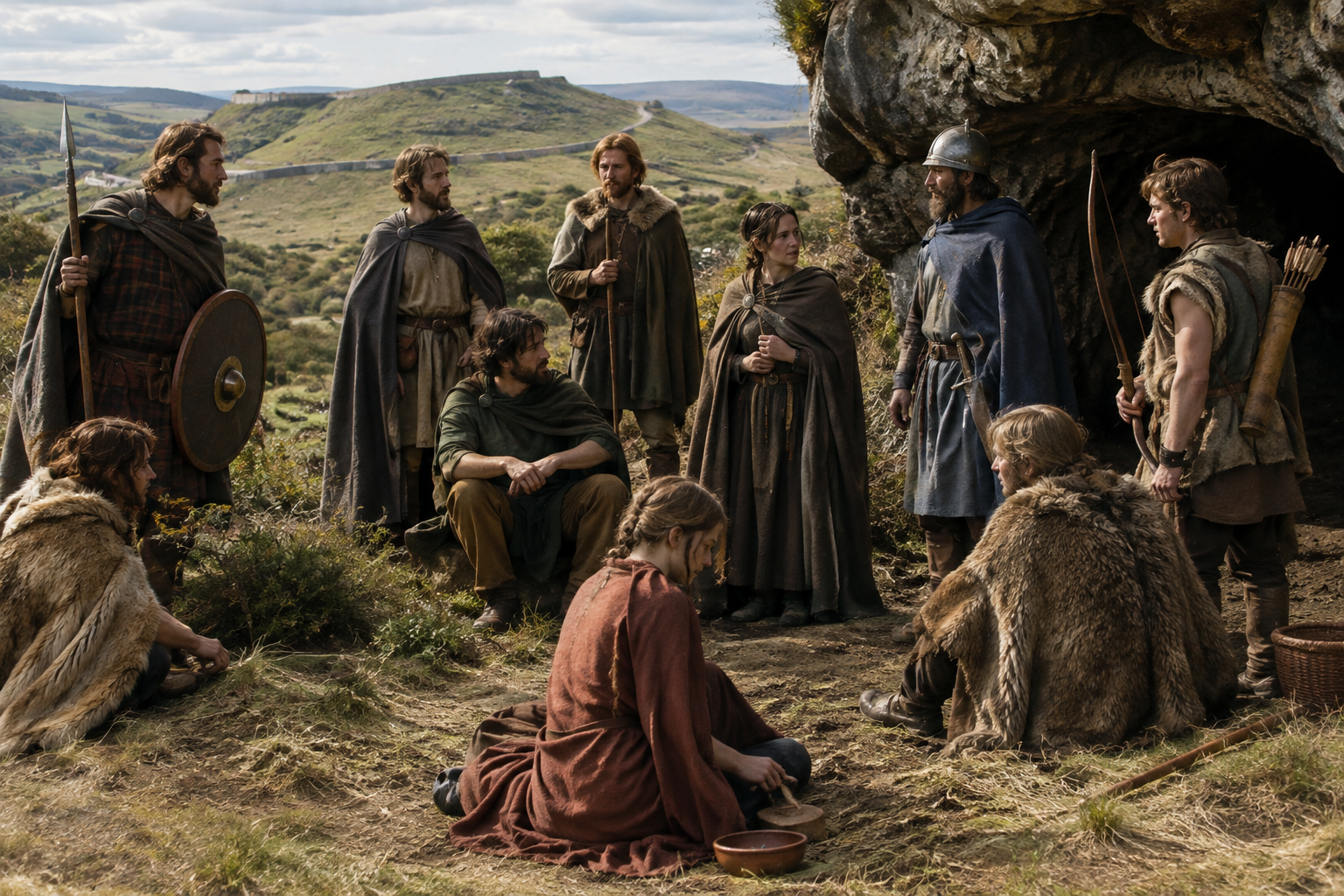
Some Y-DNA haplogroups announce themselves with a familiar historical label. This one does not. R1b1a1b1a1a2c1a5c2a is the sort of lineage name that looks, at first glance, like a string only a geneticist could love. But behind that formidable label lies something rather human: a paternal line that appears in ancient Britain, in the Germanic world of the southern Baltic, and in later medieval Scandinavia. It turns up not in legend, but in burials, hill forts, caves, and churchyard landscapes.
That is what makes it interesting. Y-DNA haplogroups trace one very specific line of descent: the direct paternal line, father to son to son. They do not describe a person's whole ancestry, culture, identity, or family story. Still, when ancient DNA places related paternal branches in real archaeological contexts, it gives us a rare way to follow male-line continuity and movement across centuries. In the case of R1b1a1b1a1a2c1a5c2a, the evidence supplied here points above all to a North Sea and British story, with roots that must be understood cautiously within the much wider history of R1b in Europe.
This haplogroup belongs to the broad and historically important Y-chromosome family known as R1b, one of the major paternal lineages in western Europe today. That broad fact, however, is not the same thing as saying that every episode in the deep history of R1b can be pinned directly onto this much narrower branch. The sensible approach is more modest: we can place R1b1a1b1a1a2c1a5c2a within that wider paternal tree, and then ask where and when closely related ancient examples appear.
The samples provided suggest a distribution especially relevant to Britain and the North Sea zone, with appearances in Iron Age England, Bronze Age Scotland, Roman-period or early historic Poland, Anglo-Saxon Yorkshire, and Viking Age Sweden. That spread does not prove a single continuous elite dynasty, nor does it map neatly onto one ethnicity. What it does show is that related paternal lines were moving through, and persisting within, regions shaped by Celtic-speaking communities, Germanic migrations, and Scandinavian expansion.
For readers interested in the deeper background to how ancient DNA reshaped these questions, MyTrueAncestry's article on archaeogenetics is a useful companion.
The earliest sample in the list is I3132, from Bronze Age Covesea Cave Scotland, dated 2000 BC. Even without forcing too much from a single individual, this matters. It places a related paternal line in northern Britain very early indeed, in a period when communities across Britain were already living in the aftermath of major prehistoric population changes. One ancient man in a Scottish cave does not explain the whole lineage, but he tells us this branch, or a close relative of it, was present in Britain long before Rome, the Anglo-Saxons, or the Vikings.
Then we move into Iron Age England, where the picture becomes richer. I21647, from Celtic Parisi Iron Age England East Yorkshire Pocklington, dated 225 BC, is particularly evocative because Pocklington has become famous for its square barrows and chariot burials associated with the Iron Age Arras culture. Here the lineage appears in a world of regional identities, warrior display, and local aristocracies long before the English kingdom existed.
Other Iron Age finds widen the map. I20628, from Iron Age Hill Fort Fin Cop Derbyshire England, dated 52 BC, places the lineage in the uplands of central England, in a fortified setting tied to the tense final centuries before full Roman domination. I11153, from Iron Age Trumpington Cambridgeshire England, dated 300 BC, adds an eastern English example. And in Oxfordshire, two men from Stanton Harcourt - I21272 and I21277, both dated 250 BC - suggest that related paternal lines were not confined to one corner of Britain.
This is not proof that all these men belonged to one close family in the everyday genealogical sense. Shared haplogroups can unite men separated by many centuries. But taken together, these finds strongly suggest that this paternal branch, or close neighboring branches, had a real footprint in pre-Roman Britain.
If you would like a wider look at how such burials fit into British prehistory, there is a particularly relevant MyTrueAncestry article on Iron Age Britain and kinship.
The supplied evidence does not stop in Britain. R10626, from Germanic Weklice Poland, dated 130 AD, places the haplogroup in a very different but connected setting: the southern Baltic world during the Roman era. Weklice is associated with the Wielbark cultural horizon, often discussed in connection with populations living between the Vistula and the Baltic coast. That does not mean we can simply label this lineage "Gothic" or "Germanic" in a simplistic way. Still, it does place a related paternal branch in a region central to long-running debates about mobility between the Baltic and the wider Roman frontier.
Then there is I16392, from the Anglo-Saxon Kingdom of Northumbria Yorkshire Britain Fox Holes Cave Clapdale Ingleborough Hill, dated 725 AD. Here the same broader paternal history appears in early medieval northern England, by now in a Christianizing and politically complex kingdom shaped by migration, intermarriage, and local continuity. This is a very useful reminder that the early English world was not created from scratch. Ancient DNA again and again shows that post-Roman Britain included both newcomers and descendants of earlier populations.
Finally, VK405, from Viking Age Skara Varnhem Sweden, dated 1050 AD, carries the story into medieval Scandinavia. By this period, the North Sea and Baltic were highways rather than barriers. Merchants, raiders, settlers, clergy, and noble households moved through networks linking England, Denmark, Norway, Sweden, and beyond. A paternal lineage appearing in both Britain and Sweden across different periods is exactly the sort of thing that makes ancient DNA so useful: it helps us think geographically, not just nationally.
For readers drawn to that Scandinavian angle, MyTrueAncestry has a good companion piece on Viking Age population history.
What, then, of the later historical setting linked here through the House de Coleby and Coleby Hall in Lincolnshire? The answer is not that an Iron Age man from Pocklington can be marched straight into the genealogy of a Lincolnshire landed family. That would be nonsense. But the setting is historically revealing.
Coleby sits in a landscape with very long continuity. Nearby ran Ermine Street, one of Roman Britain's major roads, binding Lincolnshire into imperial communications and trade. The village appears in Domesday Book, anchoring it securely in the written record of Norman England. The present Coleby Hall, mainly seventeenth century in date, later became associated with the Fane family, a family of local and national importance. The hall, altered and enlarged over time, represents that familiar English pattern in which medieval village, Roman routeway, and later country house all occupy the same enduring landscape.
That is precisely the kind of place where genetic history becomes interesting. Not because the building itself proves a haplogroup, and not because every de Coleby or Fane male necessarily carried the same paternal line, but because Lincolnshire lies within the same broad eastern English world where ancient and early medieval movement was intense. Roads, estates, parishes, and noble houses preserved social memory; DNA preserves something different, the memory of biological lineages. The two are not identical, but they can illuminate one another.
Readers interested in the local noble dimension may want to compare the dedicated community features on these families.
R1b1a1b1a1a2c1a5c2a is historically interesting not because it unlocks a single heroic origin story, but because it appears across a striking sequence of contexts: Bronze Age Scotland, Iron Age England, the southern Baltic, Anglo-Saxon Northumbria, and Viking Age Sweden. That pattern hints at long-term persistence around the North Sea world and in Britain, with episodes of migration and reshuffling layered over older populations.
What it cannot do, by itself, is certify identity. A Y-DNA haplogroup does not prove that a man was "Celtic," "Germanic," "Anglo-Saxon," or "Viking" in any complete sense. Nor does sharing a haplogroup with a noble family tradition prove descent from that family. Haplogroups work best when joined to archaeology, history, and geography - to caves, roads, villages, cemeteries, and kingdoms.
That is perhaps the real fascination here. The direct paternal line behind this formidable label was present in Britain before Rome, visible again in the age of Northumbria, and still part of the wider Scandinavian world by the Viking Age. It is not a fairy tale of pure blood or neat continuity. It is something much more interesting: a record of men and male lines moving through the messy, connected history of northern Europe.
If your own Y-DNA falls somewhere in the wider R1b world, or if you are simply curious about how ancient samples like I3132, I21647, R10626, I16392, or VK405 help reconstruct the past, MyTrueAncestry can help you explore those links. Ancient DNA matches can offer remarkable historical perspective, even when they do not prove direct descent from a particular ancient individual or noble house.






Comments