Haplogroup R1b1a1b1a1a2c1a5b1a1a4a

– 6 min read


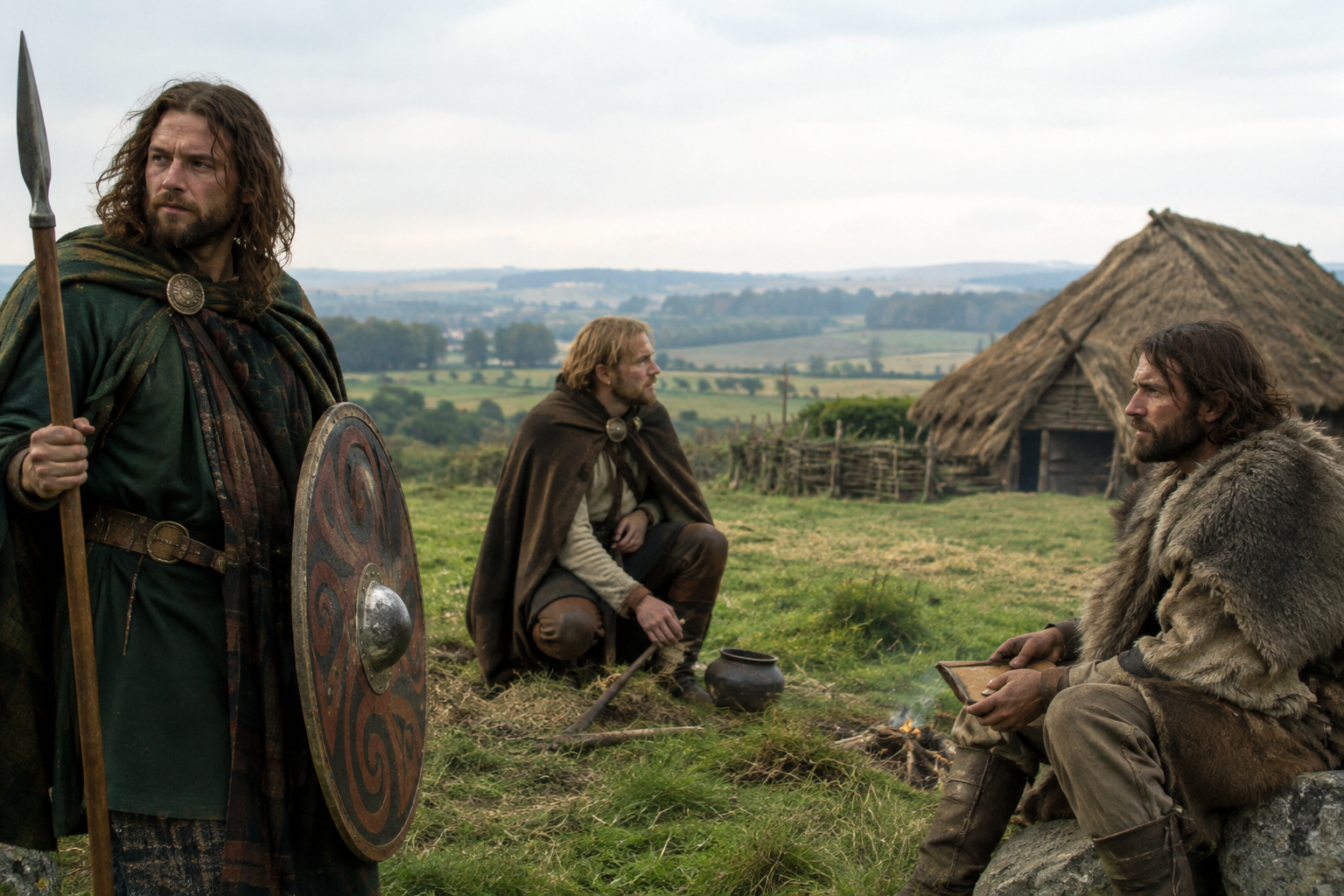
Some Y-chromosome lineages are famous because they are broad and common. Others are interesting precisely because they are so narrow. R1b1a1b1a1a2c1a5b1a1a4a belongs to that second category: a very specific paternal branch, one tiny twig on the great Y-DNA tree. That can make it harder to discuss with confidence, but also more rewarding, because narrow branches remind us what Y-DNA really is. It is not a badge of ethnicity, and it is certainly not a complete account of anyone's ancestry. It is one direct male line, traced father to son across centuries and, sometimes, millennia.
In practice, a lineage like this sits within the much larger world of R1b, a major Y-chromosome family widely found in western Europe and often discussed in connection with later prehistoric population change. But one must be careful: the broad history of R1b is not automatically the exact history of every tiny downstream branch. What ancient DNA can do, however, is give us glimpses of where related paternal lines appear in real people, in real graves, in real landscapes. In this case, the evidence supplied points us toward Iron Age and early medieval Britain, and from there to the later historical world of Anglo-Norman Ireland and Belvelly Castle in County Cork.
Y-DNA haplogroups trace direct paternal descent only. Your mother's father, your father's mother, and thousands of other ancestors are not represented in a single Y-line. Even so, these lineages are invaluable for reconstructing how male lines moved, persisted, or were replaced over time.
For a subclade as specific as R1b1a1b1a1a2c1a5b1a1a4a, the safest approach is to place it in its wider context. Its ancestry lies within the large R1b family, whose branches became important across much of western Europe in later prehistory. In Britain and Ireland, many ancient and later historic male lines belong somewhere within that broader R1b world. But the exact path taken by this particular downstream branch is not something we should invent. Instead, we can ask a better question: what do the ancient samples from Britain suggest about the landscapes in which closely related paternal lines were living?
Explore Celtic origins through ancient DNA
The most striking thing about the supplied ancient evidence is its chronological spread. We are not looking at a single cemetery or one isolated discovery. We are looking at men from Iron Age Britain and early Anglo-Saxon England, which means this paternal background appears in very different cultural settings.
Take I21552, identified as Celtic Parisi Iron Age England East Yorkshire Pocklington Year:225 BC. Pocklington has become one of the most evocative archaeological landscapes for Iron Age Britain, associated with the Arras culture and the people often called the Parisi of East Yorkshire. To find a paternal lineage in that setting is a reminder that the Iron Age was not an abstract category but a world of local communities, elite burials, regional identities, and long-distance links across the North Sea and continental Europe.
Then there is I12778, listed as Celtic Briton Carsington Pasture Cave Derbyshire England Year:290 BC. This is a very different sort of place. A cave burial in Derbyshire conjures not royal pageantry but more intimate and puzzling mortuary practice. It shows that related paternal backgrounds could be present in inland Britain too, beyond the eastern Yorkshire sphere. If East Yorkshire suggests tribal identity and visible status, Carsington Pasture Cave suggests something more local, perhaps more ritualized, but no less important for reconstructing population history.
Finally we move forward into the early medieval period with OAI012, Anglo Saxon Oakington England Year:470 AD. This is where the story becomes especially interesting. Oakington belongs to the world that followed Roman rule in Britain, when communities with mixed local and continental origins were taking shape. A paternal line found in an Anglo-Saxon context does not prove an "Anglo-Saxon haplogroup," still less a simple ethnic label. It does show that related Y-lineages could appear across major cultural transitions: Iron Age Briton, then centuries later an early medieval burial linked to Anglo-Saxon England.
That is exactly the sort of continuity-and-change problem ancient DNA is so good at exposing. Written history often prefers sharp breaks. Genetics often shows something messier.
Read more on Iron Age Britain and DNA
What do these samples tell us overall? Not that one unbroken dynasty can be traced from 290 BC to 470 AD. That would be fantasy. But they do place this paternal background, or very near relatives within its broader phylogenetic neighborhood, in Britain across a long stretch of time.
That matters because Britain was never static. Late prehistoric communities were shaped by earlier migrations and local continuity alike. Roman rule then introduced soldiers, traders, administrators, and new social networks. After Rome, eastern and southern Britain saw substantial migration from the continent, yet not simple replacement. Ancient DNA has repeatedly shown that post-Roman England involved both newcomers and people with deeper local roots.
So a lineage turning up in both Iron Age and Anglo-Saxon contexts is a useful warning against crude historical storytelling. Paternal lines can survive political collapse, language shift, conquest, intermarriage, and changing burial customs. They can also move considerable distances while leaving little trace in the written record.
Explore Anglo-Saxon migration genetics
By the medieval period, our evidence shifts from graves to documents, lordship, and stone. Here the supplied historical connection is Clan Hodnett and Belvelly Castle near Cobh in County Cork.
Belvelly Castle stands by the old bridge near Cobh and reaches back to the late 1300s, when it was likely built by the Hodnett family after Anglo-Norman settlers had become established in the area. That detail matters. Anglo-Norman settlement in Ireland was not just a military episode; it was a reshaping of landholding, language, alliances, and architecture. Tower houses like Belvelly were both residences and defensible statements of control.
The castle later passed through the hands of the de la Roches and then the Earls of Desmond, before the upheavals of the 1600s brought new ownership and decline. In other words, Belvelly is not a monument to one frozen family line. It is a record of changing power in Cork Harbour. Yet for that very reason it offers a useful parallel to the genetic story. Just as a Y-line may persist through shifting cultural worlds, a castle may outlast the dynasty that first raised it.
It is important to be exact here. The association of Clan Hodnett with this haplogroup in a community context does not prove that every historical Hodnett male carried R1b1a1b1a1a2c1a5b1a1a4a, nor that the family can be directly linked to any of the ancient British men above. What we can say is more modest and more interesting: the paternal lineage sits comfortably within a historical zone shaped by Britain, Ireland, migration, settlement, and medieval lordship.
Belvelly itself helps us imagine that world. It guarded a strategic route across Great Island, serving as home and small fortress. By the 19th century it had become a striking ruin, and in recent times it was restored and brought back into use. That long afterlife is rather apt. Paternal lineages, too, survive in fragments, are rediscovered, and acquire new meaning when set beside archaeology and history.
Discover the story of Clan Hodnett
The real value of a lineage like R1b1a1b1a1a2c1a5b1a1a4a is not that it gives a neat label. Quite the opposite. It forces us to think historically. A direct paternal line may connect a modern tester to a deep branch of western European male ancestry, but that does not make him simply "Celtic," "Anglo-Saxon," "Norman," or "Irish." Those are historical identities, not Y-chromosome categories.
What ancient DNA does offer is something more grounded. It shows that related paternal lines appear in Iron Age East Yorkshire, in a Derbyshire cave burial, and in early Anglo-Saxon England. The historical material then places the later family association in an Anglo-Norman and Irish context centered on Belvelly Castle. None of that proves direct descent from I21552, I12778, or OAI012. But it does create a credible historical setting in which this paternal branch belongs: the layered world of Britain and Ireland, where continuity and migration were always intertwined.
See how Norman-era DNA reshaped Britain
If your Y-DNA falls on a branch like R1b1a1b1a1a2c1a5b1a1a4a, you are looking at one surviving thread from a very old paternal story. MyTrueAncestry can help place that thread beside ancient individuals, archaeological cultures, and historical regions. Those comparisons can be illuminating, even when they do not prove direct descent from a specific ancient person or noble family.
Upload your DNA to MyTrueAncestry and see whether your results connect you with Iron Age Britain, early medieval migration, or the later worlds of clans, castles, and frontier lordships.






Comments