Haplogroup R1b1a1b1a1a2c1a5b1a1a2b1

– 6 min read


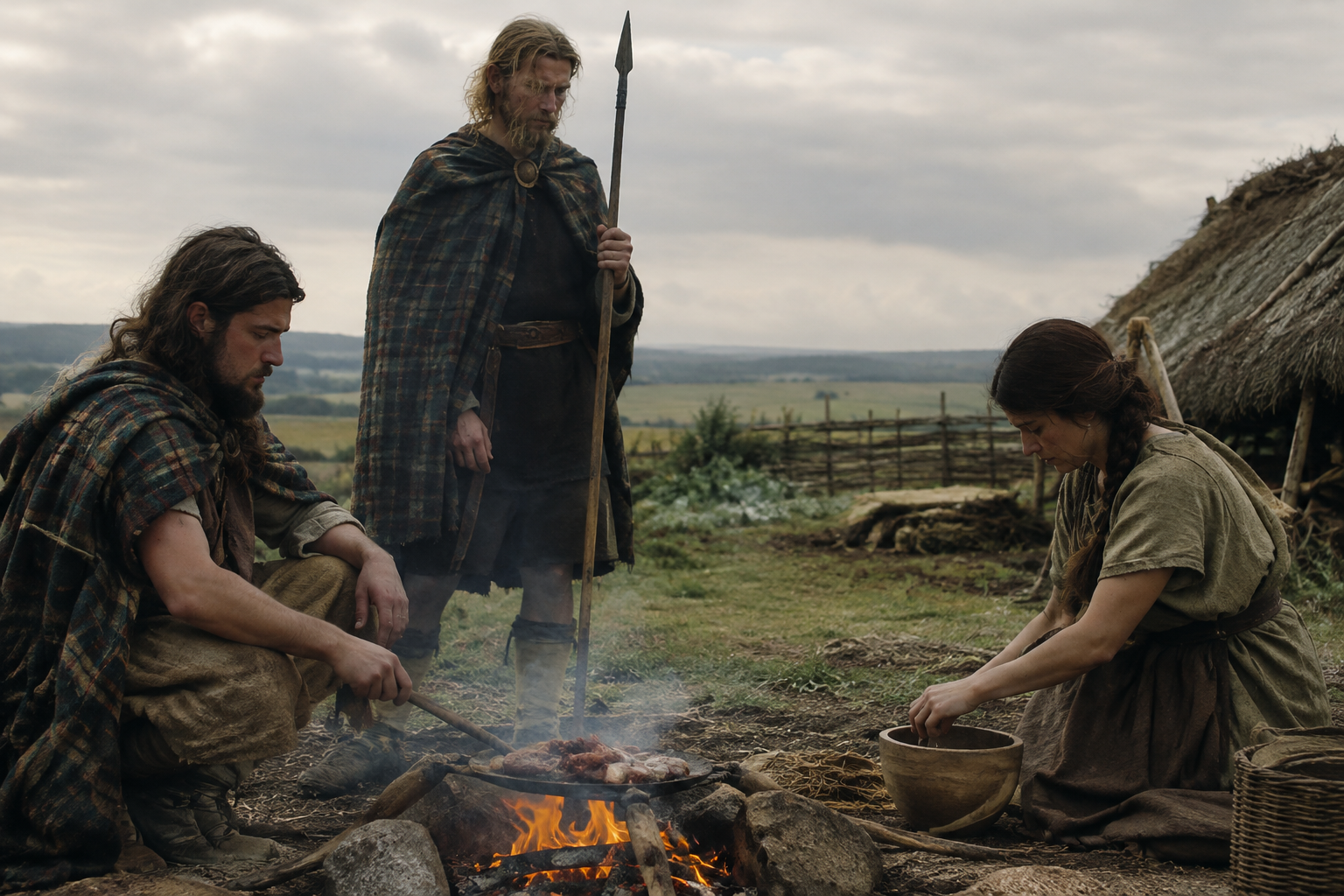
Some Y-DNA haplogroups announce themselves with grand continental scale. Others are more revealing precisely because they narrow our focus. The very specific paternal branch R1b1a1b1a1a2c1a5b1a1a2b1 belongs to the vast and famously widespread family of R1b lineages, but its interest lies in what happens when a broad prehistoric framework meets real places, real burials, and later historical landscapes in Britain.
That is where ancient DNA becomes so useful. Y-DNA haplogroups trace a direct paternal line: father to son to son across generations. They do not describe a person's whole ancestry, culture, or identity. But when a paternal branch turns up in excavated Iron Age burials, and when later clan traditions and castle histories occupy some of the same regional worlds, we get something valuable: not proof of direct descent, but a sharper sense of long-term continuity, movement, and settlement across the British past.
This haplogroup sits deep within R1b, a major Y-chromosome lineage with an important place in later prehistoric and historic Europe. That larger R1b story has often been discussed in connection with Bronze Age population change and the spread of steppe-related ancestry into western Europe. But caution matters here. A very narrow downstream branch such as R1b1a1b1a1a2c1a5b1a1a2b1 should not simply inherit every claim made about R1b as a whole.
What can be said more safely is that this paternal line belongs within a family of lineages that became well established in western Europe, including Britain, long before the medieval period. By the Iron Age, Britain was not some isolated edge of the world, but part of a network of exchange, local rivalries, and regional identities stretching across the Channel and the North Sea. Ancient DNA increasingly shows that paternal lines could persist locally for long periods even while material culture, political structures, and alliances changed around them.
For readers interested in the deeper archaeological background to these paternal histories, MyTrueAncestry's article on Bell Beaker change in northwestern Europe is a useful companion piece.
Explore Bell Beaker Population Change
The most immediate evidence supplied for this haplogroup comes from Iron Age England, and that matters enormously. Instead of speaking vaguely about "ancient Celts" in the abstract, we can point to individuals recovered from specific sites.
Two of them come from Wetwang Slack in East Yorkshire: I31025 and I37163, both dated to 225 BC and identified as Celtic Parisi Iron Age England East Yorkshire Wetwang Slack. Wetwang Slack is one of the most evocative Iron Age cemeteries in Britain, associated with the Arras culture and particularly known for elite burials and chariot graves. The Parisi of East Yorkshire occupy an intriguing place in British archaeology because their burial customs have long raised questions about links, parallels, or shared fashions with parts of continental Europe.
That does not mean a Y-haplogroup can solve every historical argument about the Parisi. It does mean that paternal-line data now anchors those debates in real human remains. Men such as I31025 and I37163 were living in a region with pronounced local traditions, yet they also belonged to a Britain connected to wider Iron Age worlds. Their Y-DNA helps show that this paternal lineage, or a close related branch, was present in eastern Britain before Roman rule and long before medieval surnames or clans.
The third sample, I16611, comes from Iron Age Middle Wallop Suddern Farm England, dated to 300 BC. This places the lineage in southern England too, not only in Yorkshire. Middle Wallop in Hampshire and Wetwang Slack in East Yorkshire are quite different landscapes and archaeological settings. Seeing related paternal ancestry in both reminds us that Iron Age Britain contained regional diversity without complete isolation.
These samples are especially useful because they show geography rather than genealogy. They do not prove that the three men were close kin, and they certainly do not prove direct descent to any later family. What they do reveal is that this paternal branch belongs in the documented human landscape of Iron Age England.
If you want a broader look at how such evidence is transforming our picture of Britain before Rome, this related study is well worth reading.
Discover Iron Age Britain Through DNA
There is always a temptation to take an ancient Y-line and pin a neat ethnic label on it: Celtic, British, tribal, noble, even national. Ancient DNA is most useful when it resists that temptation. The men from Wetwang Slack and Middle Wallop lived in communities that archaeologists describe using cultural terms, and those terms are helpful. But a haplogroup is not an ethnicity. It is a paternal signal carried by individuals who also had mothers, grandmothers, local customs, and social lives far more complicated than a single chromosome can capture.
Still, the pattern is historically suggestive. A paternal lineage present in Iron Age England could persist through the Roman period, the post-Roman centuries, Viking-age upheavals, and the formation of medieval lordships. Not unchanged in every household, of course, and not as a single unbroken noble pedigree, but as part of the durable male-line background of the British Isles. Written genealogy usually begins far too late to see this. Ancient DNA pushes the record back into the centuries when tribal names, burial rites, and local power structures were still forming.
For a wider perspective on how genetics and archaeology are reshaping the story of Celtic-speaking Europe, this article makes an excellent next step.
Read About Celtic Origins and DNA
The later historical associations supplied with this haplogroup take us north, into Scotland and the Anglo-Scottish borderlands. Here the story changes register. We leave excavated burials and enter the world of named families, defended houses, and local lordship.
Clan Kinninmont is linked here with Craighall Castle in Perthshire. The castle began as a fortified house of the Rattray family in the 16th century, on a site tied to an older medieval estate. That detail is telling. Craighall was not one of the immense royal fortresses that dominate schoolbook history. It was a laird's residence, built for a world in which kinship, status, local defense, and shifting alliances mattered intensely. Its later alteration and enlargement chart the changing priorities of the Scottish landed class: protection first, then comfort, display, and continuity. Even its decline and restoration are part of the story, because they remind us that family memory often outlasts political power.
Clan Heron, meanwhile, is associated with Chipchase Castle in Northumberland. Its origins as a late 14th-century pele tower place it squarely in the violent frontier society of the Anglo-Scottish border. Later expansion into a Jacobean house under the Heron family marks another familiar transition: the rough necessities of raiding and defense giving way, at least partly, to prestige and domestic grandeur. Chipchase still embodies both worlds at once, half-fortress and half-country house.
These families and castles should be handled with care in genetic terms. Their appearance alongside this haplogroup does not prove that every Kinninmont, Rattray, or Heron male belonged to this exact paternal branch, nor that the Iron Age men from Yorkshire or Hampshire were their direct ancestors in a documented genealogical sense. But geographically and historically, the connection is still meaningful. It places the haplogroup in a long British sequence: from pre-Roman burials to medieval estates, from tribal cemeteries to tower houses on contested ground.
Readers interested in one of those family histories can continue with the clan article below.
Explore the Story of Clan Heron
So what does R1b1a1b1a1a2c1a5b1a1a2b1 reveal? First, it belongs to a paternal framework well at home in later prehistoric western Europe. Second, the supplied ancient DNA places it firmly in Iron Age England, in both East Yorkshire and southern England, through individuals I31025, I37163, and I16611. Third, its historical associations point toward later British regional worlds in which family, landholding, and fortified residences preserved memory in ways that written sources only partly capture.
The real fascination lies in scale. A single Y-line can connect an excavated burial at Wetwang Slack, a burial at Middle Wallop, and the later landscapes of Perthshire and Northumberland without collapsing them into one simplistic pedigree. Archaeology gives us bodies, grave settings, and dates. History gives us surnames, castles, and border politics. Genetics gives us another layer entirely: one narrow thread of paternal continuity that can survive while almost everything else changes.
If your own Y-DNA falls somewhere within the wider R1b world, ancient DNA comparisons may help place your paternal line in that larger British and European setting. They cannot prove that you descend from a Parisi burial or from the lords of Chipchase or Craighall. But they can show that your direct paternal ancestry belongs to the same deep historical landscape that produced Iron Age burials, medieval frontier families, and the castles that still hold their stories in stone.
Upload your DNA to MyTrueAncestry to explore ancient matches, compare your results with archaeological samples, and see how your family history fits into the long human past.






Comments