Haplogroup R1b1a1b1a1a2c1a5b1a1a

– 6 min read


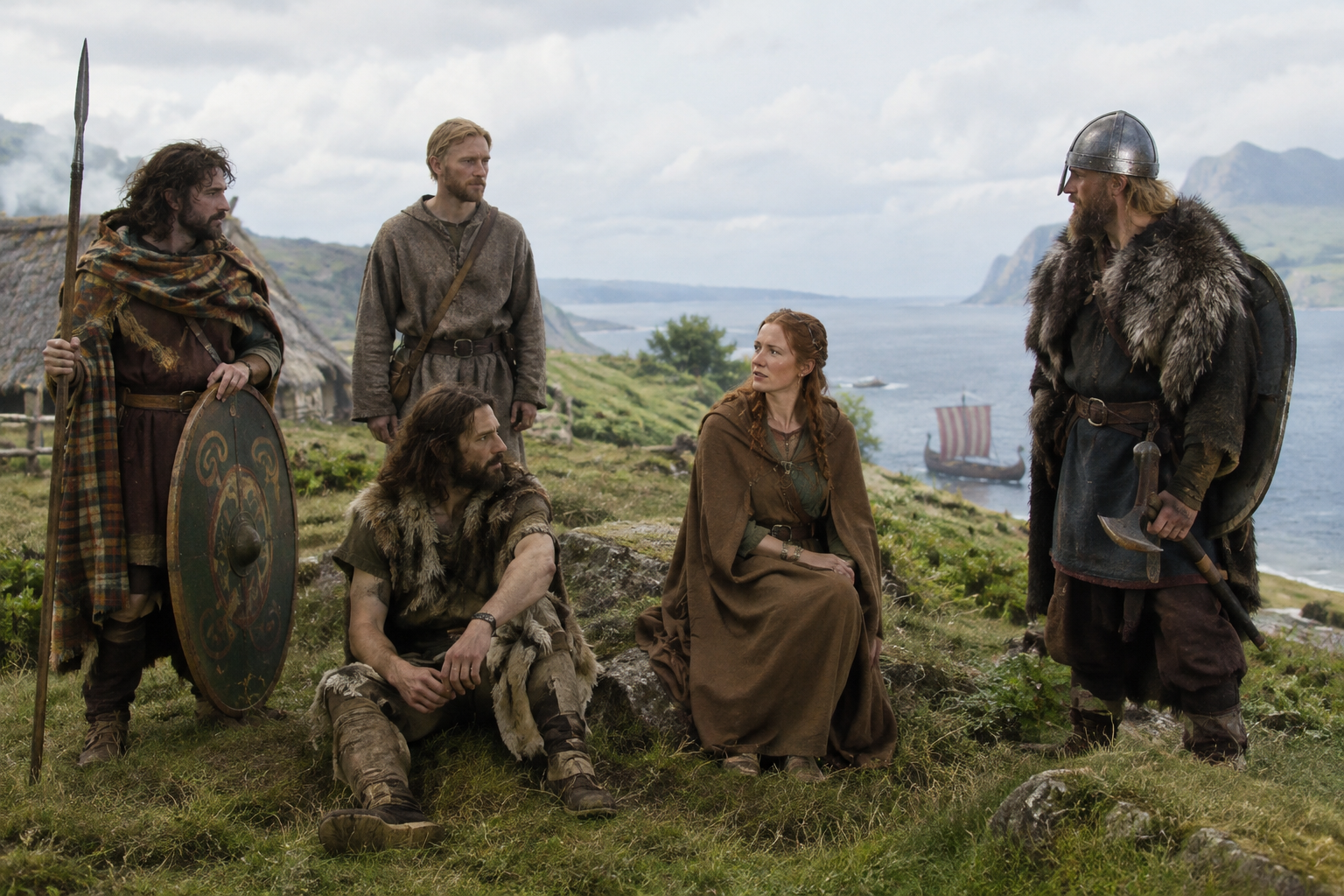
Some Y-chromosome lineages are easy to place in the broad sweep of European history. Others are more like finding a particular thread in a very old and much-repaired garment: recognisable, but only when you look closely. Haplogroup R1b1a1b1a1a2c1a5b1a1a belongs to that second category. It is a highly specific paternal branch, deep within the wider R1b family, and its interest lies not in grand, simplistic claims but in what it suggests about continuity, movement, and the survival of male lines across very different worlds.
That wider R1b story is well known in outline. R1b is one of the major Y-DNA lineages found in western Europe today, and ancient DNA has shown that branches of it became important in later prehistoric and historic populations across Britain, Ireland, Atlantic Europe, and beyond. But a Y-DNA haplogroup traces only one line of descent: father to father to father. It does not describe a person's whole ancestry, culture, language, or identity. Still, when a narrow branch turns up in Iron Age Britain, early medieval England, and Viking Age Iceland, it gives us a wonderfully concrete way of thinking about how paternal ancestry can persist while politics, languages, and kingdoms change around it.
Because this is such a specific subclade, we have to be careful. It would be wrong to dump the entire prehistoric history of all R1b men onto R1b1a1b1a1a2c1a5b1a1a as if they were all the same thing. What we can say, more responsibly, is that this branch sits within a lineage family that became deeply established in western Europe and is often encountered in contexts linked to later prehistoric and historic populations of the British Isles.
That matters because the British Isles were never a sealed world. The paternal lines found there were shaped by repeated episodes of migration and mixture: the later prehistoric transformations associated with Bell Beaker and Bronze Age populations, the development of Iron Age societies, Roman-era mobility, post-Roman settlement, and then Viking movement across the North Sea. A narrow Y-DNA branch surviving across those periods does not prove one unbroken local dynasty. It does, however, show that some male lines weathered all that upheaval remarkably well.
For readers interested in the deeper background to Celtic-speaking populations and how ancient DNA has changed that conversation, this related article is especially useful:
Explore ancient Celtic origins
The most striking thing about the sample set is how firmly it plants this paternal lineage in Iron Age Britain. Take I21552, described as Celtic Parisi Iron Age England East Yorkshire Pocklington Year:225 BC. Pocklington has become one of the most vivid windows into Iron Age Yorkshire, a region of chariot burials, elite display, and local identities that classical writers only dimly understood. A Y-line appearing here places this branch in a society that was unmistakably British, local, and pre-Roman, but also connected to broader currents in Iron Age Europe.
Then there is I12778, the Celtic Briton Carsington Pasture Cave Derbyshire England Year:290 BC. The setting could hardly be more different. Not an East Yorkshire cemetery landscape, but a cave in Derbyshire, with all the interpretive awkwardness caves tend to bring. Cave use in later prehistory can suggest ritual, unusual burial practice, or selective deposition rather than tidy textbook funerary custom. Yet the paternal signal matters because it shows that this lineage was not confined to one little pocket of eastern England.
A third sample, I16611, from Iron Age Middle Wallop Suddern Farm England Year:300 BC, pushes the story farther south. Now we are in Hampshire, in southern England, a landscape with its own Iron Age traditions and later dense involvement in Roman and post-Roman history. Taken together, these three individuals do not prove a single tribal identity or a coherent "people" in the modern sense. What they do suggest is that closely related paternal ancestry could be found across multiple regions of Iron Age England.
If you want to see how archaeogenetics handles these kinds of British Iron Age discoveries more broadly, this article makes an excellent companion:
The line does not stop in the Iron Age. OAI012, listed as Anglo Saxon Oakington England Year:470 AD, brings the haplogroup into the unsettled centuries after Roman rule in Britain. Oakington is one of those sites that has helped demolish the old habit of imagining neat ethnic boxes labelled "Briton" and "Anglo-Saxon." Early medieval cemeteries show a world of mobility, marriage, adoption of customs, and complex local communities. The appearance of this paternal branch in that setting is a reminder that early medieval identity was social as much as biological. A man buried with Anglo-Saxon cultural markers was not thereby cut off from deeper British paternal landscapes.
And then comes SSG-A2, Danish Gaelic Viking Iceland Year:935 AD. That description is a small history lesson in itself. Viking Age Iceland was populated through movement from Scandinavia but also from the Norse world in the British Isles, including places where Norse and Gaelic communities mixed. A paternal lineage with earlier appearances in Britain turning up in Iceland is exactly the kind of thing one might expect in a North Atlantic world stitched together by ships, raiding, settlement, fosterage, and intermarriage. Not proof of direct descent from any one British Iron Age man, of course, but entirely consistent with long-term circulation of lineages around the Irish Sea and North Sea zones.
For more on that larger maritime setting, this is a particularly apt follow-up:
The later historical setting supplied with this haplogroup is Clan Anderson and Peebles, on the River Tweed. That is a lovely fit, not because it proves that medieval Anderson men carried this exact Y-DNA branch, but because Peebles sits in one of the great contact zones of British history. It began as an early medieval crossing place and local centre, became a royal burgh under David I in the twelfth century, and then lived for centuries in the hard, restless frontier world of the Anglo-Scottish Borders.
This is exactly the sort of place where long-established paternal lines, incoming families, shifting loyalties, and local identities all met. Trade, farming, raids, royal administration, ecclesiastical life, and warfare all passed through towns like Peebles. By the later Middle Ages it was shaped by the violence of border conflict, yet it was never just a battleground. It was also a market town, a civic community, and later a place associated with wool, textiles, industry, roads, and the railway. In other words, Peebles is not merely picturesque backdrop. It is a historical landscape in which ancestry, movement, and continuity make sense.
There is no castle description here to hang the story on in the usual romantic fashion, and that is no bad thing. Too often ancestry writing leaps greedily at towers and battlements. Peebles instead offers something better: a real urban landscape, with a surviving street plan, old buildings, and the memory of its royal burgh traditions. If a Y-line such as R1b1a1b1a1a2c1a5b1a1a tells us anything in historical terms, it is not that one can point to a single fortress and say "there lived your ancestor." It is that male lines persisted through working towns, contested frontiers, and ordinary communities as much as through noble halls.
Readers interested in the broader historical world of the family should continue with the dedicated clan article here:
So what can we responsibly say about R1b1a1b1a1a2c1a5b1a1a? First, that it belongs to a western European paternal framework with convincing appearances in Britain across a long stretch of time. Second, that the ancient samples supplied here show this branch, or closely related ancestry within its line, in contexts ranging from Iron Age Britain to Anglo-Saxon England and Viking Age Iceland. Third, that its historical interest lies in continuity across change: the same paternal inheritance moving through Celtic-speaking, post-Roman, Germanic-associated, and Norse-Gaelic worlds.
What it does not tell us is equally important. It does not prove tribal identity. It does not prove that a modern bearer descends from any named ancient sample. It does not prove that Clan Anderson, or every Anderson line, belonged to this haplogroup. It does not convert a broad historical association into a certified medieval pedigree. Written genealogy and ancient DNA answer different questions, and the best results come when they are used together rather than confused.
That, really, is the delight of archaeogenetics. A single Y-line can link an Iron Age man from Pocklington, a burial from Derbyshire, a southern English individual from Middle Wallop, an early medieval cemetery at Oakington, and a Viking Age man in Iceland into the same conversation. Not the same family tree in the narrow genealogical sense, but the same long human story of fathers, sons, migration, adaptation, and survival.
If your own paternal ancestry touches this part of the R1b tree, MyTrueAncestry can help place it in a much larger historical landscape. By comparing your DNA with ancient individuals and archaeological populations, you may discover striking connections to the people of Iron Age Britain, early medieval England, or the Viking North Atlantic. These matches do not by themselves prove direct descent or membership in a noble family, but they can offer an illuminating new perspective on where your deep ancestry fits in the human past.






Comments