Haplogroup R1b1a1b1a1a2c1a5b1a1

– 6 min read


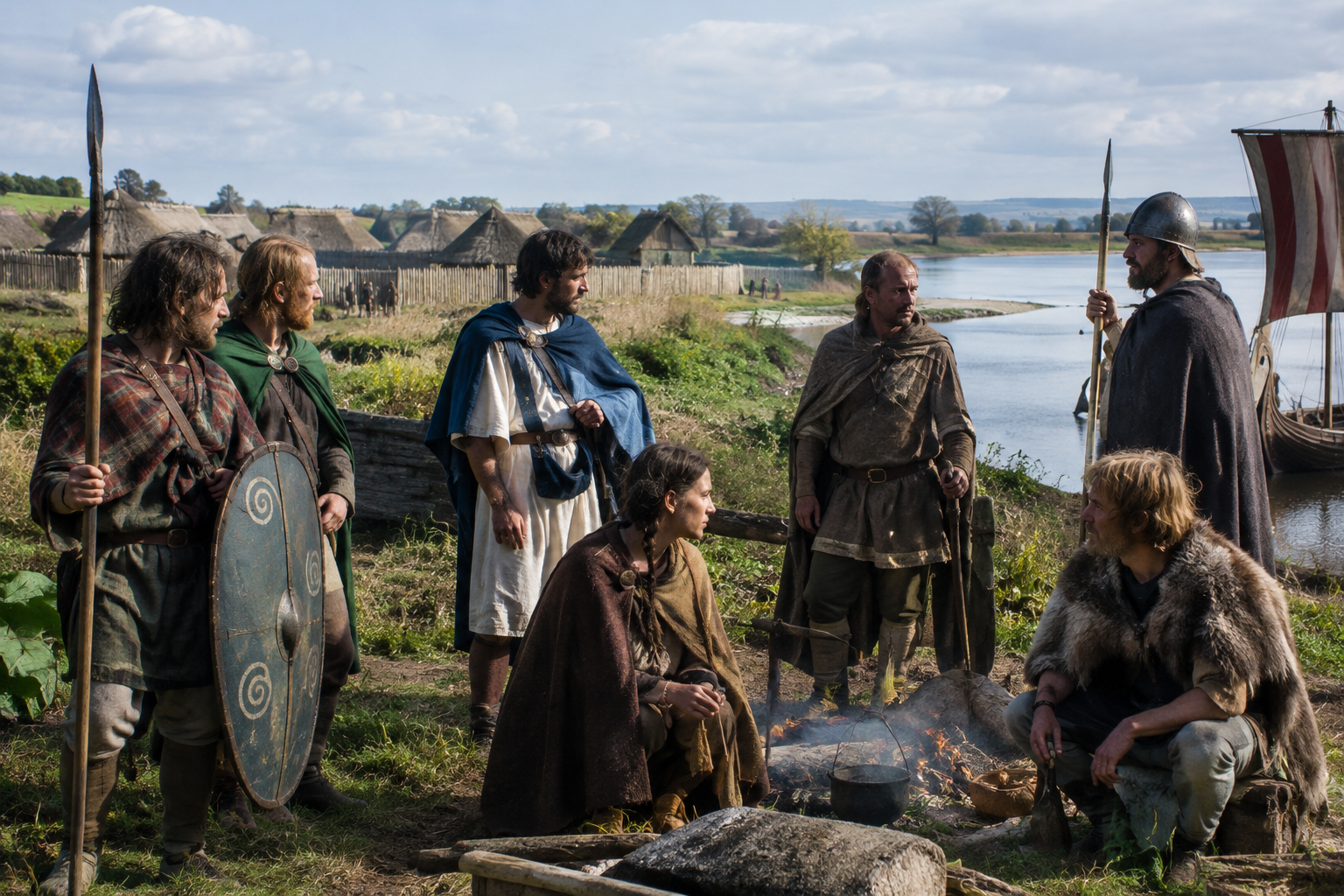
Some Y-chromosome lineages are easiest to understand when you stop staring at the formidable string of letters and numbers and instead ask a simpler question: where do we actually meet these men in history? Haplogroup R1b1a1b1a1a2c1a5b1a1 is one of those cases. On its own, the label looks like a filing reference in a very stern archive. Yet behind it lies a pattern that becomes much more human when ancient DNA turns up in Iron Age Britain, late prehistoric Gaul, Anglo-Saxon England, and Viking Age Iceland.
That matters because Y-DNA traces one narrow line of ancestry: the direct paternal line, passed from father to son. It does not describe a person's whole ancestry, culture, or identity. Still, paternal lineages can be wonderfully revealing. They let us see how certain male lines persisted, moved, and reappeared across centuries, even when languages changed, kingdoms rose and fell, and families rewrote their own histories in charters rather than chromosomes.
This haplogroup sits deep within the wider R1b family, one of the major Y-chromosome groupings in western Europe. For a very specific downstream branch like R1b1a1b1a1a2c1a5b1a1, caution is essential. We should not lazily pour the whole history of broad R1b into this narrower subclade as if nothing changed along the way. What we can say from the samples provided is that this lineage, or very close paternal relatives within its branch structure, appears in a striking arc stretching across Iron Age France and Britain and later into the early medieval North Atlantic world.
That is already suggestive. It places the haplogroup in landscapes often associated with Celtic-speaking communities of later prehistory, then among populations shaped by Anglo-Saxon migration, and later among a Viking Age individual in Iceland with Danish Gaelic identity. In other words, this is not the story of a single "ethnic" marker. It is the story of a paternal line turning up in different societies that shared geography, mobility, and long contact across the Channel and the North Sea.
Readers interested in the bigger background to how ancient DNA is transforming these questions may enjoy the broader overview in Ancient DNA and the Rise of Archaeogenetics.
The most vivid evidence comes from named ancient individuals. In East Yorkshire, the sample I21552, described as Celtic Parisi Iron Age England East Yorkshire Pocklington Year:225 BC, places this paternal line in one of the most discussed Iron Age regions of Britain. Pocklington has become famous for elite burials and chariot-associated archaeology, a reminder that Iron Age eastern Yorkshire was hardly some sleepy edge of the world. It was connected, locally powerful, and culturally distinctive.
Then there is COL239, listed as Gallic Tribe Colmar France Year:340 BC. Colmar, in eastern France, brings the story onto the continental mainland. It is tempting to see samples like COL239 and I21552 as hints of a cross-Channel or wider trans-regional pattern in late prehistoric western Europe. That is plausible, but it remains a hypothesis rather than a neatly proven migration route. What the data certainly show is that related paternal lines were present on both sides of the Channel before Rome.
Britain itself offers more than one appearance. I12778, a Celtic Briton Carsington Pasture Cave Derbyshire England Year:290 BC, and I16611, from Iron Age Middle Wallop Suddern Farm England Year:300 BC, suggest that this was not an isolated Yorkshire curiosity. From Derbyshire to Hampshire, we glimpse a paternal lineage distributed across different Iron Age communities in Britain.
If you want to explore that world further, MyTrueAncestry has an excellent companion piece on the broader genetic context of these communities in Ancient DNA and matrilineal kinship in Iron Age Britain.
What makes the story particularly interesting is that the line does not vanish with the end of the Iron Age. OAI012, described as Anglo Saxon Oakington England Year:470 AD, turns up in early medieval England. Oakington is one of those sites that have helped complicate older ideas of a simple replacement of Britons by Anglo-Saxons. A paternal lineage found in Iron Age Britain and also in an Anglo-Saxon-period burial does not prove direct continuity from one named people to another, but it does show that lineages can pass through periods of major cultural change without obligingly carrying little labels saying "Celtic" or "Germanic."
Finally, SSG-A2, listed as Danish Gaelic Viking Iceland Year:935 AD, carries the story into the Viking Age Atlantic. Icelandic settlement drew in people from Scandinavia and from Gaelic-speaking parts of Britain and Ireland. A lineage appearing here after its earlier appearances in Britain and Gaul is exactly the sort of pattern that reminds us how entangled these histories were. Men moved by war, marriage, trade, raiding, settlement, and opportunity. DNA does not tell us which motive applied to one individual, but it can show the long geographic range of the paternal line.
For readers interested in that later northern world, see Exploring Viking Age Genetics: Insights from Population Genomics and Ancient DNA.
So what does this add up to? Not a tidy tribal badge, and not a certificate of descent from any glamorous ancient warrior. Rather, it shows how a paternal branch connected with western European populations could persist across a very long historical span. The Iron Age samples point toward a strong presence in Britain and Gaul. The Anglo-Saxon and Viking Age examples show the same larger paternal story continuing through eras usually treated as sharp historical breaks.
That is one of the useful correctives offered by archaeogenetics. Written history likes neat chapters: Iron Age, Roman, Anglo-Saxon, Viking. Human reproduction was less polite. Male lines did not reset when a new language arrived or a new ruling elite took power. Some continued locally; some arrived from elsewhere; some blended into new societies whose members would never have described themselves in our modern genetic shorthand.
This is where later history becomes especially evocative. The supplied noble association points us to Clan Nesbitt and to Nisbet House near Duns in Berwickshire. Berwickshire sits in the eastern Scottish Borders, a region that has seen centuries of movement, conflict, intermarriage, and political reinvention. If you wanted a landscape in which older paternal lineages might survive while family identities changed shape over time, the Borders would do very nicely.
Nisbet House itself was built in the 1630s for Sir Alexander Nisbet on the site of an older tower. That detail matters. So often in Britain and Scotland, the grand classical country house sits atop, beside, or in memory of something earlier and rougher - a peel tower, a fortified house, a medieval predecessor. Nisbet House later became one of the finest early classical houses in Scotland, with 18th- and 19th-century changes to interiors and grounds. In other words, it is a building that records ambition across generations.
It remained with the Nisbet family for generations and became notable not only for architecture but for its antiquities, including Egyptian material collected by Alexander Nisbet of Carphin. There is something almost pleasingly apt about discussing ancient DNA beside a house known for collecting antiquity: a Border laird's residence turned into a kind of museum of remembered pasts. In the 20th century the house endured decline and dispersal of contents, yet survived as an important historic building. Its survival mirrors a larger historical truth: lineages, houses, and identities often persist by adaptation rather than by purity or stillness.
That does not mean Clan Nesbitt is genetically proven to descend from any of the ancient men above, nor that every Nesbitt male line carried this haplogroup. The responsible claim is more modest and more interesting: the family belongs to a region where ancient paternal continuity, migration, and reshaping of identity have very deep roots indeed.
For readers who want the clan history itself, MyTrueAncestry also has Clan Nesbitt.
Haplogroup R1b1a1b1a1a2c1a5b1a1 is historically interesting because it appears in a sequence of real ancient settings: Iron Age Gaul, Iron Age Britain, Anglo-Saxon England, and Viking Age Iceland. That spread suggests durability and mobility across the western European world. It also reminds us that paternal ancestry works on a different timescale from surnames, heraldry, and family legend.
A shared Y-DNA branch can place people in the same broad paternal story without proving close kinship, direct descent, or membership in a particular tribe or noble house. Ancient DNA is best treated as context: a powerful way of seeing where a lineage has appeared before, and how it moved through landscapes later claimed by kingdoms, clans, and families.
If this lineage appears in your own results, that is an invitation to ask better historical questions. Which regions keep appearing? Which periods? Which movements across Britain, Gaul, the North Sea, or the Atlantic world might help explain the trail?
Upload your DNA to MyTrueAncestry to explore whether your results show links to ancient individuals like I21552, COL239, OAI012, I12778, I16611, or SSG-A2, and to discover how archaeology and genetics can illuminate your paternal past without pretending to turn it into a simple family tree.






Comments