Haplogroup R1b1a1b1a1a2c1a5b

– 7 min read


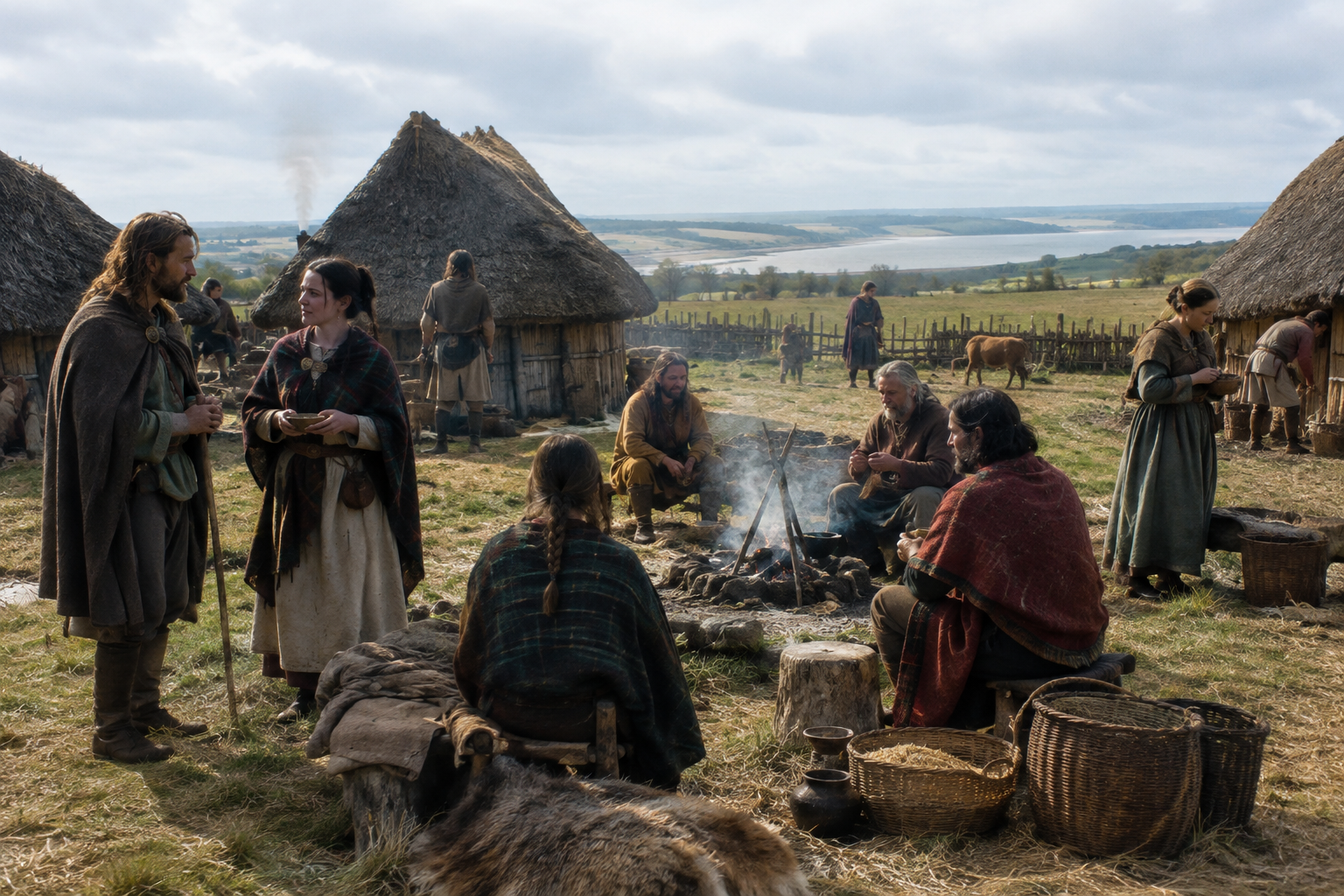
Some Y-DNA haplogroups appear in the ancient record like a sudden flash. Others turn up again and again in the same broad landscapes, across many centuries, until they begin to look less like a passing episode and more like part of the long local history of a region. Haplogroup R1b1a1b1a1a2c1a5b belongs to that second kind of story.
This is a very specific branch on the Y-chromosome tree, part of the wider R1b family that has an important place in the paternal history of western Europe. As always, a caution is needed at the start: Y-DNA traces one direct paternal line only - father to son to son - and it does not represent a person's whole ancestry. Still, that one line can be extraordinarily revealing. In this case, the ancient samples associated with this branch point us repeatedly toward Britain, with intriguing appearances elsewhere in Europe too, from Roman Dalmatia to early medieval Belgium.
What makes this branch especially interesting is not a single royal skeleton or one spectacular grave, but the accumulation of evidence: Bronze Age men in Britain and Ireland, Iron Age Britons and Parisi in Yorkshire, Durotriges in Roman Dorset, a post-Roman man on the Dorset coast, and later medieval and continental appearances. It is a lineage that seems to sit comfortably inside the long human history of the Atlantic archipelago and its connections to the wider European world.
Because this is such a narrow subclade, it would be wrong to simply pour the entire prehistory of broad R1b into it as if nothing changed along the way. But it is fair to say that branches of R1b became prominent in many parts of western Europe during later prehistory, especially after major Bronze Age transformations. The ancient individuals linked here suggest that this particular paternal line, or close relatives of it, was already established in Britain by the early and middle Bronze Age.
That matters. It means we are not looking only at an Iron Age or medieval arrival. We are looking at a paternal thread that appears in Britain long before written history, long before tribes such as the Durotriges or Parisi were named by anyone, and very long before the tower houses and baronial facades of later Scotland.
Among the earliest signposts are I2417, from Bronze Age Amesbury Down in Wiltshire, dated 2300 BC, and I4950, a Bell Beaker individual from Upavon in Wiltshire, also dated 2300 BC. Add to them I3256 from Trumpington Meadows, Cambridge, dated 2100 BC, I5377 from Early Bronze Age England Thames, dated 1800 BC, and dfb002 from Down Farm Pond Barrow in Dorset, dated 1900 BC. Further north there is I5473 from Boatbridge Quarry, South Lanarkshire, Scotland, dated 2250 BC, and offshore there is KD061 from Links of Noltland, Westray, Orkney, dated 1498 BC.
That is already a remarkable spread: southern England, eastern England, Scotland, and Orkney. It suggests not one tiny isolated pocket, but a paternal line moving within, or persisting across, Bronze Age communities over a large part of Britain.
Explore Bell Beaker-era population change
Then the evidence thickens dramatically. In East Yorkshire, especially at Wetwang Slack and nearby sites associated with the Arras culture and the Celtic Parisi, this paternal branch appears again and again. There is a whole cluster: I36889, I36880, I36885, I36974, I37335, I37336, I37342, I37344, I36867, I36869, I36870, and many more from Wetwang Slack, mostly dated 225 BC.
It is hard not to pause over that. One sample can be an accident of survival. A whole cemetery zone full of related paternal signals begins to look like social history. We are peering into a community in which certain male lines were clearly well established. That does not mean every man there belonged to one close family, nor that the cemetery was genetically uniform. But it does suggest real local continuity in paternal ancestry.
Some of these burials are especially evocative. I36995 is listed as an Elite Celtic Parisi Chariot Burial from Wetwang Slack, dated 225 BC. I36972 comes from an Arras Culture Primary Barrow Burial, also 225 BC. These are not merely names in a spreadsheet. They belong to a society with distinctive burial customs, including chariot graves that still catch the public imagination. The Y-chromosome here does not prove aristocracy in any medieval sense, but it does place this paternal line in socially visible Iron Age contexts.
The East Yorkshire cluster is complemented by nearby finds from Pocklington, including I14100 dated 320 BC, I14102, I14104, I13753, I13760, I21978, I21644, and I5509, many dated 225 BC. Elsewhere in Britain the line appears in I12775 from Carsington Pasture Cave, Derbyshire, dated 270 BC; I11156 from Bradley Fen, Cambridgeshire, dated 290 BC; I11991 from Worlebury, Somerset, dated 150 BC; I12785 from Greystones Farm, Gloucestershire, dated 100 BC; I21309 from Battlesbury Bowl, dated 57 BC; and HI2, a Celt from Hinxton, dated 45 BC.
In other words: this was not just a Yorkshire affair. The branch appears across Iron Age Britain, though East Yorkshire is especially rich.
Read more on Iron Age Britain and kinship
The Roman period adds another layer. In Dorset, among the Durotriges at Duropolis, Winterborne Kingston, there is an extraordinary concentration of individuals dated 125 AD: WBK12, WBK20, WBK29, WBK41, WBK05, WBK30, WBK43, WBK06, WBK08, WBK18, and WBK191. Again, not a solitary occurrence but a local pattern.
This is one of the most striking features of the evidence for R1b1a1b1a1a2c1a5b: the apparent persistence of related paternal ancestry in Britain from the Bronze Age into the Iron Age and into the Roman era. The empire arrived, roads were built, towns expanded, old identities shifted, and yet some paternal lines plainly remained in place.
There is even a later Dorset appearance in I11580 from post-Roman Worth Matravers, dated 600 AD. That does not prove an unbroken father-to-son chain from Bronze Age Wessex to early medieval Dorset - ancient DNA rarely gives us such neat stories - but it does hint at long regional continuity.
At the same time, the lineage was not confined to Britain. I26776, from Imperial Roman Era Zadar, Croatia, dated 200 AD, places it in the Roman Adriatic world. R10656 from Late Roman Era Klosterneuburg, Lower Austria, dated 407 AD, and R10488 from Late Roman Conimbriga, Portugal, dated 330 AD, widen the map still further. Then there are IND013 from a Merovingian Grave in North Rhine-Westphalia, dated 600 AD, and two individuals from Sint-Truiden, Belgium, ST2025 and ST1308, both dated 900 AD.
These continental finds are a useful corrective. They remind us that even a branch with strong British representation belonged to a Europe of movement, military service, trade, marriage, migration, and changing political frontiers.
Explore Roman and early medieval Britain
So where do later noble families come in? Carefully, and with the brakes on. A shared haplogroup is not a document, and no ancient sample here proves direct descent from, or direct ancestry to, a medieval or early modern clan. But historical families inhabited regions whose deeper population histories can now be studied in entirely new ways.
Clan Guthrie belongs to that later chapter. Their seat, Guthrie Castle in Angus, Scotland, began as a fortified tower house in the 15th century. Over time it grew into a larger country house as the Guthrie family held the estate for a long period. In the 17th century it was caught up in the turbulence of Scottish politics and religion. Later it was altered to suit changing taste rather than pure defence, and in the 19th century David Bryce remodelled it in baronial style, giving it much of its present romantic appearance. After leaving family hands in the 20th century, it passed through several owners and uses.
This is the sort of place historians love because it shows time layered in stone. A defensive residence becomes a statement house; a family stronghold becomes an architectural memory of family prestige. And in a region like eastern Scotland, where Bronze Age and later paternal lines already have deep archaeological roots, such castles sit in landscapes that were old long before heraldry and charters arrived.
That does not mean the Guthries can be assigned this exact Y-DNA branch from the information provided here. It means something subtler, and in many ways more interesting: the clan belongs to a part of Britain where ancient paternal lineages had been circulating for millennia, and genetics gives us a new way to think about the human depth behind later regional identities.
Discover the story of Clan Guthrie
R1b1a1b1a1a2c1a5b is historically interesting because it is not confined to one dramatic moment. It appears in Bronze Age Britain, flourishes in Iron Age contexts, is strongly represented in Roman and post-Roman southern England, and also turns up across parts of continental Europe. That combination suggests both persistence and mobility: men carrying this paternal line could remain rooted in local communities for centuries, while related branches could also move through the wider worlds of Rome and early medieval Europe.
Ancient DNA is so valuable here because written genealogy cannot reach these periods. No medieval pedigree will tell you about I36995 in his East Yorkshire chariot burial, or WBK12 at Roman-era Winterborne Kingston, or KD061 in Bronze Age Orkney. Yet together these men help sketch the deeper background against which later British and Scottish regional histories unfolded.
If this haplogroup appears in your own paternal results, the real excitement lies not in claiming a tribe, a castle, or a clan badge, but in seeing how your direct male line fits into a much longer human story - one that includes prehistoric burial mounds, Iron Age cemeteries, Roman provincial life, and the later landscapes of families such as the Guthries.
To explore more of that wider background, readers may also enjoy our article on broader Celtic movements and language dispersal.
Explore ancient DNA and Celtic origins
The story of haplogroup R1b1a1b1a1a2c1a5b shows how one paternal line can appear in Bronze Age Britain, Iron Age Yorkshire, Roman Dorset, and later European settings without collapsing all those people into one simple identity. MyTrueAncestry lets you explore these ancient DNA connections for yourself and see whether your results show similarities to ancient individuals and historic populations discussed in studies like these. Such matches can offer powerful clues and historical context, while still not proving direct descent from any one ancient person or noble family.






Comments