Haplogroup R1b1a1b1a1a2c1a5a1

– 6 min read


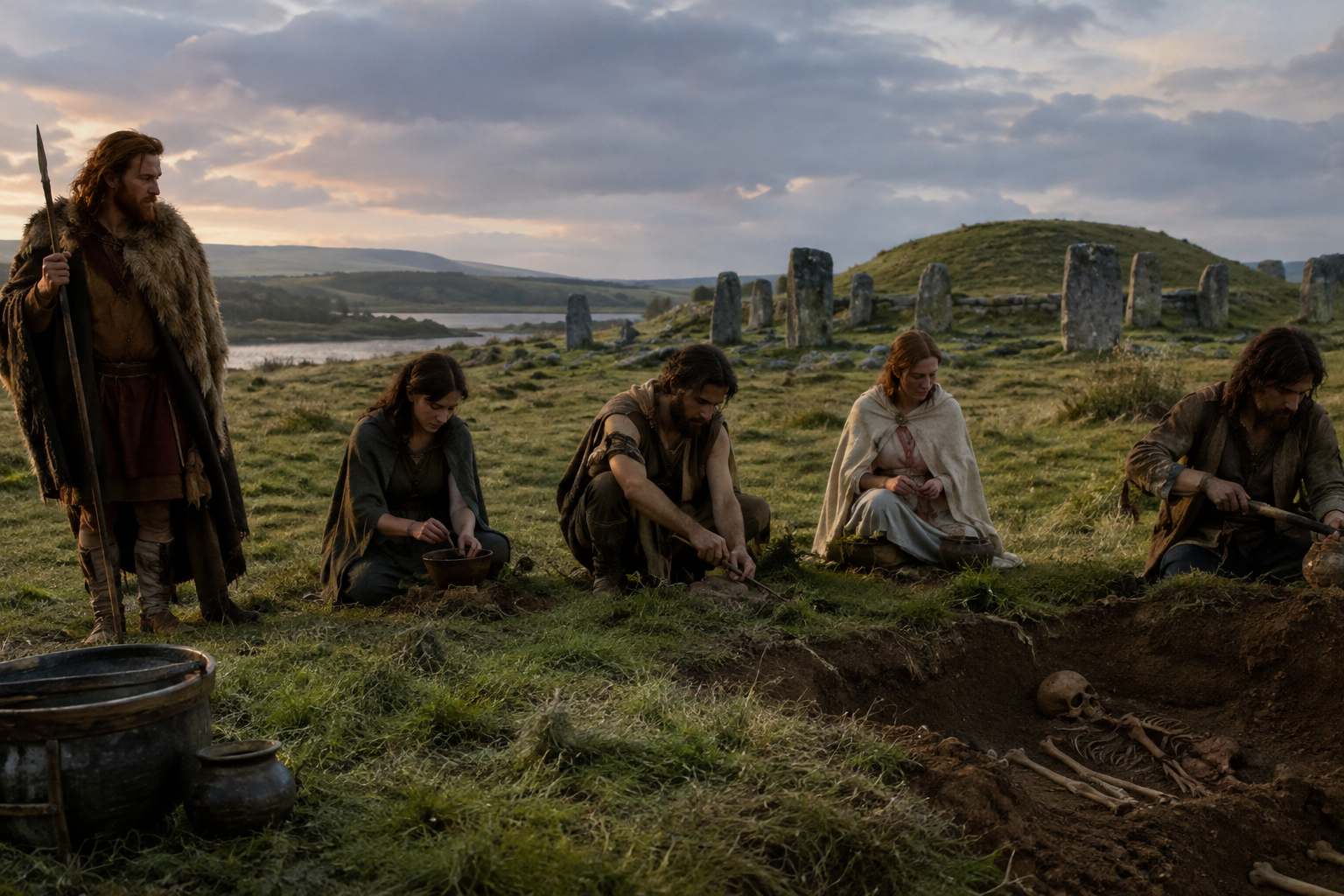
Some Y-DNA haplogroups arrive with trumpets and banners. Others come to us in a more intriguing way: as a very specific branch name, a scattering of ancient burials, and a landscape that keeps returning us to the western edge of Britain and Ireland. Haplogroup R1b1a1b1a1a2c1a5a1 belongs to that second category. It is a highly refined paternal lineage within the wider R1b family, one of the major Y-chromosome groupings in western Europe. That matters because Y-DNA traces one direct male line only - father to son to son - and so it can preserve a narrow but sometimes surprisingly durable thread through history.
With a branch this specific, caution is essential. We should not lazily dump onto it the whole prehistory of every R1b lineage from the Atlantic to the Urals. But the evidence supplied here does let us tell a careful story. The ancient samples point toward Britain and Ireland across a long span of time, from the Copper Age through the Iron Age and into the early Anglo-Saxon period. In other words, this is not a haplogroup that appears only in one dramatic migration horizon and then vanishes. It turns up in places where archaeology, language history, and later political history all overlap in interesting ways.
R1b1a1b1a1a2c1a5a1 sits deep within the Y-chromosome tree. Its long name is really a map of branching descent: each added letter and number marks a further split from an older paternal ancestor. The broader R1b family is widely associated with many later prehistoric and historic populations of western Europe, but a narrow subclade like this one has its own more local story. What makes it interesting is not just phylogeny but context: where it turns up, when it appears, and what sorts of communities carried related paternal lines.
On present evidence, the safest reading is that this branch belongs in the long male-line history of the British Isles, especially in zones that later became associated with Celtic-speaking populations and, in the medieval period, with regional dynasties and marcher lordships. That is not the same as saying it was "the Celtic haplogroup," still less that it belonged to one royal house. Haplogroups do not equal peoples. But they can help us see continuity and change in the male lines moving through the same landscapes over many centuries.
Explore Celtic origins through ancient DNA
The oldest supplied sample is Rathlin1B, dated to 1950 BC and described simply as Ireland Copper Age. Even in that spare label there is a great deal to think about. Copper Age Ireland was part of a wider world of technological change, exchange, and shifting social identities. A paternal line present there so early gives us a foothold in the prehistory of the islands before the better-documented political identities of later centuries. It does not prove uninterrupted descent to any modern family, of course, but it shows that related male lines were established in Ireland deep in prehistory.
By the Iron Age, the picture becomes geographically richer. We have I12783, a Celtic Briton from Lechlade-on-Thames Gloucestershire England dated to 660 BC. Then I12775, another Celtic Briton from Carsington Pasture Cave Derbyshire England dated to 270 BC. Then I11156 from Bradley Fen Cambridgeshire England dated to 290 BC, and I12785 from Greystones Farm Gloucestershire England dated to 100 BC. Taken together, these are not random dots. They suggest that closely related paternal ancestry was present across different parts of Britain in later prehistoric centuries, from the west Midlands and Gloucestershire to Cambridgeshire.
The labels "Celtic Briton" and "Iron Age" also remind us of an awkward but important truth: archaeology and genetics do not map neatly onto ethnic boxes. These men lived in societies later described by classical writers in broad tribal terms, but their Y-DNA tells us only about one paternal strand. Even so, the recurrence of this lineage in Iron Age Britain is precisely the sort of evidence that helps anchor the haplogroup in the lived world of hillforts, river valleys, cave deposits, farmsteads, and regional exchange networks.
Discover kinship in Iron Age Britain
One sample in particular complicates any neat attempt to label this lineage as belonging to only one cultural tradition. I11586 comes from an Early Anglo Saxon Cemetery West Heslerton Yorkshire and is dated to 550 AD. That matters because early medieval England was not a blank slate written over by incoming migrants. Ancient DNA increasingly shows a world of mixture, persistence, and local survival alongside migration. So when a paternal lineage appears in both Iron Age British contexts and an early Anglo-Saxon cemetery, the most responsible conclusion is not a simple tale of replacement, but a more entangled one.
West Heslerton sits in Yorkshire, a region deeply involved in the transformations of post-Roman Britain. The presence of this paternal branch there in 550 AD may reflect continuity of local male lines, incorporation of men of varied backgrounds into early Anglo-Saxon communities, or some combination of both. Genetics cannot settle that question on its own, but it does insist that early medieval identities were historical constructions, not biological absolutes.
If that larger setting interests you, the MyTrueAncestry community has an especially relevant article on post-Roman population history in Britain and another on Anglo-Saxon migration more broadly.
Read about DNA in post-Roman Britain
The supplied noble-family field points us not to a detailed genealogy but to Welsh Royalty, plus what appears to be a placeholder note rather than historical data. That means we must resist the temptation to invent a castle, a princely line, or a triumphant claim that this haplogroup "belongs" to the kings of Wales. Still, the association is suggestive in a broader historical sense, and that broader sense is worth exploring.
Medieval Wales preserved some of the most durable royal traditions in the British Isles. Dynasties such as those of Gwynedd, Powys, and Deheubarth ruled from landscapes where older Brittonic identities had deep roots. If a lineage like R1b1a1b1a1a2c1a5a1 appears in Iron Age and early historic Britain, it is historically reasonable to place it in the same regional world from which later Welsh princely houses emerged. That is a geographical and cultural context, not a demonstrated genealogical bridge.
Castles enter the story later. The great stone fortresses that dominate Welsh history are mostly medieval products of conquest, resistance, and administration. They preserve the memory of dynasties and contested frontiers, but they are not themselves proof of paternal descent. In historical writing, one must always distinguish between a family remembered in chronicles and a Y-chromosome branch detected in burials. The excitement lies precisely in putting these different kinds of evidence side by side without forcing them into a false certainty.
For readers interested in how MyTrueAncestry approaches this world of dynasties and regional memory, the community article on Welsh royal history is the obvious next step.
Explore the history of Welsh royalty
What, then, does R1b1a1b1a1a2c1a5a1 reveal? First, it offers evidence for a paternal lineage present in Ireland by the Copper Age and in multiple parts of Britain by the Iron Age. Second, it appears again in an early medieval Anglo-Saxon cemetery, reminding us that cultural change did not wipe the male-line slate clean. Third, it sits comfortably in the kinds of regions that later mattered enormously in the political histories of Britain, including the western and borderlands zones tied to Brittonic and Welsh traditions.
What it cannot do is identify a person's full ancestry, prove membership in an ancient tribe, or certify descent from a medieval royal family. Shared Y-DNA can indicate that two men belong somewhere on the same paternal tree, but depending on the branch depth, their common ancestor may have lived many centuries or even millennia earlier. Genetics is powerful precisely when used with restraint.
That is also why ancient DNA is so valuable. Written genealogies are patchy, partisan, and often late. Archaeology gives us landscapes and objects. Ancient DNA adds actual biological relationships and population patterns. Put together, they do not solve every historical puzzle. But they make the past less abstract. A code like I12783 or Rathlin1B stops being just a lab label and becomes a man who lived in a recognizable place, at a definite time, among communities whose descendants and successors went on to build kingdoms, bury their dead in churchyards, and argue over who truly belonged to the land.
If you want to explore whether your own DNA shows links to ancient individuals such as Rathlin1B, I12783, I12775, I11156, I12785, or I11586, MyTrueAncestry can help place your results beside the archaeological record. Those matches do not prove direct descent from a king, a noble house, or any one ancient person. But they can offer a striking window into the older populations that shaped your paternal story.






Comments