Haplogroup R1b1a1b1a1a2c1a5a

– 7 min read


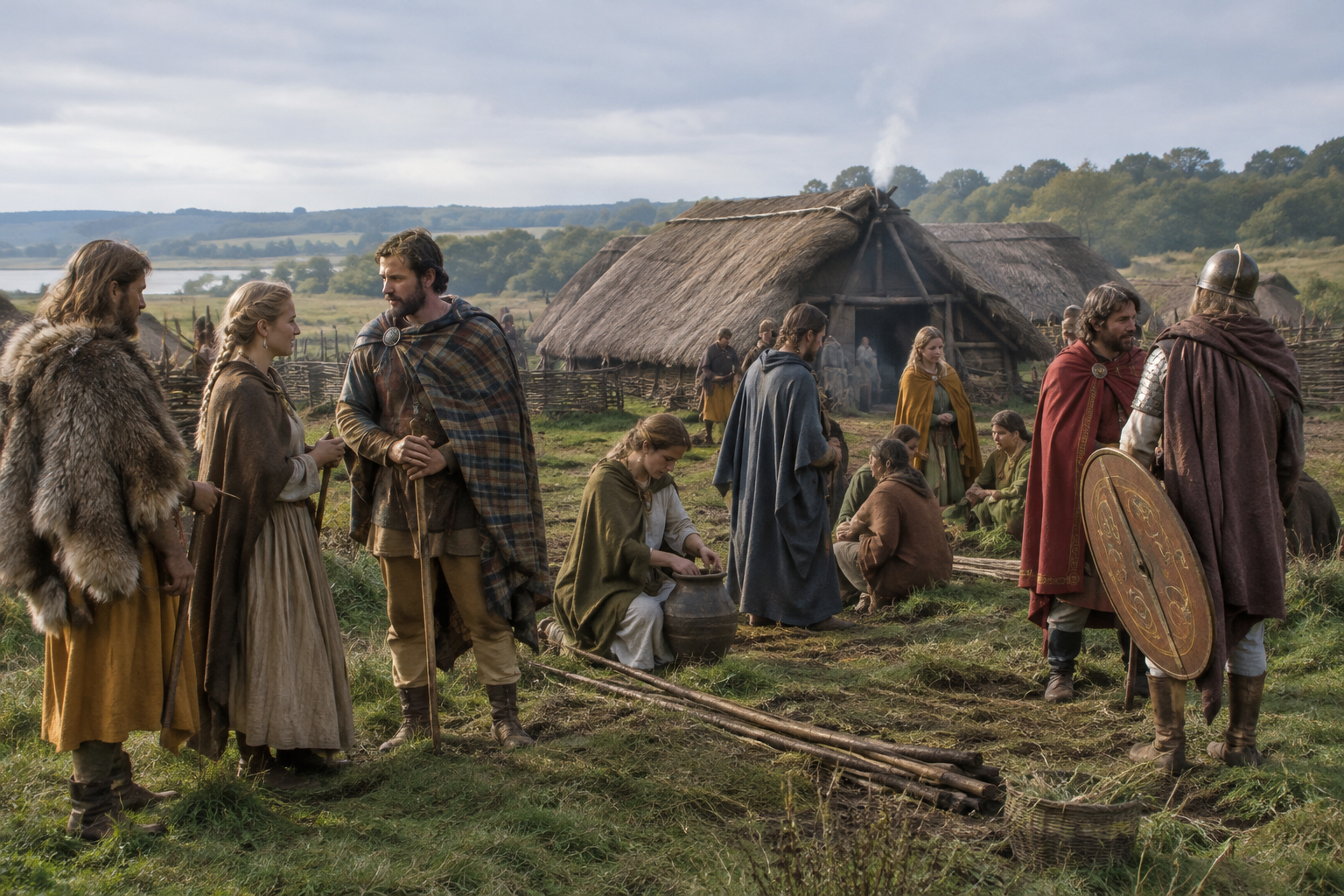
Some Y-DNA haplogroups announce themselves with a great continental sweep. Others are more intriguing because they appear in the record like a series of footprints across a wet shoreline: here in Bronze Age Britain, there again among Iron Age communities, later still in Roman and early medieval settings. Haplogroup R1b1a1b1a1a2c1a5a belongs to that second sort of story. It sits deep within the wider R1b family, one of the major paternal lineages in western Europe, yet this very specific branch is best understood not as a label for an entire people, but as a narrow paternal thread glimpsed through archaeology, burial grounds, and the occasional fortunate survival of ancient DNA.
That distinction matters. Y-DNA traces one direct paternal line only: father to son to son across the generations. It does not describe a person's whole ancestry, language, identity, or social rank. But when a branch turns up repeatedly in ancient burials from Britain, Ireland, Scotland, and beyond, it gives us a valuable way of asking historical questions. How old is local continuity? How much did Roman rule alter older paternal landscapes? And how do medieval clans, castles, and noble houses sit in regions where these lineages had already been present for centuries, or even millennia?
The broader haplogroup R1b has a long and complicated history in Europe, especially in the west. For a specific downstream branch such as R1b1a1b1a1a2c1a5a, caution is essential. We should not simply pour the full history of all R1b into this much narrower subclade. Still, the ancient samples supplied here suggest that this paternal line belongs within a western European pattern that was already established by the Bronze Age and remained visible in later Britain and neighboring regions.
That is striking because the sample list spans an impressive chronological range. We see early evidence in I2417, a Bronze Age individual from Amesbury Down, Wiltshire, dated to 2300 BC, and I4950, a Bell Beaker burial from Upavon in Wiltshire, also dated to 2300 BC. There is more Bronze Age evidence in I3256 from Trumpington Meadows, Cambridge, dated to 2100 BC, in dfb002 from Down Farm Pond Barrow in Dorset, dated to 1900 BC, and in the Copper Age Irish samples Rathlin1B dated to 1950 BC and Rathlin2B dated to 1880 BC. This is not proof that every later carrier in Britain or Ireland descended directly from any one of these men. But it does show that closely related paternal lines were already present across Atlantic-facing Britain and Ireland very early on.
Even more evocative is I5473 from Boatbridge Quarry, South Lanarkshire, Scotland, dated to 2250 BC, and KD061 from Links of Noltland on Westray in Orkney, dated to 1498 BC. Those finds place this paternal story in Scotland long before there were castles on the Firth of Forth or songs about Airlie.
Explore Celtic origins through ancient DNA
If the Bronze Age gives us early anchors, the Iron Age gives us density. Few things are more persuasive in ancient DNA than repetition, and here repetition arrives in force from East Yorkshire. The cemetery world of the Parisi and the Arras culture appears again and again in the sample list: I36889, I36880, I36885, I36974, I37335, I37336, I37342, I37344, I36867, I36869, I36870, I36843, I36844, I36972, I36995, and many others from Wetwang Slack, Pocklington, Melton, and Burton Fleming, mostly around 225 BC.
This concentration matters because it suggests that the branch, or closely related paternal lines within its immediate neighborhood, was not a stray arrival represented by one isolated burial. It was part of the male landscape of Iron Age eastern Britain. The elite chariot burial I36995 at Wetwang Slack is especially tantalizing. Not because it lets us identify a dynasty in any simplistic way, but because it shows that this paternal line could appear in a socially prominent burial setting. That is exactly the sort of finding that reminds us how genetics and archaeology complement one another: the DNA gives lineage, the burial gives status, but neither alone supplies ethnicity, language, or an unbroken family tree.
The same wider picture extends beyond Yorkshire. There are Iron Age and later prehistoric examples from I12775 at Carsington Pasture Cave, Derbyshire, dated to 270 BC; I12783 from Lechlade-on-Thames, Gloucestershire, dated to 660 BC; I11991 from Worlebury, Somerset, dated to 150 BC; I11156 from Bradley Fen, Cambridgeshire, dated to 290 BC; I12785 from Greystones Farm, Gloucestershire, dated to 100 BC; and I21309 from Battlesbury Bowl, dated to 57 BC. This is a wide English spread, not just one local pocket.
Read more on Iron Age Britain and ancient DNA
One of the more interesting features of this haplogroup's sample trail is that it does not vanish with the Roman conquest. At Duropolis in Dorset, the Durotriges samples WBK12, WBK20, WBK29, WBK41, WBK05, WBK30, WBK43, WBK06, WBK08, WBK18, and WBK191, all dated to 125 AD, show that related paternal lines remained present in a Romano-British setting in southern England. That is important because it hints at continuity through political change. Rome could reorganize taxation, roads, towns, and law; it did not necessarily erase local paternal histories.
Nor was this lineage confined to Britain. The sample I26776 from Imperial Roman Era Zadar, Croatia, dated to 200 AD, points to a wider European distribution. So do R10488 from Late Roman Conimbriga, Portugal, dated to 330 AD, and R10656 from Late Roman Era Klosterneuburg, Lower Austria, dated to 407 AD. Add CGG023699 from Gallic France Parancot, dated to 497 BC, and this starts to look less like a purely insular story than a western and central European one with a particularly strong British concentration in the present dataset.
That does not mean there was one grand migration carrying this exact subclade neatly from place to place. Human history is rarely so tidy. What it does suggest is that this paternal branch, or its close upstream kin, was embedded in several populations across later prehistoric and Roman Europe.
Explore Roman and early medieval Britain
The early medieval samples make the picture even more interesting. I11580 from post-Roman Worth Matravers, Dorset, dated to 600 AD, suggests that in at least some parts of southern Britain, local paternal lines continued after imperial rule ended. Yet alongside that we have I11586 from the early Anglo-Saxon cemetery at West Heslerton, Yorkshire, dated to 550 AD. That pairing is rather wonderful because it warns against lazy ethnic assumptions. The same paternal branch, or one extremely close to it, can turn up in contexts we would historically describe as Brittonic and Anglo-Saxon.
Elsewhere in northwestern Europe, the early medieval presence continues with IND013 from a Merovingian grave at Alt-Inden in North Rhine-Westphalia, dated to 600 AD, and the Belgian samples ST2025 and ST1308 from Sint-Truiden, dated to 900 AD. By this point we are looking at a lineage that has crossed not just geography but major historical transitions: Bronze Age burial societies, Iron Age communities, the Roman world, and the post-Roman kingdoms.
That long background is what makes the later historical associations so appealing. Not because ancient DNA lets us declare a medieval noble family descended from one excavated man in a barrow - it does not - but because clans and houses occupied landscapes where these paternal lineages had deep roots already.
Take Clan Wemyss. Wemyss Castle in Fife stands above the Firth of Forth on ground tied to the medieval Wemyss family, whose name comes from the nearby caves, or weems. The present castle was built around the fifteenth century and later altered over time as the seat of the Earls of Wemyss. It was a noble residence bound up with Scottish marriage politics and landed power rather than a vast royal fortress. In a haplogroup story with ancient Scottish evidence from South Lanarkshire and Orkney, Wemyss Castle provides exactly the sort of historical setting that helps readers see continuity of region without confusing it with proof of a single genealogical line.
Clan Ogilvie offers a different sort of memory. Airlie Castle in Angus began as a medieval stronghold of the Ogilvy family, probably in the fifteenth century, and later became famous through feud, civil war, and song. Its destruction in 1640 by Archibald Campbell, Marquess of Argyll, while Lady Ogilvy was heavily pregnant, entered Scottish legend as The Bonnie House o Airlie. What survives is more house than fortress now, but its story is thick with the politics of clan identity. Genetics cannot confirm every Ogilvie tradition, of course, yet it can remind us that the male lines moving through eastern and central Scotland belong to a much older human landscape than the documents alone reveal.
Then there is House Knollys and Greys Court near Henley-on-Thames. Here the mood changes from Scottish cliff and feud to English manor and adaptation. The site goes back to the twelfth century, fortified by the de Grey family after the Norman period, and over the centuries it evolved from medieval manor and moat into Tudor and Georgian country house. Its layered fabric mirrors the historical lesson of the haplogroup itself: continuity does not mean stasis. Places survive by changing, and so do lineages.
R1b1a1b1a1a2c1a5a is historically interesting because it appears to belong to a paternal network with clear visibility in Britain from the Bronze Age onward, strong representation in Iron Age Yorkshire, survival into Romano-British Dorset, and a broader footprint stretching into Ireland, Scotland, Gaul, Iberia, the Balkans, Austria, Germany, and Belgium. That is a serious historical range. It suggests persistence, movement, and local continuity all at once.
But the right lesson is not "this haplogroup equals Celts," or "this castle proves that clan." The right lesson is subtler, and in some ways more exciting. Ancient DNA allows us to place later historical families inside much older regional histories of settlement and kinship. Written genealogy usually begins in the medieval period, if one is lucky. Y-DNA and archaeology push the question much further back, into cemeteries, caves, barrows, and chariot graves.
If you carry this haplogroup, or a nearby branch, MyTrueAncestry may help you explore whether your paternal line shows affinities with ancient individuals from places such as Wetwang Slack, Pocklington, Duropolis, Rathlin, Orkney, or Bronze Age Scotland. Those matches do not prove direct descent from a named ancient man or membership in a noble family. But they can place your line within a real historical landscape populated by farmers, warriors, townsmen, and lords long before surnames were fixed.
Upload your DNA to MyTrueAncestry and see whether your ancestry connects with the ancient people behind these graves, these regions, and the later worlds of castles and clans.






Comments