Haplogroup R1b1a1b1a1a2c1a4d2

– 6 min read


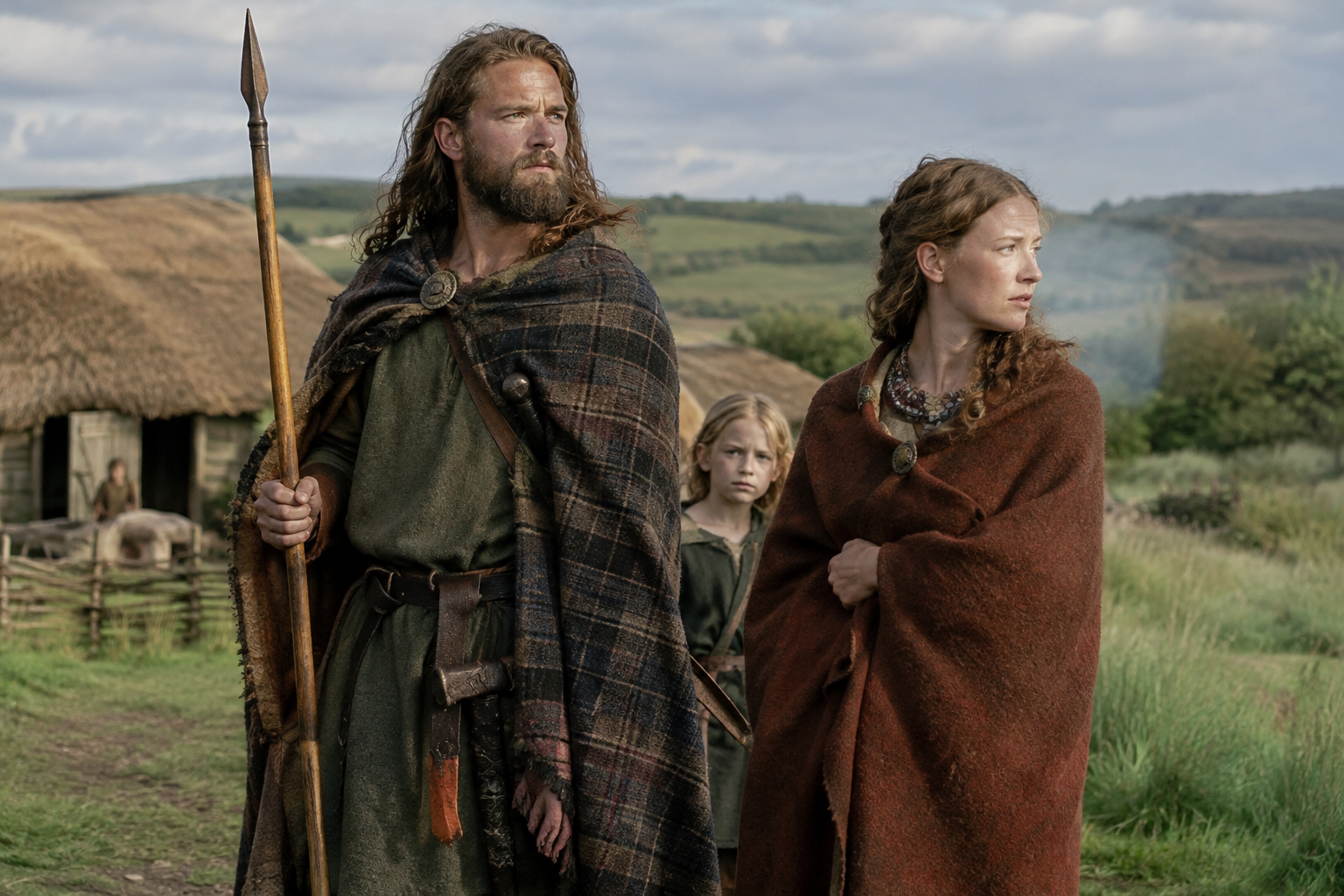
Some Y-DNA haplogroups arrive with a flourish: kings, famous graves, a neat map, a tidy origin story. R1b1a1b1a1a2c1a4d2 does not quite behave so obligingly. It is a very specific branch deep within the wider R1b tree, and that is precisely what makes it historically interesting. Narrow subclades like this remind us that paternal history is built not only from grand labels such as "Celtic" or "Steppe," but from much smaller surviving lineages that passed from father to son across centuries of migration, local continuity, upheaval, and chance.
Y-DNA haplogroups trace one line only: the direct paternal line. They do not describe a person's whole ancestry, culture, language, or identity. Still, they are extraordinarily useful. They let us follow the history of male lineages through ancient burials, across landscapes, and into later historical regions where clans, lordships, and castles emerge in the written record. In the case of R1b1a1b1a1a2c1a4d2, the broader background points us toward the enormous and varied history of R1b in western Europe, while the more specific branch demands caution. We can place it in that larger story, but we should not lazily assign the entire history of broad R1b to this exact subclade without evidence.
The haplogroup R1b is one of the major Y-chromosome lineages in western Europe today, and ancient DNA has shown that branches of R1b became especially important in later prehistoric Europe, particularly after major Bronze Age population movements linked to steppe-derived ancestry. That broad framework is well established. What is less simple is the exact path taken by every downstream twig of the tree. A branch as specific as R1b1a1b1a1a2c1a4d2 almost certainly represents a much later narrowing within that larger paternal expansion.
That distinction matters. It is reasonable to say that this lineage belongs to a paternal family tree whose deeper roots are tied to the transformations of Bronze Age Europe. It is not responsible scholarship to claim, without direct evidence, that this exact branch was already present in every region where broader R1b once spread. Instead, the likely historical interest lies in how one western European paternal tradition endured and subdivided through Iron Age and medieval populations.
For readers wanting a wider archaeological frame for how paternal lineages and Celtic-speaking worlds came to be discussed together, one useful companion piece is this community article on ancient genomics and language spread.
Explore Celtic Origins Through Ancient DNA
The most concrete anchor in the evidence supplied here is an ancient individual from Iron Age Britain: I37127, described as Celtic Parisi Iron Age England East Yorkshire Wetwang Slack Year:225 BC. Wetwang Slack is one of those wonderfully evocative British archaeological names that sounds almost invented, but the site is very real and very important. It belongs to the Iron Age landscape of East Yorkshire, an area famous for chariot burials and often associated with the group known in classical and archaeological discussion as the Parisi.
That single burial matters because ancient DNA is most powerful when it takes an abstract lineage and puts it back into a human setting. Here, the setting is not a vague "Celtic past" but a particular place in Iron Age eastern England around 225 BC. That is a world of local elites, regional burial customs, exchange networks across the North Sea and the Channel, and communities whose identities were shaped by both continuity and contact.
Even so, caution is essential. A shared haplogroup does not prove close kinship between any modern tester and I37127, nor does it prove that everyone in the Parisi carried the same paternal line. What it does show is that a branch relevant to this haplogroup's story was present in Iron Age Britain. That is valuable because it places at least part of this paternal history firmly in the pre-Roman British world.
If you want a broader look at how ancient genomes illuminate family structures and social life in Britain beyond one paternal line, this related article is well worth reading.
Discover Iron Age Britain and Kinship
So how might we connect a highly specific R1b branch with a man buried in East Yorkshire before the Roman conquest? The safest answer is geographic and chronological rather than genealogical. Much of western Europe's paternal landscape was reshaped in later prehistory, especially during and after the Bronze Age. Over time, those broad paternal lineages fragmented into many local branches. By the Iron Age, Britain was not an isolated edge of Europe but part of a lively zone of contact stretching to the continent.
That means lineages like this one may reflect several layers of history at once: older Bronze Age paternal foundations, later regional developments, and local Iron Age survival. East Yorkshire in particular has often drawn attention because of its distinct archaeology and its links, whether through trade, mobility, or shared cultural trends, to northern France and the Low Countries. Ancient DNA has made those old historical questions sharper, even if it has not made them simple.
In that sense, R1b1a1b1a1a2c1a4d2 is less a badge of one people than a signpost within a long sequence of male-line descent. It points us to the endurance of paternal lines across changing cultural worlds: Bronze Age communities, Iron Age polities, Roman provinces, and medieval lordships all succeeded one another, while some Y-chromosome lines quietly persisted underneath.
Readers interested in the longer British sequence from Roman into early medieval times may want to follow that story further here.
Read Roman and Early Medieval Britain
The later historical association supplied with this haplogroup brings us north to Clan Livingstone and to Achanduin Castle on the shore of Loch Etive in Argyll. It is a striking setting, and the history attached to it is exactly the sort of thing that reminds us how misleading tidy family legends can be. The castle is thought to have been built in the 13th century, perhaps by the MacDougalls when they were major lords in western Scotland. Later it passed into Campbell hands as Highland power shifted. By the 16th or 17th century it had fallen out of use and into ruin. What survives is a roofless stone tower house with parts of an enclosing wall: not merely a picturesque relic, but a fragment of the long contest over lordship in Argyll.
This is where genetics and history meet, though not in the simplistic way people sometimes hope. A clan name, a ruined castle, and a Y-DNA haplogroup do not automatically add up to proven descent. Not every man in a clan shared one paternal line, and not every later bearer of a surname descends from an original chiefly line. Medieval lordship was full of fosterage, alliance, inheritance through women, cadet branches, retainers, dependants, and name adoption. In other words, real history was messier than heraldry suggests.
Yet the connection is still meaningful. Argyll, like East Yorkshire, sits within the western British world where old paternal lineages could endure through dramatic political change. Achanduin Castle stands in a region where Norse, Gaelic, and later Scottish political forces overlapped. A haplogroup associated with deeper western European paternal history fits naturally into that broader setting, even when no direct line can be demonstrated from an Iron Age burial in Yorkshire to a medieval clan in Argyll.
For readers who want to explore the clan context itself, the community article on the Livingstones offers the natural next step.
The real value of R1b1a1b1a1a2c1a4d2 lies in scale. At the broadest level, it belongs to a paternal family of lineages deeply involved in the making of later prehistoric western Europe. At a finer scale, the presence of the Iron Age individual I37127 at Wetwang Slack shows that relevant branches were present in Britain before Rome. At the historical scale, associations with places such as Achanduin Castle remind us that later surnames, clans, and castles occupied landscapes whose paternal histories were already ancient.
Ancient DNA and written genealogy do different jobs. Genealogy begins with names and works backward when it can. Ancient DNA begins with bones and works outward, often into periods where names are lost. When the two meet, the results can be illuminating, but they are rarely neat. A shared haplogroup can suggest deep paternal affinity, regional continuity, or a place within the same broad historical stream. It cannot, by itself, certify noble descent or identify a specific medieval ancestor.
That is, perhaps, the most interesting lesson of all. The story is not smaller because it is careful. It is larger. It stretches from an Iron Age burial in East Yorkshire to a ruined stronghold on Loch Etive, from archaeology to clan memory, from anonymous paternal lines to recorded lordship. And all of it survives because ancient DNA lets us ask better questions of the past.
If you have tested your DNA, MyTrueAncestry can help you explore whether your results show similarities to ancient individuals like I37127 or to the wider historical populations discussed here. Those matches do not prove direct descent from a particular ancient person or noble family, but they can offer a fascinating new perspective on your paternal past.






Comments