Haplogroup R1b1a1b1a1a2c1a4b2c3

– 5 min read


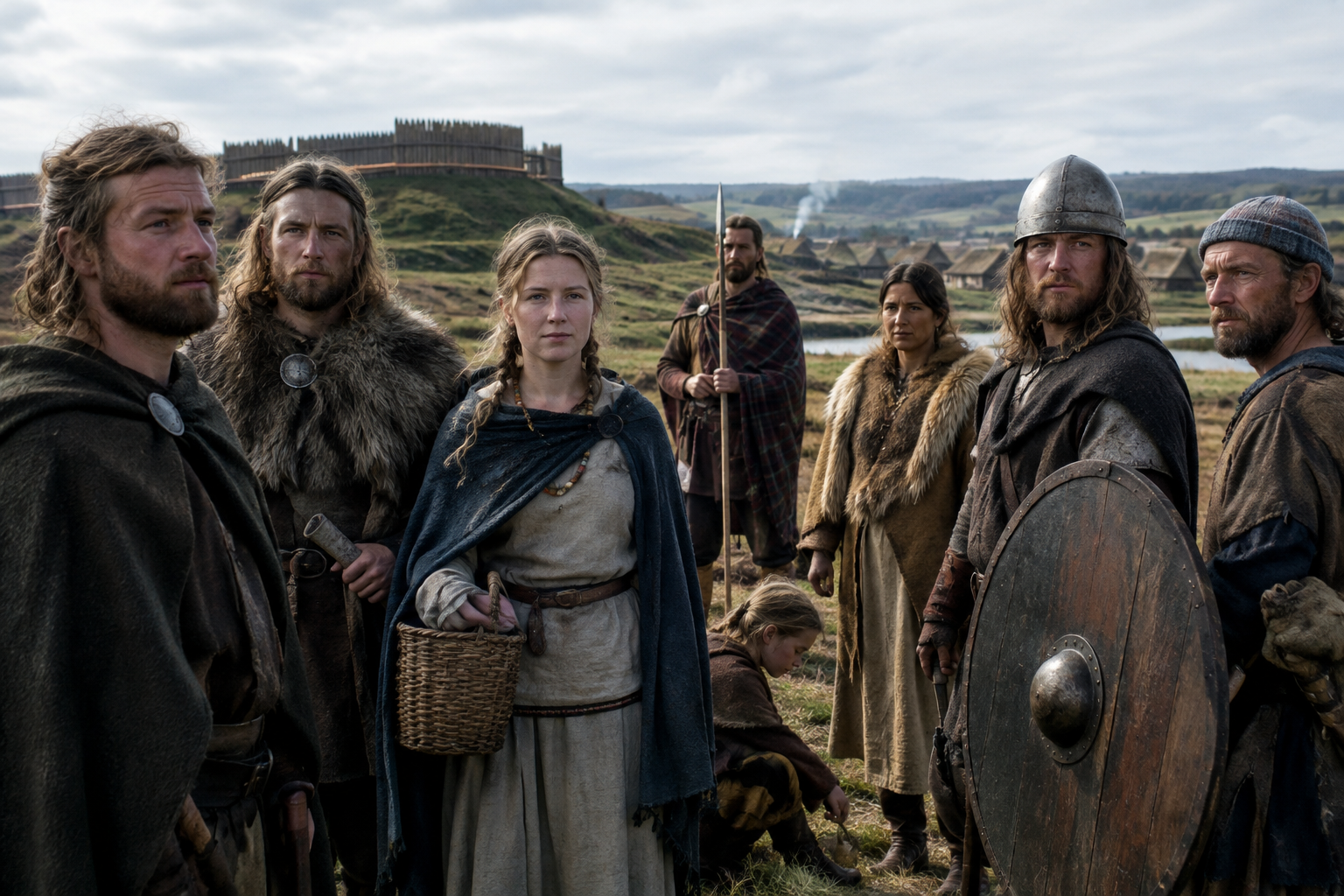
Some Y-chromosome lineages announce themselves with grand imperial associations. Others are more interesting because they do not. Haplogroup R1b1a1b1a1a2c1a4b2c3 sits deep within the sprawling R1b tree, one of the major paternal lineages of western Europe, but the real historical intrigue lies in how a very specific branch must be approached: not as a shortcut to ethnicity, and certainly not as proof of noble descent, but as one narrow paternal thread that can sometimes be glimpsed in burials, settlements, and family traditions scattered across centuries.
That is what makes this branch compelling. The supplied ancient DNA points us not to a single dramatic origin story, but to a pattern centered on Britain and the North Atlantic world: Bronze Age England, Iron Age Yorkshire and Hampshire, medieval Cambridgeshire, and Viking Age Iceland. Y-DNA traces a direct paternal line only, not a person's total ancestry, yet even that narrow line can reveal how male lineages endured, moved, and reappeared in very different historical settings.
The long label R1b1a1b1a1a2c1a4b2c3 tells us we are dealing with a downstream branch inside the wider R1b family. That matters. It is perfectly reasonable to place it within the broad paternal history of western Europe, where R1b lineages became prominent over prehistoric and later periods, but it would be careless to assign this exact branch the full age, spread, or cultural story of all R1b men everywhere.
What we can say, cautiously, is that the evidence here fits a lineage found in western European settings, especially Britain and regions linked to later movement across the North Sea and into the North Atlantic. Ancient DNA is invaluable precisely because it replaces arm-waving with dated individuals in known archaeological contexts. Instead of saying "this lineage belonged to Celts" or "this was a Viking marker," we can ask a better question: in what kinds of communities does this paternal branch actually appear?
For readers wanting a broader background on how archaeogenetics has transformed this kind of question, MyTrueAncestry's overview of the field is a useful companion.
The earliest anchor in the supplied evidence is I7640, from Bronze Age Trumpington England, dated 1330 BC. One sample does not define an entire population, but it does place this paternal line, or a closely related form of it, in southern Britain well before the Roman conquest and long before medieval surnames or clans. It reminds us that later British paternal history did not begin with Saxons, Vikings, or Normans. Much of it runs deeper.
Then the picture sharpens in the Iron Age. At Wetwang Slack in East Yorkshire, several men from the Arras Culture appear in the record: I36964, a Primary Barrow Burial dated 225 BC, alongside I36783 and I30993, also dated 225 BC. A related regional example, I28922, comes from Melton in East Yorkshire, dated 270 BC. These are associated with the Celtic Parisi, a famous name in British Iron Age archaeology.
Here, though, one must tread carefully. The genetics do not mean this branch was "the Celtic haplogroup," nor that language or identity can be read straight off the Y chromosome. But the concentration of these samples in Iron Age East Yorkshire does suggest that this paternal lineage was established among communities living within that cultural world. In other words, the branch was not a fleeting arrival. It had roots.
Another revealing sample is I17264, from a Belgic Tribe Hillfort Danebury Hampshire England context, dated 60 BC. Danebury belongs to a rather different archaeological landscape from Wetwang Slack: hillfort country in southern England, with links often discussed in relation to later Iron Age continental contacts. That does not prove a migration of this exact lineage from one site to the other, but it does show the branch turning up in more than one British Iron Age setting.
If you want to explore how ancient genomics is reshaping debates around Iron Age language and population history, one particularly relevant community article is worth reading alongside these finds.
The story does not stop in prehistory. ATP_PSN_1268, from Late Medieval England Clopton Cambridgeshire, dated 1300 AD, shows the paternal line still present in medieval eastern England. That is historically interesting because it bridges a world separated from the Bronze and Iron Age samples by Roman rule, post-Roman change, Scandinavian settlement, and Norman lordship. No single sample can prove continuity from any specific earlier man, but it does show that this line persisted through all that upheaval.
Then there is ORE-A1, a Gaelic Settler Viking Iceland sample dated 935 AD. This is perhaps the most evocative of the set. Icelandic settlement was never simply "Viking" in an uncomplicated ethnic sense. It involved people from Scandinavia, but also individuals and families from the British Isles, including Gaelic-speaking regions. A paternal lineage with British and Irish-world associations appearing in Viking Age Iceland fits that mixed colonial society rather well.
Readers interested in that hybrid North Atlantic setting may enjoy a related MyTrueAncestry article on the wider settlement story of the Norse Atlantic.
Discover Viking Atlantic Settlers
How, then, does a lineage like R1b1a1b1a1a2c1a4b2c3 connect with later noble history? The supplied family association is Clan Ramsay, with Dalhousie Castle near Bonnyrigg in Midlothian. This is exactly the sort of case where history is richer if one avoids genetic overclaiming.
Dalhousie Castle began as a 13th century stronghold of the Ramsay family and developed over centuries into one of Scotland's oldest continuously occupied castles. It belonged to the rough politics of lowland Scotland: border warfare, noble rivalry, rebuilding in the 15th and 17th centuries, then a 19th century reshaping in romantic baronial style. In the 20th century it passed out of family hands and eventually became a hotel. In short, it is not a frozen medieval relic but a building that has lived many historical lives.
That layered history matters because castles preserve memory differently from DNA. A castle can tell us where a family held power, how it wished to present itself, and how later generations reinvented the medieval past. Genetics asks a narrower question: what happened along one paternal line? The two are not the same evidence, but they illuminate one another. A Y-DNA association with a clan does not prove that every Ramsay carried this haplogroup, nor that a modern tester with the same branch descends from the lords of Dalhousie. What it can do is place a paternal lineage into the same historical geography.
And that geography is suggestive. The ancient samples cluster heavily in Britain. The Ramsays belong to the medieval and later British world. That is a contextual parallel, not a documented pedigree. Still, it is exactly the kind of parallel that makes Y-DNA fascinating: one can sometimes see a paternal branch in prehistoric burials, in medieval villagers, and then in the historical landscapes of named families and castles.
For readers who want to go further into that particular family history, the community's Ramsay feature is the obvious next stop.
The great value of R1b1a1b1a1a2c1a4b2c3 is not that it hands us a neat label like "Celtic," "Scottish," or "Viking." It does something better. It shows how a paternal branch can be traced in real people from Bronze Age England, Iron Age Yorkshire, a late Iron Age Hampshire hillfort, medieval Cambridgeshire, and Viking Age Iceland. That spread suggests durability, mobility, and regional depth in the British and North Atlantic worlds.
It also offers a good lesson in method. Ancient DNA does not replace history, archaeology, or genealogy. It complicates them. Written pedigrees rarely reach beyond the Middle Ages; DNA can reach far earlier, but only in fragments and probabilities. Castles such as Dalhousie preserve aristocratic memory; graves like those at Wetwang Slack preserve something older and harder to name. Put together, they allow us to ask better questions about continuity and change across two thousand years and more.
If your own Y-DNA belongs somewhere within the R1b world, MyTrueAncestry can help place that paternal line beside ancient individuals like I7640, I36964, I17264, ATP_PSN_1268, or ORE-A1. That will not prove you descend from a Celtic barrow burial or from the Ramsays of Dalhousie. But it may show that your paternal ancestry belongs to the same deep historical landscape.
Upload your DNA to MyTrueAncestry and see whether your results connect you to the ancient populations, medieval regions, and paternal lineages behind this remarkable branch.






Comments