Haplogroup R1b1a1b1a1a2c1a4b2c1

– 6 min read


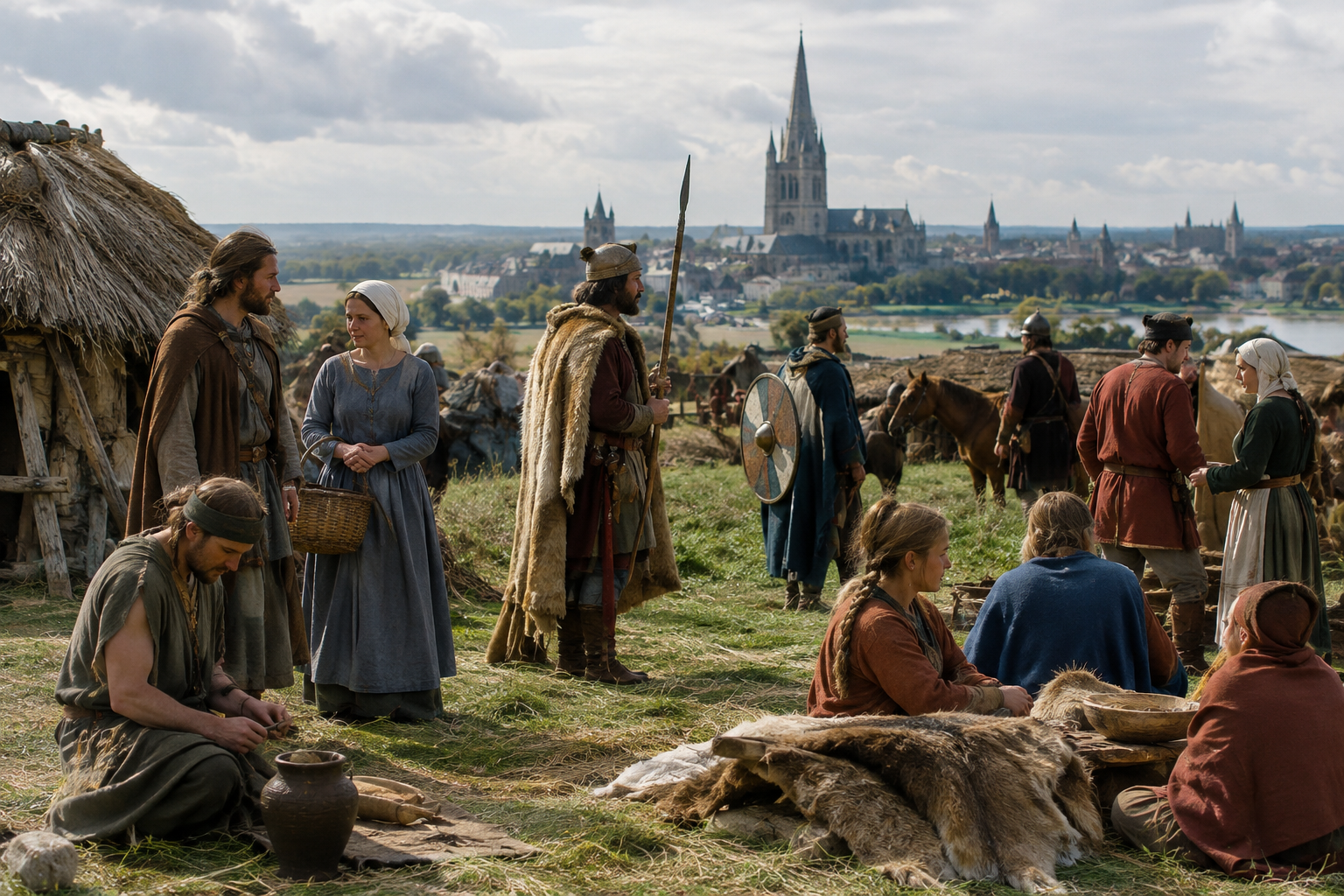
Some Y-DNA haplogroups announce themselves with a familiar surname cluster or a well-known royal pedigree. Others are more elusive, and in some ways more interesting for that very reason. The subclade R1b1a1b1a1a2c1a4b2c1 belongs to one of the great paternal branches of western Eurasia, but this very specific lineage comes into view not through grand claims, but through a scatter of ancient men found in graves, battlefields, churchyards, and early medieval settlements from Britain to Belgium and beyond.
That is exactly why it deserves attention. Y-DNA traces a direct paternal line, father to son across generations. It does not describe a person's whole ancestry, culture, or identity, and it certainly does not turn a haplogroup into a nationality. But when a narrow branch like this appears in ancient DNA across Iron Age England, Bronze Age northern Europe, medieval Ireland, Viking Age Scandinavia, and later Belgium, it offers a valuable clue about the long-lived male lineages that moved through the North Sea world and adjacent regions over many centuries.
This haplogroup sits within the broader R1b family, one of the best-known Y-chromosome lineages in western Europe. That broader family has a long and complicated prehistoric history, and many of its branches are associated in general terms with later prehistoric expansions across Europe. But one must be careful here. The full story of R1b cannot simply be pasted onto a highly specific downstream branch such as R1b1a1b1a1a2c1a4b2c1. What we can say more responsibly is that this lineage belongs within a paternal framework that became deeply established in parts of Europe, and that its documented ancient appearances point especially toward northwestern Europe and the wider North Sea zone.
The sample list supplied for this branch is striking for its geography. We see it in East Yorkshire during the Iron Age, in Hampshire among a Belgic tribal setting, in Cambridgeshire in the medieval period, in Roscommon in early medieval Ireland, in Oland and Staraya Ladoga in Viking contexts, and in St. Rombouts in Belgium in the late medieval and early modern periods. That distribution does not prove a single continuous family. It does, however, suggest that closely related paternal lines of this sort were at home in the interconnected world of Britain, the Low Countries, Ireland, and Scandinavia.
Explore Celtic Origins Through Ancient DNA
If there is one place where this haplogroup feels especially grounded, it is Iron Age East Yorkshire. Several samples come from the famous Arras culture zone and from burials associated with the Celtic Parisi: I36850, I36846, I36825, I31007, I30993, I36894, I36898, and I39730, all from Wetwang Slack around 225 BC, together with I28922 from Melton at 270 BC.
That concentration matters. Wetwang Slack is not a vague dot on a map but one of the best-known windows into Iron Age life in Britain, particularly for elite burials, chariot traditions, and regional identity. When the same paternal branch appears repeatedly in one archaeological landscape, it hints that this was not an isolated arrival but part of a local male-line presence within that community. We should not leap from haplogroup to tribe, and certainly not to language with certainty. But it is reasonable to say that this branch was present among men living in the social world archaeologists associate with the Parisi and Arras culture.
A related English appearance comes from I17264, a Belgic Tribe Hillfort Danebury Hampshire England Year:60 BC sample. Danebury sits in a rather different southern setting from East Yorkshire, yet the recurrence of the lineage in Iron Age England suggests that paternal lines of this kind were not confined to one corner of the island.
Even further back, I7640 from Bronze Age Trumpington England Year:1330 BC and WEZ59 from the Bronze Age Germany Tollense Valley Battlefield Mecklenburg-Vorpommern Year:1250 BC widen the frame. Tollense in particular is one of the great prehistoric battle discoveries of Europe, a reminder that the Bronze Age north was no sleepy backwater. These earlier samples do not prove that the exact later branch had already formed in its medieval or modern sense, but they place related paternal ancestry in northern European settings long before Roman authors and medieval chroniclers began naming peoples.
Discover Bronze Age Mobility in Europe
The next chapter is not one of disappearance, but of reappearance in new historical worlds. KIL020, from Medieval Ireland Kilteasheen Roscommon Bishops Seat Year:650 AD, places the lineage in an early medieval Irish ecclesiastical landscape. Kilteasheen is important because it reminds us that paternal continuity is not only a matter of warriors and chiefs. These lineages also belonged to men buried in religious and settled communities that formed the fabric of early medieval society.
Then there are the northern samples: VK349 from Early Viking Age Oland Sweden Year:829 AD and VK218 from Viking Age Staraya Ladoga Year:1000 AD. That is a remarkable span. Oland sits within the Baltic sphere of early Scandinavian activity, while Staraya Ladoga was one of the great contact zones between Scandinavia and eastern Europe. Their presence does not mean this haplogroup was "a Viking haplogroup" in any simple ethnic sense. Viking Age populations were varied, mobile, and mixed. But these finds do place this paternal line squarely within the maritime and trading networks of the early medieval north.
For readers interested in how these northern worlds connected genetically as well as historically, MyTrueAncestry has explored similar questions in Exploring Viking Age Genetics: Insights from Population Genomics and Ancient DNA.
Explore Viking Age Genetic History
By the later Middle Ages and into the early modern period, the branch appears in contexts that feel more recognizably close to documented family history. ATP_PSN_1268, from Late Medieval England Clopton Cambridgeshire Year:1300 AD, shows the lineage still present in medieval England. Across the Channel, four samples from St. Rombouts in Belgium - STR105d at 1677 AD and STR105b, STR105c, STR105f at 1800 AD - show the same paternal branch turning up in a church-associated urban setting in the Low Countries.
This is the sort of evidence ancient DNA is especially good at supplying. Traditional genealogy usually works downward from named families in records. Ancient DNA works sideways and backward, revealing that certain paternal lines persisted across towns, regions, and social transformations. It gives us continuity without pretending to give us a neat family tree.
Readers who want to follow that English medieval thread further may enjoy Genetic Chronicles: Unveiling Pre- and Post-Black Death Cambridgeshire, which adds broader context for the region in which ATP_PSN_1268 was buried.
Read Medieval Cambridgeshire DNA
How does all this connect to the noble families supplied with this haplogroup? Carefully. A historical association is not proof that every man of a clan or house carried this exact Y-DNA branch, and no responsible reader should confuse regional linkage with certified descent. But the families and castles attached here help us see the later landscapes in which paternal lines like this were embedded.
Clan Comyn brings us to Rait Castle in Nairnshire, Scotland, probably built in the late 1200s or early 1300s before passing to the Mackintoshes after the Wars of Scottish Independence. The ruined tower house is famous locally for its grim murder legend, but behind that dark tale lies something more historically useful: the world of medieval lordship, alliance, feud, and territorial display. Castles such as Rait were not merely defensive shells. They were statements in stone about who controlled land, loyalty, and memory.
House Musgrave leads south to Eden Hall in Cumbria, seat of the Musgrave family from the medieval period and famous for the Eden Hall Luck, the glass beaker whose loss was said to doom the family's fortune. The house was transformed in the nineteenth century into a Gothic Revival mansion and later largely disappeared after the Second World War. Here the message is different from Rait Castle's violence: lineage was preserved not only in blood and land, but in heirlooms, legend, rebuilding, and reinvention.
Then there is Clan MacKay and Castle Varrich, dramatically placed above the Kyle of Tongue in northern Sutherland. Its origins as a Norse stronghold before becoming a Mackay seat are particularly evocative in light of the Viking Age samples for this haplogroup. No, that does not prove a direct paternal chain from VK349 or VK218 to the MacKays. But it does place the later clan seat in a region where Norse and Gaelic worlds overlapped for centuries, precisely the sort of historical borderland in which lineages, languages, and loyalties became entangled.
For more on one of these families in its own right, see The House Musgrave.
The real fascination of R1b1a1b1a1a2c1a4b2c1 is not that it unlocks a single dramatic origin story. It is that it appears again and again in places that mattered: Bronze Age conflict zones, Iron Age burial grounds, early medieval religious communities, Viking Age maritime networks, medieval English settlements, and Belgian church contexts. That pattern suggests a paternal lineage at home in the long history of northwestern Europe, especially around Britain and the North Sea world.
Ancient DNA does not tell us that an Iron Age man from Wetwang Slack was the ancestor of a laird at Rait Castle, or that a Viking-era sample from Oland founded a Scottish clan. What it does tell us is, in some ways, more useful. It shows that paternal lines can persist through enormous cultural changes: from Bronze Age warrior societies to Iron Age tribal communities, from Christian kingdoms to feudal lordships, and from ruined castles to archived surnames.
If your own Y-DNA falls on a branch like this, MyTrueAncestry can help you explore where your paternal line fits within that much larger historical picture. Ancient DNA matches may reveal connections to archaeological populations and historical regions, even though they do not by themselves prove direct descent from any specific ancient individual or noble house.
Upload your DNA and see whether your ancestry intersects with Iron Age Yorkshire, medieval Ireland, Viking Age Scandinavia, or the later families and landscapes that kept these paternal lines alive in history.






Comments