Haplogroup R1b1a1b1a1a2c1a4b2c

– 6 min read


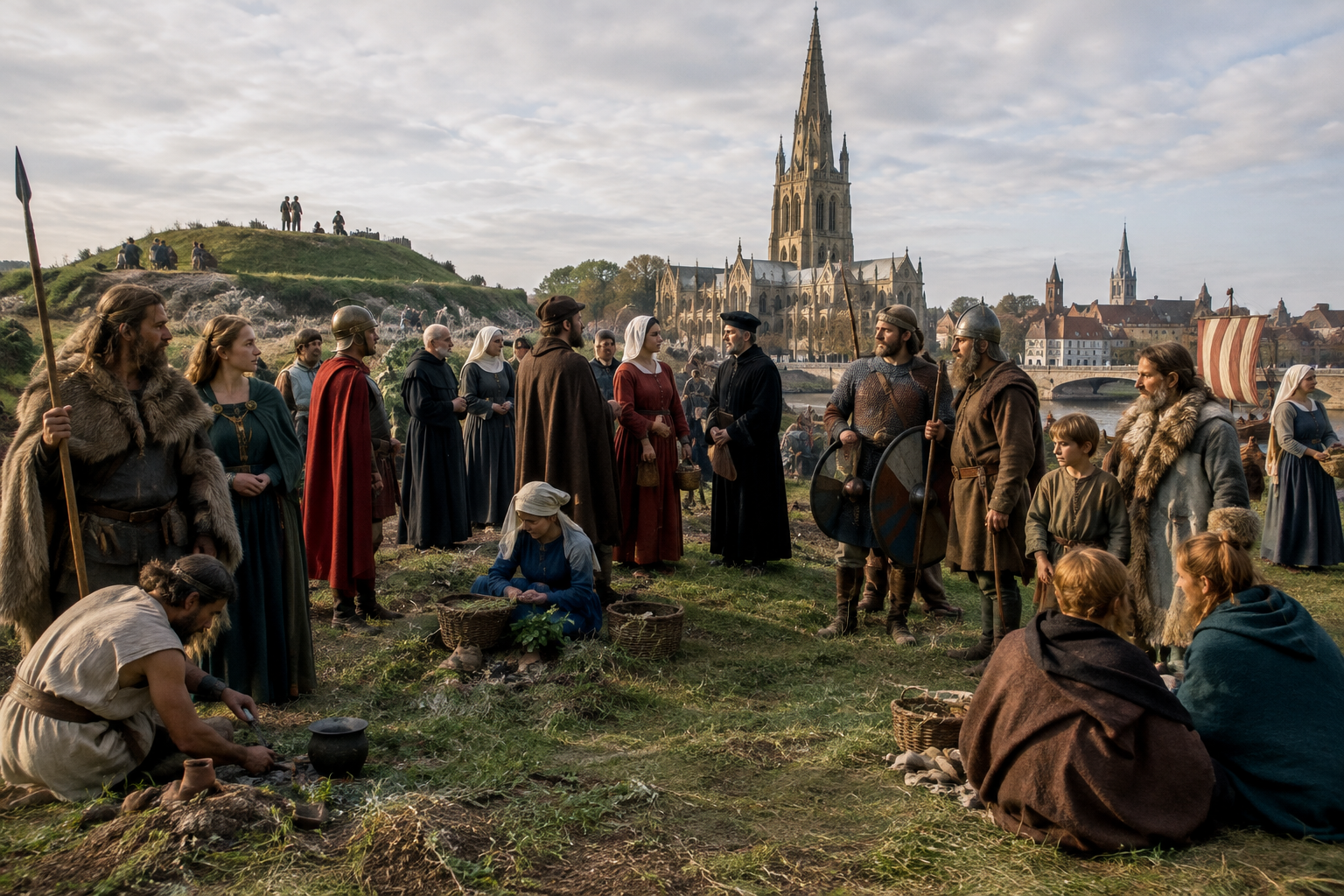
Some Y-chromosome lineages are easy to tell broad stories about. This one, R1b1a1b1a1a2c1a4b2c, is not. It sits deep within the great western Eurasian haplogroup R1b tree, in a place where the interesting work is less about grand slogans and more about careful reconstruction. And that, in truth, is where ancient DNA becomes most exciting: not in turning a haplogroup into a mythic tribe, but in watching a paternal line appear across centuries, landscapes, and burial grounds, leaving behind a scattered but revealing trail.
What makes this lineage especially intriguing is the pattern supplied by the ancient evidence here. We are not looking at one isolated grave or one fashionable royal claim. We are looking at a set of finds stretching from Bronze Age England to Iron Age Yorkshire, from Belgic-period southern Britain to medieval Ireland, Viking Age Scandinavia and Iceland, and on into late medieval and early modern Belgium. That does not mean every one of these men belonged to the exact same narrow branch in the way a modern family tree works. It does mean that this paternal line, or very near relatives within its part of the tree, seems to have had a long history around the North Sea world and the neighboring regions of Britain and northwest Europe.
R1b is one of the major Y-DNA lineages of western Europe, but that broad label can be misleading if used lazily. A very specific subclade such as R1b1a1b1a1a2c1a4b2c should not automatically be given the whole biography of all R1b men from prehistory to the present. The responsible way to read it is more modestly: this lineage belongs within a wider paternal family that became important in Europe over time, and its deeper history must be inferred from where closely related ancient branches appear, not assumed from the headline reputation of R1b itself.
Y-DNA, after all, traces only one line: father to son to son to son. It is powerful for reconstructing direct paternal ancestry, but it is never the whole of a person's ancestry. A medieval nobleman, an Iron Age chariot burial, and a modern tester may share part of a paternal tree while having very different overall genetic backgrounds, languages, and identities.
Still, the geography here is suggestive. The cluster of ancient samples points repeatedly toward Britain, Ireland, the North Sea, and the Low Countries. That raises a historically plausible picture of long-term paternal continuity mixed with movement across the seaways that connected eastern England, the Low Countries, Scandinavia, and the Atlantic fringe.
The earliest sample in this set is I7640 from Bronze Age Trumpington England, dated 1330 BC. One sample does not found a dynasty, nor does it prove uninterrupted descent into later periods. But it does place this paternal neighborhood in Britain well before the Roman conquest, well before the Anglo-Saxons, and well before the genealogists begin writing down surnames and pedigrees.
Then the evidence becomes much richer in Iron Age Yorkshire. A remarkable series of men from the Parisi world and the Arras Culture appear in and around Wetwang Slack, Melton, and Burton Fleming. Among them are I36850, I36846, I36964, I36825, I36783, I31007, I30993, I28922, I36894, I36898, I39730, and I28928, mostly dated around 225 BC to 269 BC.
This is where the story becomes wonderfully concrete. These are not abstract markers on a map but men buried in a distinct Iron Age archaeological setting in East Yorkshire, a region famous for its square barrows and, in some cases, chariot burials. The concentration suggests that related paternal lines were well established in that local society. It does not mean all Arras Culture men belonged to one clan, nor that this haplogroup was uniquely "Celtic." But it does show that this lineage had a place in Iron Age eastern Britain among communities often discussed in relation to continental connections and regional elite display.
Further south, I17264 from the Belgic Tribe Hillfort Danebury Hampshire England, dated 60 BC, adds another piece. Danebury belongs to a different landscape and archaeological tradition from Arras Yorkshire, yet the appearance of a related paternal line there hints that this branch or neighboring branches were not confined to one corner of Britain.
By the early medieval period, the same general paternal story has moved into a recognizably maritime world. KIL020 from Medieval Ireland Kilteasheen Roscommon Bishops Seat, dated 650 AD, shows the lineage in Ireland. VK349 from Early Viking Age Oland Sweden, dated 829 AD, places it in Scandinavia. And ORE-A1 from Gaelic Settler Viking Iceland, dated 935 AD, is especially evocative because it belongs to that mixed Norse-Gaelic frontier society that peopled Iceland.
Now, one must be disciplined here. These finds do not prove a single migration route from Yorkshire to Oland to Iceland. Ancient DNA is not a railway timetable. But taken together, they show that men carrying this paternal signature, or close relatives in the same branch complex, appear in the very networks that tied together Britain, Ireland, Scandinavia, and the North Atlantic.
This is precisely why such a haplogroup is historically interesting. It seems at home in the sort of world where identities were layered: local by burial custom, regional by politics, maritime by opportunity, and often mixed by family history.
The later samples make the story feel less prehistoric and more personal. In England, ATP_PSN_192 from Medieval England Cambridge St Johns Hospital, dated 1250 AD, and ATP_PSN_1268 from Late Medieval England Clopton Cambridgeshire, dated 1300 AD, show that the paternal line remained present in medieval eastern England.
Across the Channel, a small cluster appears at St. Rombouts in Belgium: STR105d from 1677 AD, and STR105b, STR105c, and STR105f, all dated 1800 AD. These are late individuals, of course, but they matter because they show the lineage still circulating in the Low Countries in the early modern era. That fits a wider historical reality: England and the Low Countries were never strangers. They traded, fought, intermarried, migrated, and borrowed habits from one another for centuries.
So if one asks what sort of historical setting best suits this haplogroup, the safest answer is not "this was the lineage of X people" but rather: it appears repeatedly in the connected worlds of Britain and northwest Europe, across periods when movement and continuity existed side by side.
This brings us to the noble family attached to the haplogroup in the supplied material: the House of Brereton. Here again, caution is essential. A historical association between a family and a haplogroup is not proof that every male Brereton carried this exact Y-DNA line, and it certainly does not allow us to leap from an Iron Age burial in Yorkshire to a Tudor gentleman in Cheshire as though the paperwork were complete. What it does offer is regional and historical texture.
Brereton Hall in Cheshire began as the grand Tudor house of the Brereton family in the late 1500s, most likely for Sir William Brereton, on the site of an older manor. Even in that bare summary, the usual English story of landed continuity and reinvention is visible: a family seat rising over an older holding, then altered by later generations as fashion and fortune changed.
During the Civil War, the Breretons backed the Royalist cause, placing the hall within a landscape of local tension and divided loyalties. Later the estate passed out of Brereton hands and the building was enlarged and altered in the 18th and 19th centuries. Its striking gatehouse became one of its best-known features, and in modern times the house survived by adaptation, taking on institutional and then hotel uses. That, as any historian of English houses will tell you, is not decline so much as afterlife.
Why does this matter in a haplogroup article? Because Y-DNA often tempts people to think only in terms of prehistoric migrations. But paternal history also lives in places: manor sites, county loyalties, gentry ambitions, rebuilt halls, and families whose identity became attached to a district over centuries. Brereton Hall preserves the memory of one such lineage in Cheshire, even if the building itself cannot prove a genetic claim.
Discover the House of Brereton
R1b1a1b1a1a2c1a4b2c is interesting precisely because it resists caricature. Its ancient appearances suggest a paternal line rooted somewhere within the wider western European R1b world, but the supplied evidence gives it a particularly strong historical presence around Britain, Ireland, Scandinavia, Iceland, and the Low Countries. Bronze Age England, Iron Age Yorkshire, Belgic southern Britain, medieval Ireland, Viking Age Oland, Gaelic Iceland, medieval Cambridge, and early modern Belgium together form a pattern of persistence across the seaways of northern Europe.
That is the real gift of ancient DNA. Written genealogy tends to begin late and favor the literate, the propertied, and the noble. Ancient DNA drops us into older, stranger company: a man in a Yorkshire barrow, a burial at Danebury, a patient or inmate at St Johns Hospital in Cambridge, a settler in Viking Iceland, a later burial at St. Rombouts. They are not all one family. But they help us see the long survival and movement of paternal branches that history books alone would never reconstruct.
If this haplogroup appears in your own results, the most sensible conclusion is also the most interesting one: your direct paternal line may belong to a branch with deep roots in the historical populations of northwest Europe. That is not proof of descent from any specific ancient individual or noble house. It is, however, an invitation to explore where your paternal story fits into the older human map uncovered by archaeology and genetics.
Upload your DNA to MyTrueAncestry to see whether your results show connections to ancient individuals like I7640, I17264, KIL020, VK349, or the men of Wetwang Slack, and to place your own family story beside the archaeological record. The matches will not certify a noble pedigree or direct descent from a named burial, but they can open a remarkable window onto the long history of your paternal line.






Comments