Haplogroup R1b1a1b1a1a2c1a4b

– 6 min read


Some Y-DNA haplogroups announce themselves with a flourish. Others make their case more quietly, by turning up again and again in graves spread across centuries, landscapes, and social worlds. Haplogroup R1b1a1b1a1a2c1a4b belongs to that second category. It sits deep within the wider R1b tree, one of the major paternal lineages in western Europe, but this very specific branch is interesting not because it lets us make grand claims, but because it helps us trace a narrow male-line thread through archaeology, ancient mobility, and later historical memory.
That is worth pausing over. A Y-DNA haplogroup follows only the direct paternal line: father to son to son, and so on. It does not describe a person's whole ancestry, culture, language, or identity. But when ancient DNA repeatedly places related paternal branches in Bronze Age Britain, Iron Age eastern Yorkshire, Roman-period southern England, medieval England, Belgium, Croatia, and beyond, it gives us something unusually vivid: not a myth of pure descent, but a map of how male lines persisted, moved, and mingled in real historical communities.
R1b1a1b1a1a2c1a4b is a downstream branch within the larger R1b family. Broadly speaking, many R1b lineages became prominent in western Europe during and after later prehistoric population changes connected with Bell Beaker and Bronze Age expansions. That much is well established at the level of the parent haplogroup. What we must not do is lazily pour that entire vast history into one tiny subclade as if every chapter automatically applies in full.
Still, the sample pattern here does suggest something meaningful. The concentration of relevant ancient individuals in Britain, especially from the Bronze Age through the Iron Age and into the Roman and medieval periods, points to a paternal line with notable depth in Atlantic and northwestern European settings. The appearance of related samples in Belgium, France, Portugal, Austria, Germany, and Croatia also reminds us that male lines do not respect tidy national borders. They move with marriage, trade, war, migration, and simple human relocation.
If you want the wider background to how paternal lineages and ancient genomes changed across Europe, MyTrueAncestry readers may also enjoy this overview of archaeogenetics more generally.
Explore Ancient DNA and Archaeogenetics
The earliest signposts in the supplied evidence come from Bronze Age Britain and nearby islands. Sample I4950, from Bell Beaker Wiltshire Upavon England, dated to 2300 BC, is especially suggestive because Bell Beaker-period Britain is one of the major turning points in the story of western European paternal lineages. Nearby in time are I2417 from Bronze Age Amesbury Down Wiltshire England, also 2300 BC, I3256 from Bronze Age Trumpington Meadows Cambridge England, dated 2100 BC, and I5377 from Early Bronze Age England Thames, dated 1800 BC. Add Rathlin2B from Ireland Copper Age, dated 1880 BC, and the picture broadens into the Irish Sea world.
None of these individuals proves that the exact modern subclade was already fixed in precisely the same form. But together they show that closely related paternal ancestry was present in Britain and Ireland very early, embedded in the societies that followed the great transformations of the late third and early second millennia BC.
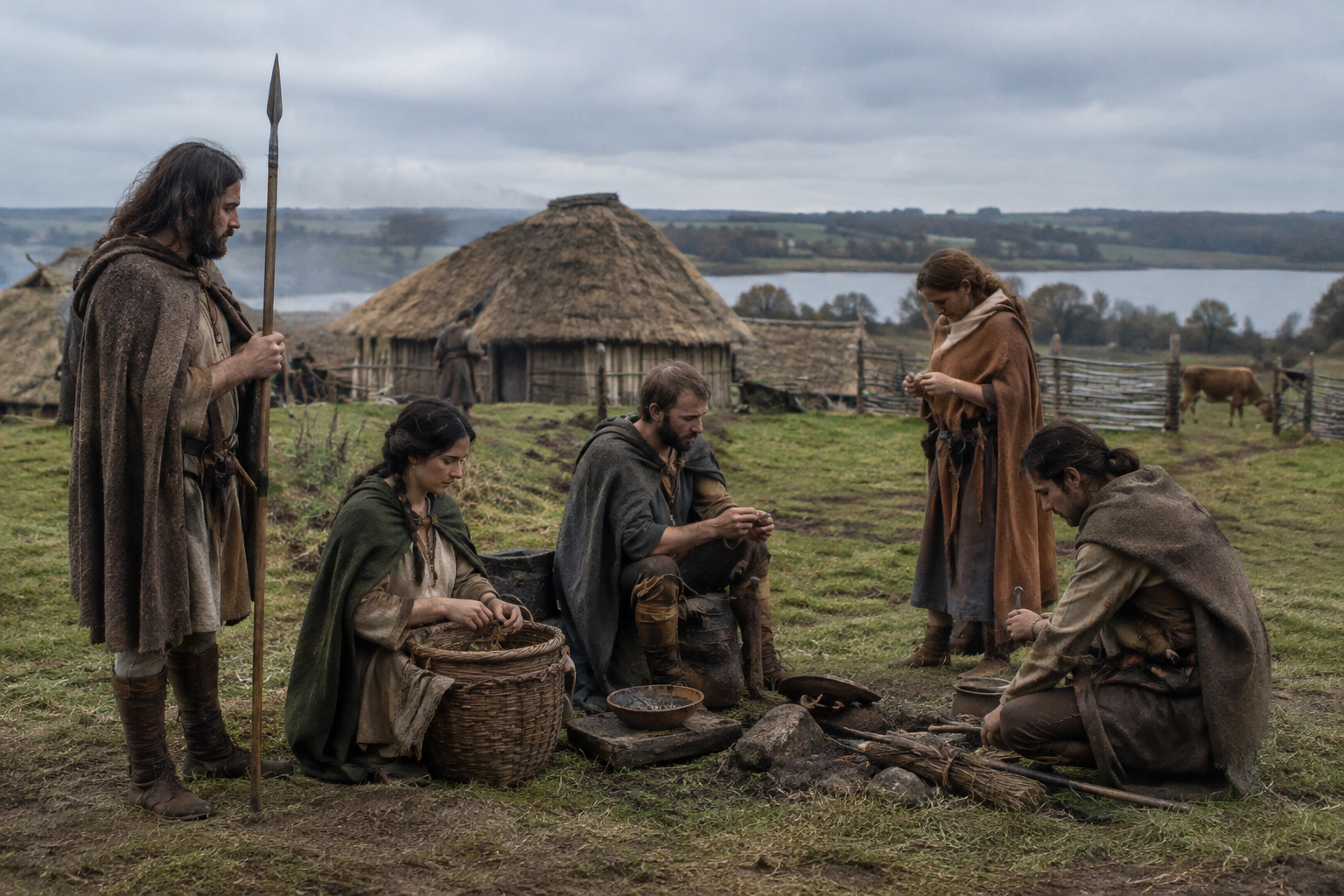
Then, by the Iron Age, the evidence becomes almost crowded. East Yorkshire in particular is striking. At Wetwang Slack, Pocklington, Melton, and Burton Fleming, we see an extraordinary cluster of men assigned within this paternal neighborhood: I36889, I36880, I36885, I36974, I37335, I37336, I37342, I37344, I36843, I36844, I36972, I21978, I14100, I14102, I14104, I21644, I5509, and the elite chariot burial I36995, mostly around 225 BC or nearby.
This does not mean all these men were close kin. But it does suggest that related paternal lines were well rooted in the Arras culture and Parisi-associated communities of Iron Age East Yorkshire. In other words, this is not a one-off curiosity dug from a lonely grave. It looks more like a durable regional male-line presence.
For readers interested in the bigger question of how genetics relates to Celtic-speaking worlds, this article is a natural companion.
Read About Celtic Origins and DNA
The story does not stop with Iron Age Britain. It continues into Roman and post-Roman settings, which is exactly what makes this branch so historically engaging. In southern England, the Durotriges samples from Duropolis, Winterborne Kingston, dated to 125 AD, are an impressive cluster: WBK12, WBK20, WBK29, WBK41, WBK05, WBK30, WBK43, WBK06, WBK08, WBK18, and WBK191. Here we are in Roman Britain, but dealing with a population explicitly tied to a local Iron Age people. That matters. Roman rule transformed administration, economy, and movement, but local paternal continuity could remain quite strong.
Other samples widen the frame. I26776 from Imperial Roman Era Zadar Croatia, dated 200 AD, R10488 from Late Roman Conimbriga Portugal, dated 330 AD, and R10656 from Late Roman Era Klosterneuburg Lower Austria, dated 407 AD, show that related paternal branches were also present across the Roman world. That need not imply a single migration event; rather, it reflects the sheer mobility of the empire, which could move soldiers, traders, laborers, and families from one frontier to another.
After Rome, the line still surfaces. I11580 from Post Roman Era Worth Matravers Dorset England, dated 600 AD, and IND013 from a Merovingian grave in Alt-Inden, North Rhine-Westphalia Germany, also dated 600 AD, hint at continuity and reshuffling in the centuries when Roman political structures had gone but populations certainly had not vanished.
To explore one side of that Roman legacy further, this piece on Iberia is especially relevant.
Explore Roman Hispania's Genetic Legacy
By the medieval period, the same broad paternal story is still visible. England provides ATP_PSN_192 from Cambridge St Johns Hospital, dated 1250 AD, and ATP_PSN_1268 from Clopton, Cambridgeshire, dated 1300 AD. Belgium adds ST2025 from Early Medieval Sint-Truiden Groenmarkt, dated 900 AD, ST1308 from medieval Sint-Truiden Onze-Lieve-Vrouwekerk, also 900 AD, and much later STR016b from St. Rombouts, dated 1821 AD. These are not the same men, not the same families, and certainly not a single documented pedigree. But they do show how a paternal branch can remain in circulation over a very long time in northwestern Europe.
That is one of the chief lessons of Y-DNA. Written genealogies usually begin late, often among elites. Ancient DNA does something different: it reveals that the male lines later found in noble houses, villages, towns, and churchyards may have much older local histories than any surviving archive can show.
This is where the medieval and early modern historical world enters the picture. The supplied noble connection is Clan Madden, associated with Cloghan Castle in County Offaly. Here we must be careful and clear. The presence of this clan alongside the haplogroup in the input gives us a historical association worth discussing, but it does not by itself prove that every Madden male carried haplogroup R1b1a1b1a1a2c1a4b, nor that any specific ancient sample was an ancestor of the clan.
What it does offer is regional and cultural context. Cloghan Castle is a 16th century Irish tower house standing near the old frontier between the Gaelic and English worlds. That location matters enormously. County Offaly was not a quiet backwater. It was part of the contested Midlands, where lordship, alliance, feud, and Tudor pressure shaped everyday politics. A tower house like Cloghan was not a giant royal fortress. It was a fortified residence: home, lookout, and declaration of status in a crowded and uneasy landscape.
There is something very apt about linking a deep paternal lineage to a place like this. Not because the stones can prove the genetics, of course, but because castles preserve the historical memory of families rooted in particular regions. Cloghan later declined as military practice and political power changed, yet it survived and has been restored for modern use. In that sense, it mirrors the haplogroup story rather well: not a dramatic uninterrupted saga of kings, but persistence through change.
Readers interested in the wider historical background of this Irish clan should continue with the dedicated community article below.
R1b1a1b1a1a2c1a4b is a fine example of how narrow paternal branches can illuminate large historical questions. The evidence supplied here points to a lineage strongly represented in Britain from the Bronze Age onward, heavily visible in Iron Age East Yorkshire, still present in Roman Britain, and then traceable across medieval northwestern Europe. Along the way, related samples also appear in France, Portugal, Austria, Germany, Croatia, Belgium, Scotland, and Ireland. That is not a tidy ethnic label. It is a record of continuity mixed with movement.
And that, in the end, is the real excitement of ancient DNA. It does not flatten the past into a slogan. It makes it messier, older, and more human. A tower house in Offaly, a chariot burial in East Yorkshire, a hospital grave in Cambridge, a Roman-era burial in Zadar: these are not chapters from one family tree we can simply draw with a pen. But they are chapters from a much larger history of paternal descent in Europe.
If your own Y-DNA belongs somewhere near this branch, MyTrueAncestry can help you explore whether your paternal line shows connections to ancient individuals and historical populations like those discussed here. Such matches do not by themselves prove direct descent from any one ancient person or noble clan, but they can offer a remarkable new perspective on where your deeper ancestry fits into the human past.






Comments