Haplogroup R1b1a1b1a1a2c1a4a1

– 5 min read


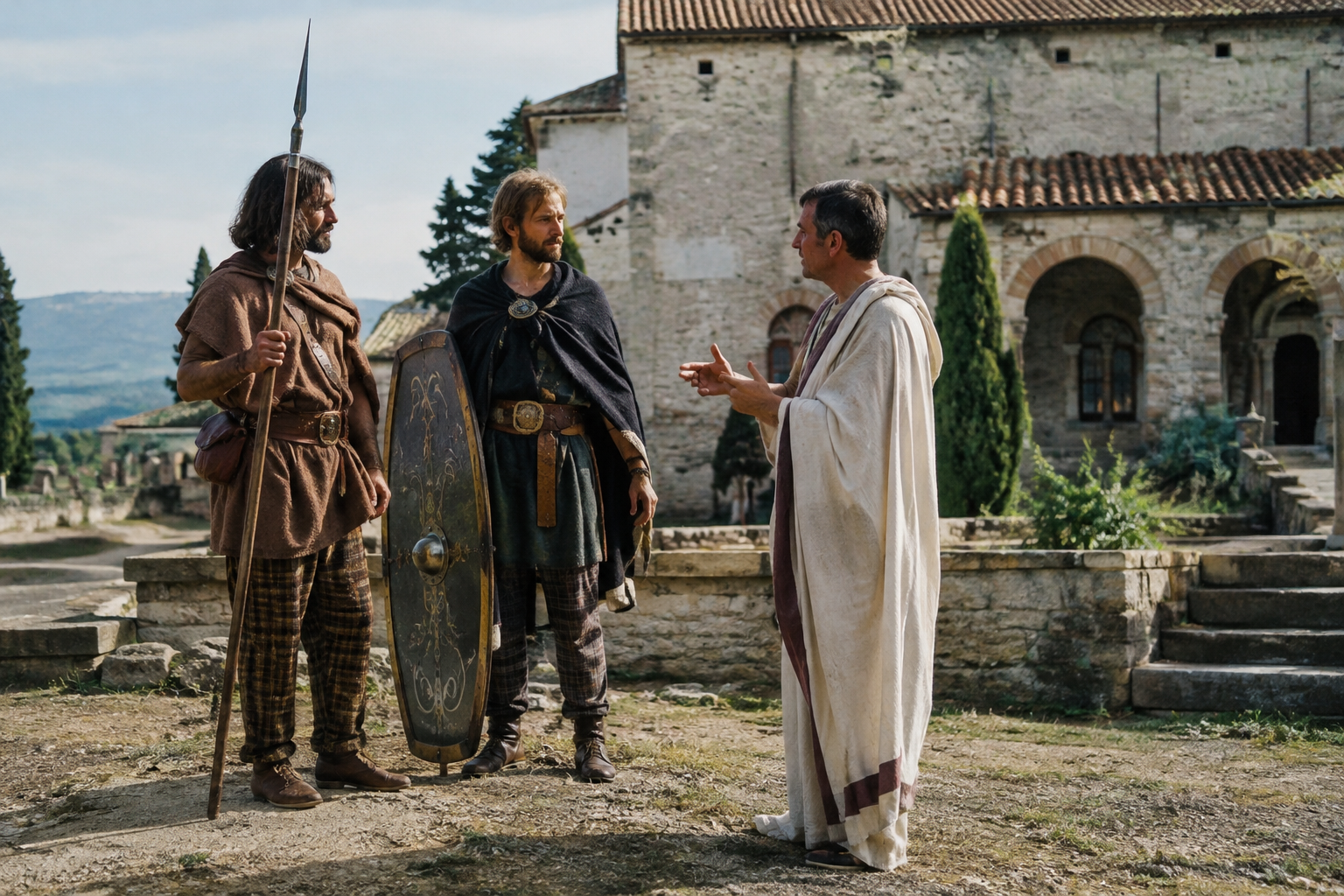
Some Y-chromosome branches come with a grand public reputation. Others sit quietly in the background until an ancient burial, a tribal name in a classical source, or a medieval dynasty suddenly makes them interesting. Haplogroup R1b1a1b1a1a2c1a4a1 belongs to that second category: a very specific paternal branch whose importance lies not in sweeping claims, but in how it helps anchor men, families, and movements in particular places and moments.
That matters because Y-DNA is a narrow but powerful tool. It follows one direct paternal line only: father to son to son across the centuries. It does not describe a person's whole ancestry, culture, or identity. But when that line turns up in ancient graves and in regions later famous for kings, clans, and castles, it offers a rather sharp historical lens. In this case, the story runs from Iron Age northern Italy to medieval Leinster, and from tribal archaeology to the world reshaped by Diarmaid mac Murchadha.
The haplogroup R1b1a1b1a1a2c1a4a1 is a downstream branch within the wider R1b tree, one of the best-known paternal lineages in western Europe. That broad parent lineage has often been discussed in relation to later prehistoric and historic western European populations, but caution is essential here: the history of a very specific subclade is not identical to the history of all R1b men.
For a branch this precise, ancient DNA is especially valuable. Rather than assuming its distribution from modern surnames or present-day testing alone, archaeogenetics lets us see where related paternal lines actually appeared in the past. That can reveal local continuity, movement between neighboring regions, or the arrival of new male lineages in periods of social change.
In western and central Europe, such changes are often discussed in connection with Bronze Age mobility, Iron Age tribal worlds, and later Roman and medieval restructuring. But the sensible position is this: the deeper ancestry of this branch belongs within that broad west Eurasian and European paternal history, while its exact route into particular historical populations remains something to be reconstructed from evidence, not guessed from fame or folklore.
Explore Celtic language origins through DNA
The clearest ancient anchor supplied here is an individual from Iron Age Italy: Ancient Individual:Gallic Cenomani Tribe Italy Verona Seminario Vescovile Year:300 BC ID:3210n. Even at first glance, this is a revealing combination of labels. We are in Verona, in northern Italy, around 300 BC, and in the cultural setting of the Gallic Cenomani, a Celtic-speaking people established south of the Alps.
This matters because northern Italy in the Iron Age was not a neat ethnic map with tidy borders. It was a zone of contact: local Italic traditions, Etruscan influence, Alpine movement, and the arrival or consolidation of Celtic groups all overlapped. A burial from Verona tied to the Cenomani offers a snapshot of that world before Roman political domination remade the region.
Sample 3210n therefore gives this haplogroup a historically vivid setting. It places a paternal line associated with R1b variation in a community that classical writers would have recognized as Gallic, but which archaeology shows was also thoroughly embedded in the landscapes of northern Italy. That is exactly the sort of evidence that keeps us honest. Instead of making vague claims about "Celtic DNA," we can point to a real man, at a real site, in a real Iron Age community.
What does that prove? Not that every Cenomani male carried this branch, and not that later families in Ireland or Britain descend from 3210n. What it does show is that a related paternal lineage was present in the Iron Age Celtic world of northern Italy, a region deeply involved in the wider continental networks from which later western European histories emerged.
Read more on ancient DNA in Italy
Leap forward more than a millennium and the landscape has changed completely. Tribal cemeteries have given way to kingdoms, churches, lordships, and written chronicles. Yet Y-DNA reminds us that beneath those changes, paternal lines continued to pass from generation to generation, sometimes surviving political collapse better than dynasties did.
This is where the story of Clann Mac Murchadha becomes so compelling. Diarmaid mac Murchadha was king of Leinster in the 12th century, and his career altered the fate of Ireland. Driven from power in 1166 by rivals under Ruaidri Ua Conchobair, he sought support from Henry II of England and recruited Norman and Welsh lords, including Richard de Clare, better known as Strongbow. Their landing in 1169 began the Anglo-Norman invasion of Ireland, one of the great hinge moments in medieval history.
Diarmaid regained Leinster and married his daughter Aoife to Strongbow, but died in 1171. The political consequences outlived him by centuries. Here genetics must be handled with care. The appearance of Clann Mac Murchadha in association with this haplogroup does not by itself prove that every historical Mac Murchadha male belonged to R1b1a1b1a1a2c1a4a1, nor does it establish a documented paternal line from Iron Age Verona to medieval Leinster. What it does provide is a rich regional and historical frame in which to think about paternal continuity, elite lineages, and the way male descent lines can matter in both genetics and politics.
The supplied material does not name a specific castle, and that itself is worth noting. Too often, later stone castles are carelessly projected backward onto earlier Gaelic kingship. Diarmaid mac Murchadha was not a castle in the landscape but a ruler in a contested kingdom, operating in a world where power lay in territorial control, alliances, dynastic legitimacy, and military backing. The Norman arrival changed that world materially as well as politically, bringing with it new forms of lordship and fortification.
So if we are looking for "ancestral strongholds" here, we should think first of Leinster as a political geography rather than a single romantic ruin. Medieval lordship was rooted in places, yes, but also in networks of kinship, tribute, marriage, and armed support. Castles later became one of the most visible symbols of that transformed order. In the Mac Murchadha story, the stronghold is as much the kingdom itself as any one building.
That is one reason ancient DNA and medieval history work so well together. Archaeology gives us burials such as 3210n from Verona. Written history gives us Diarmaid and the crisis of 1166 to 1171. Genetics does not collapse these into a single family tree. Instead, it helps us ask a better question: how do paternal lineages persist, divide, move, and survive while cultures, languages, and political systems change around them?
Explore Norman-era DNA in Britain
The real lesson of R1b1a1b1a1a2c1a4a1 is not a simplistic one about ethnicity or noble blood. It is that very specific paternal branches can connect us to historical problems that are far more interesting: the making of Iron Age tribal landscapes, the local realities behind broad labels like "Celtic," and the ways medieval ruling families emerged in regions already layered with deep ancestry.
The Verona sample 3210n shows a paternal line in the Gallic Cenomani world of northern Italy around 300 BC. The Mac Murchadha material places us in the dynastic politics of 12th-century Ireland, where paternal descent mattered intensely in claims to rule. Between those points lies a long, uneven history of migration, settlement, continuity, alliance, and replacement. Y-DNA does not tell the whole story, but it does tell a story that surnames and chronicles alone cannot.
If you enjoy seeing how archaeology, ancient genomes, and medieval power intersect, you may also like reading about broader western European population change and continuity.
Explore Iron Age continuity in Europe
MyTrueAncestry lets you explore whether your DNA shows similarities to ancient individuals, archaeological cultures, and historical populations like those discussed here. Those matches do not prove direct descent from a specific king, clan, or Iron Age burial, but they can offer a fascinating new angle on your deeper ancestry and the paternal lines that helped shape the past.






Comments