Haplogroup R1b1a1b1a1a2c1a4a

– 6 min read


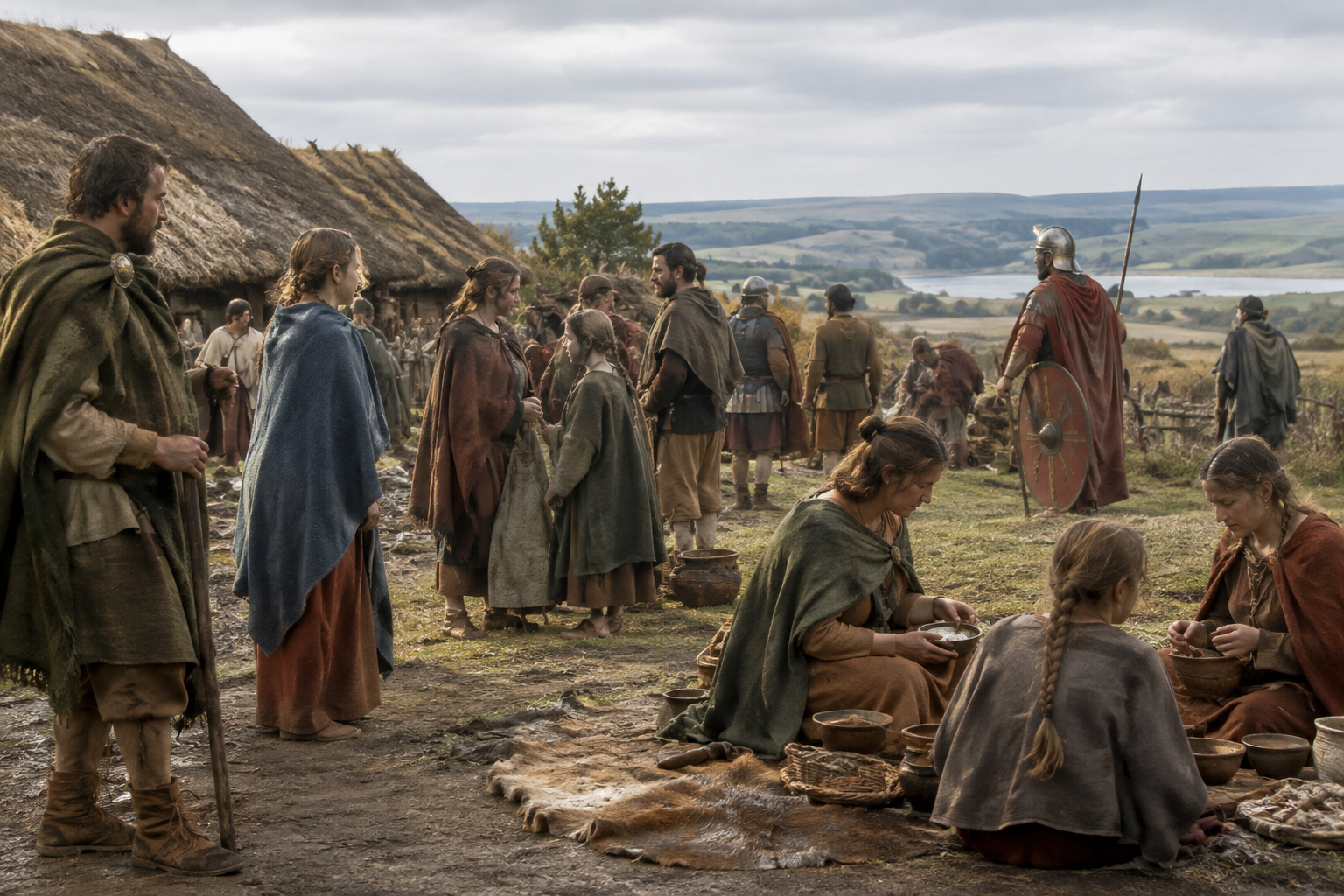
Some Y-chromosome lineages announce themselves with fanfares of empire. Others appear more quietly, in graves, barrows, hillforts, and later in the shadow of castles. Haplogroup R1b1a1b1a1a2c1a4a belongs to that second category. It is a very specific paternal branch, deep within the wider R1b tree, and what makes it interesting is not that it can be used as a shortcut to identity - it cannot - but that ancient DNA places related paternal lines again and again in the landscapes of Britain, Ireland, Gaul, and parts of the Roman world.
That matters because Y-DNA follows one narrow thread: the direct paternal line from father to son. It does not describe a person's whole ancestry, culture, language, or social status. But when a narrow branch turns up across archaeological sites and historical regions, it can help us watch the movement and persistence of male lineages over very long stretches of time. In this case, the evidence points toward a story strongly tied to later prehistoric and historic western Europe, especially Britain and neighboring regions.
This subclade sits inside the great R1b family, one of the major Y-chromosome groupings of western Europe. That broad family is often associated, at a very general level, with later prehistoric movements that reshaped Europe in the Copper Age and Bronze Age. But one must be careful here: the full story of R1b is much bigger than the history of this specific downstream branch. We should not simply pour the whole Bronze Age history of western Eurasia into one tiny terminal subclade and call the job done.
What the sample list does suggest, however, is that paternal lines related to this branch were well established in Britain by the Bronze Age and remained present through the Iron Age, Roman period, and into the early medieval centuries. That is not a trivial pattern. It hints at continuity as much as movement - lineages surviving changing languages, political systems, and ruling elites.
Explore Celtic origins in ancient DNA
The earliest anchors in the supplied evidence are striking. There is I4950, a Bell Beaker individual from Wiltshire Upavon, England, dated to 2300 BC. There is also I2417 from Bronze Age Amesbury Down, Wiltshire, also dated to 2300 BC, and I3256 from Bronze Age Trumpington Meadows, Cambridge, dated to 2100 BC. Add I5377 from Early Bronze Age England Thames, dated to 1800 BC, and dfb002 from Cranborne Chase Down Farm Pond Barrow, Dorset, dated to 1900 BC, and a pattern begins to emerge: related paternal ancestry was already present in southern and eastern Britain very early in the Bronze Age.
Nor is this only an English story. KD061 from Bronze Age Orkney, Westray Links of Noltland, dated to 1498 BC, and I5473 from Bronze Age Boatbridge Quarry, South Lanarkshire, Scotland, dated to 2250 BC, show similar paternal presence far to the north. Rathlin2B, from Copper Age Ireland dated to 1880 BC, is especially evocative. It places related paternal ancestry across the Irish Sea world in the early metal ages, long before later kingdoms, surnames, or castles entered the picture.
If the Bronze Age samples suggest arrival and establishment, the Iron Age evidence suggests staying power. And here the data become almost wonderfully repetitive - which, for a genetic historian, is exactly the point. At Wetwang Slack in East Yorkshire, among the Arras culture burials associated with the Celtic Parisi, this paternal line or closely related lineages appears over and over.
Samples including I36889, I36880, I36885, I36974, I37335, I37336, I37342, I37344, I36867, I36869, I36870, I36843, I36844, and the primary barrow burial I36972, all dated around 225 BC, point not to an isolated curiosity but to a substantial local paternal signature. The same picture is reinforced by East Yorkshire and Pocklington samples such as I21978, I14100, I14102, I14104, I21644, I5509, I13753, and I13760.
One burial stands out to the imagination: I36995, the elite Celtic Parisi chariot burial from Wetwang Slack, dated to 225 BC. Chariot burials have long caught public attention because they look aristocratic, theatrical, and faintly Homeric. But the real value here is not romance. It is that the same broad paternal signature appears in elite and non-elite contexts alike, suggesting a lineage embedded in community life rather than belonging only to a tiny warrior caste.
Read more on Iron Age Britain and kinship
This western British pattern extends beyond Yorkshire. There is I11991 from Iron Age Worlebury, Somerset, dated to 150 BC, I21309 from the Iron Age hillfort at Battlesbury Bowl, dated to 57 BC, and HI2 from Iron Age Hinxton, dated to 45 BC. Then in Roman-period Dorset we meet the Durotriges: WBK12, WBK20, WBK29, WBK41, WBK05, WBK30, WBK43, WBK06, WBK08, WBK18, and WBK191, all from Duropolis, Winterborne Kingston, dated to 125 AD. However Rome ruled Britain, local paternal lines evidently did not vanish on cue.
The British evidence is the densest, but not the whole tale. Related lineages also appear in continental settings: 3210n, a Gallic Cenomani individual from Verona Seminario Vescovile in Italy, dated to 300 BC; CGG023699 from Gallic France Parancot, dated to 497 BC; R10488 from Late Roman Conimbriga, Portugal, dated to 330 AD; I26776 from Imperial Roman Era Zadar, Croatia, dated to 200 AD; and R10656 from Late Roman Klosterneuburg, Lower Austria, dated to 407 AD.
What does that prove? Not a single tribe marching neatly across Europe with a banner labeled R1b1a1b1a1a2c1a4a. Ancient DNA is rarely that obliging. But it does suggest that paternal branches in this neighborhood circulated through Celtic-speaking regions and remained visible within the connected world of Rome. Roman roads, military service, trade, slavery, intermarriage, and urban growth all created opportunities for lineages to move far from where they had first become common.
Even later, the trail continues with I11580 from post-Roman Worth Matravers, Dorset, dated to 600 AD, IND013 from a Merovingian grave in Alt-Inden, North Rhine-Westphalia, dated to 600 AD, and ST2025 and ST1308 from early medieval Sint-Truiden in Belgium, dated to 900 AD. By then the Roman Empire had gone in the west, but the men had not all gone with it.
Explore Roman and early medieval Britain
This is where people are tempted to leap too quickly from prehistory to pedigree. Best not. A shared haplogroup does not prove that a medieval noble house descends directly from a named Iron Age burial, let alone from one particular barrow in Yorkshire. What it can do is place later families in regions where related paternal ancestry had deep roots.
Take the House of Bohun and Caldicot Castle in Monmouthshire. Caldicot began as a Norman stronghold in the 11th century and developed into a major marcher castle, heavily walled and politically charged, guarding the route between England and Wales. It belongs to a later world of frontier lordship, conquest, and feudal control. Yet it stands in a western British landscape where ancient paternal continuity is not at all implausible.
Or consider the Irish side of the story. Clan Chaomanach is linked here with Dun Ailinne in County Kildare, one of ancient Ireland's great ceremonial centers, associated in tradition with the kings of Leinster. House of Kinsella is tied to Ferns Castle in County Wexford, built in the early 13th century during the Norman takeover on a site already linked to earlier royal and ecclesiastical power. That overlap of prehistoric royal landscapes, early medieval memory, and later castle-building is exactly the sort of thing that makes genetic history so intriguing: different kinds of evidence speaking about the same ground across many centuries.
Farther north, Clan Lumsden at Pitcaple Castle and Clan Spence at Kilspindie Castle, both in Aberdeenshire, belong to a Scottish world of tower houses, lairdly ambition, and landholding kin groups. Neither site proves anything genetic by itself, of course. But when one recalls Bronze Age and later samples from Scotland such as I5473 and KD061, it becomes easier to see how deep paternal patterns may underlie much later regional histories.
The continental aristocratic world is represented too by the House Gaston and the Chateau de Foix in the Ariege. The castle rose as a stronghold by the early Middle Ages, became the seat of the counts of Foix, and later figured in the politics of the Albigensian Crusade. In southern France, as in Britain, medieval lordship sat on landscapes already old with Iron Age and Roman histories.
Discover the Noble House of Bohun
The most sensible conclusion is also the most interesting one. Haplogroup R1b1a1b1a1a2c1a4a appears to belong to a paternal story deeply at home in western Europe, especially Britain and the Irish Sea world, but also present in Gaul and the Roman-connected continent. The samples suggest long-term persistence from the Bronze Age into the Iron Age, visible continuity in Roman Britain, and survival into the early medieval centuries.
That does not make every modern carrier a Celt, a Briton, a Gaul, a Parisi chariot warrior, or a descendant of any named noble house. Y-DNA is narrower than that, and history more untidy. But it does offer something rather splendid all the same: a way of linking a modern paternal line to real archaeological populations - men buried in barrows, hillfort cemeteries, Roman towns, and post-Roman communities - whose worlds later gave rise to castles such as Caldicot, Ferns, Pitcaple, Kilspindie, and Foix.
For readers interested in how regional genetics continued into the far west of Europe, the broader Portuguese evidence is also worth exploring.
Explore the genetic history of Portugal
If you carry this haplogroup, or a nearby branch, MyTrueAncestry can help place your paternal line in a much larger human story - one built from ancient burials, archaeology, and population history rather than family legend alone. Upload your DNA and explore whether your results show similarities to ancient individuals such as Rathlin2B, I36995, or the Dorset Durotriges. These matches do not prove direct descent or noble status, but they can offer a remarkable new angle on where your deep ancestry may have stood in the ancient world.






Comments