Haplogroup R1b1a1b1a1a2c1a2b3a1a
– 4 min read


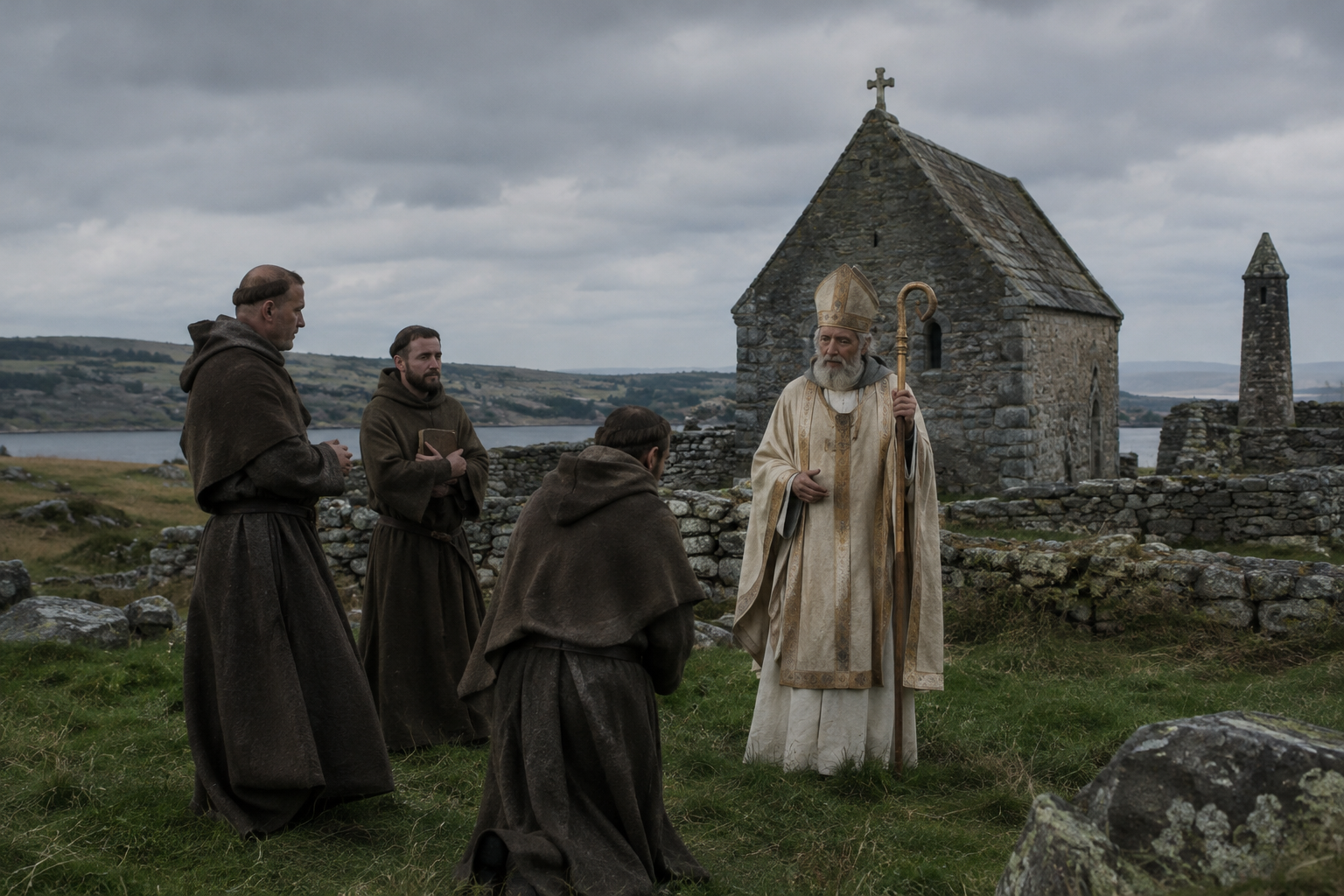
At Kilteasheen in County Roscommon, archaeologists uncovered an early medieval cemetery beside an important ecclesiastical settlement, and among the individuals studied there was KIL026, dated to around AD 650. That one burial matters because it places the very specific Y-DNA line R1b1a1b1a1a2c1a2b3a1a in a real historical landscape: not in legend, not in later genealogy, but in a seventh-century Irish burial ground linked to the spread of Christianity and the reshaping of society after the Roman world had long vanished from Britain and Ireland.
The haplogroup itself is a narrow twig on the vast R1b tree. That distinction is important. Y-DNA follows one direct paternal line only, so it cannot stand in for a person's whole ancestry, language, or identity. But when a branch like R1b1a1b1a1a2c1a2b3a1a appears in an excavated medieval Irish context, it gives us something far better than generalities: a documented paternal line anchored to a place, a date, and an archaeological community.
Kilteasheen was not just a random burial plot in the countryside. It formed part of an early medieval church landscape in Connacht, a world of monasteries, local kings, clerics, craft specialists, and farming communities. By the seventh century, such sites had become nodal points of power and memory. People were buried there not because the cemetery was anonymous, but because it belonged to a living sacred and social geography.
In that setting, KIL026 is especially useful because he is tied to a named site and a clear historical horizon. Early medieval Ireland was politically fragmented but culturally interconnected, and burial at an ecclesiastical center suggests participation in that transformed Christian order. The paternal line recorded for this individual does not tell us his status or family story on its own, but it does place this branch of R1b within a community that was already thoroughly enmeshed in the new institutions of the age.
An ancient DNA study examining the Kilteasheen material is linked through research on early medieval Irish burials, which helped bring together archaeology, burial context, and genetics in a way that older antiquarian accounts never could.
There is always a temptation to leap from a long haplogroup label to a sweeping migration saga. Best resisted. The broader parent haplogroup R1b has a deep and complicated history across western Eurasia, and many of its branches became common in Atlantic Europe. But the article's lineage, R1b1a1b1a1a2c1a2b3a1a, is far narrower than that wider family. Without a larger set of securely published ancient matches, one should not assign this exact branch a grand prehistoric route as though the matter were settled.
What we can say is more grounded, and in some ways more interesting. By about AD 650, this paternal line was present in western Ireland in an established burial community. That means the branch belongs inside the real demographic fabric of early medieval Ireland, whether its deeper roots in the island were older or whether some of its immediate paternal history involved movement between neighboring regions within Ireland or across the Irish Sea.
This is where archaeology helps keep genetics honest. A Y-chromosome label is a line of descent, not a tribe. It does not by itself make KIL026 a dynast, a saintly retainer, or a member of any later surname group. But it does let modern testers place one paternal line within the social world of Christianizing Ireland rather than in an abstract cloud of map pins and percentages.
It is easy to imagine seventh-century Ireland as remote. In fact it was busy with connections: monasteries exchanged ideas and manuscripts, elites forged alliances, craftsmen circulated, and people moved between Ireland and Britain with regularity. Genetic evidence from early medieval Europe increasingly shows that even communities that look local in archaeology could still be part of wider networks of marriage, fosterage, migration, and religious change.
That broader perspective matters for interpreting KIL026. A paternal lineage found in Roscommon is not necessarily evidence of an isolated local founder. It may represent one strand in a population already shaped by centuries of interaction around the Irish Sea. For that reason, readers interested in how population history and language spread can profitably compare this Irish case with wider work on northwest Europe and the movement of peoples in the first millennium AD.
Germanic Languages and Genomics
That does not mean early medieval Ireland was simply a recipient of outside influence. Quite the reverse. Irish church institutions, learning, and dynastic politics had their own momentum. The value of a sample like KIL026 is that it helps anchor one paternal branch inside that unmistakably Irish setting, rather than treating all R1b lines as if they must be explained by events on the continent.
With only one ancient individual explicitly tied here to R1b1a1b1a1a2c1a2b3a1a, the strength of the article is not quantity but precision. We know the site, we have the sample ID, and we can place the burial in a period when cemeteries were increasingly bound up with churches and emerging local power structures. That is enough to say something meaningful, even if it is not enough to write an entire dynastic history.
Single finds often do real work in archaeogenetics. They mark a branch in time and space. Later discoveries may show whether this lineage appears repeatedly in Irish ecclesiastical cemeteries, in secular burial grounds, or in neighboring regions such as Ulster, Leinster, or western Britain. Until then, KIL026 remains a useful fixed point.
For comparison with other first-millennium communities in the islands, there is also relevant discussion in MyTrueAncestry's coverage of genomic history in Roman and early medieval Britain, where ancient DNA helps sort local continuity from new arrivals without forcing every burial into a simple migration tale.
For someone researching this haplogroup today, the most solid historical insight is not a glamorous royal claim but a firmly located early medieval presence. R1b1a1b1a1a2c1a2b3a1a is represented by KIL026 at Kilteasheen in Roscommon around AD 650, in the orbit of an Irish ecclesiastical community. That places this paternal line within the lived world of early Christian Ireland: local, connected, and historically legible.
And perhaps that is the proper thrill of ancient DNA. Not that it turns every lineage into a saga, but that it allows one small paternal branch to step out of abstraction and stand, however briefly, in a real cemetery among the people of medieval Ireland.






Comments