Haplogroup R1b1a1b1a1a2c1a2b2b1

– 6 min read


Some Y-chromosome lineages are famous because they are broad and common. Others are interesting precisely because they are so specific. Haplogroup R1b1a1b1a1a2c1a2b2b1 belongs to that second category: a very narrow paternal branch nested inside the much larger R1b family, a lineage that has played a major role in the paternal history of western Europe. The attraction here is not that this exact subclade can be made to explain everything from prehistory to modern surnames. Quite the opposite. Its value lies in showing how ancient DNA lets us move from sweeping generalities toward finer-grained histories of real men, real burials, and real regions.
It is worth stating clearly at the start what a Y-DNA haplogroup can and cannot do. Y-DNA tracks one direct paternal line only: father to son to son across generations. It does not represent a person's whole ancestry, still less their identity, language, or social rank. But it is extraordinarily useful for following long-term male-line patterns through archaeology and history. In the case of a subclade such as R1b1a1b1a1a2c1a2b2b1, the broader setting is the great western Eurasian R1b tree, while the narrower challenge is to understand where this particular twig appears in the evidence and what sort of historical landscape it belongs to.
At the broadest level, R1b is one of the major Y-chromosome lineages of western Europe today, and ancient DNA has shown that different branches of R1b became prominent at different times and in different places. Some of that story involves major prehistoric population shifts, including movements associated with the later Neolithic and Bronze Age. But we should be careful. The full history of R1b is not automatically the history of R1b1a1b1a1a2c1a2b2b1. A very specific downstream branch may have formed much later, spread more regionally, or remained confined to particular male lines.
That caution matters especially in Britain and Ireland, where R1b is deeply woven into discussions of Bell Beaker ancestry, Bronze Age change, Celtic-speaking regions, and later medieval dynasties. Some of those themes may provide background context, but they are not proof that this exact subclade belonged to any one ancient culture or medieval people. What ancient DNA does give us is a framework: highly specific paternal lines can survive through dramatic changes in language, lordship, religion, and political allegiance.
For readers interested in the larger prehistoric setting behind western European paternal lineages, one useful companion piece is this discussion of Bell Beaker-era change in the Lower Rhine-Meuse region, a key area for understanding the wider rise of R1b in later prehistoric Europe.
Explore Bell Beaker R1b Context
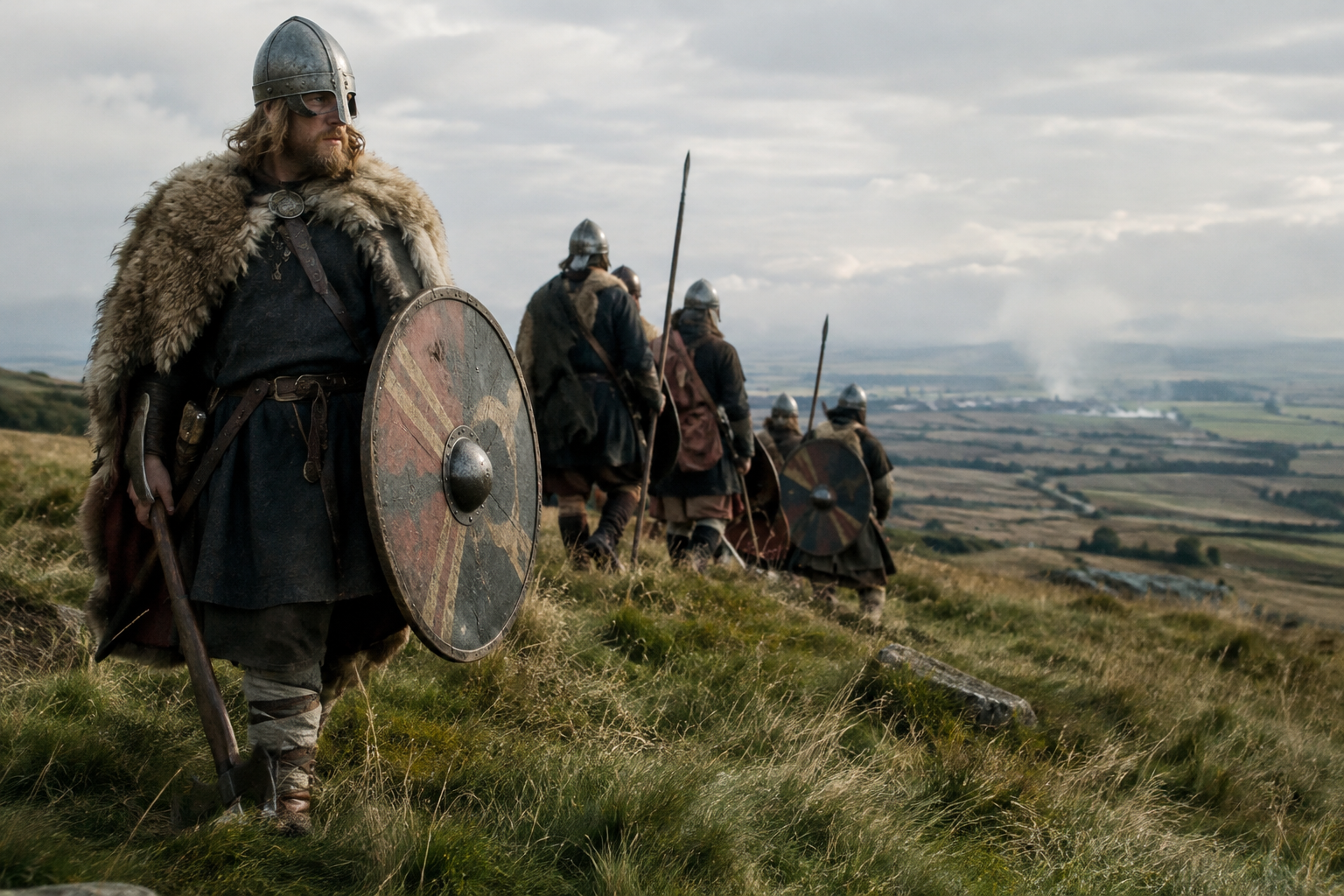
The most vivid anchor supplied for this haplogroup is an ancient individual from England: VK263, described as Viking Invader Ridgeway Hill England, dated 998 AD. That is already enough to make one stop. Ridgeway Hill is not the sort of place that invites comfortable stories about neat ethnic boxes. A "Viking invader" in late 10th-century England belongs to a world of seaborne raiding, military coalitions, shifting loyalties, and violent encounters around the North Sea.
When a paternal lineage associated with this haplogroup turns up in that setting, the finding is interesting not because it proves a simple label such as "Viking DNA," but because it places a branch of the R1b family inside a documented historical moment of mobility and conflict. By 998 AD, England was connected to Scandinavia, Ireland, the Irish Sea zone, Normandy, and the wider Atlantic seaways. Men moved as raiders, mercenaries, settlers, captives, and traders. A Y-chromosome line found in such a burial may reflect local ancestry, overseas ancestry, or a much older paternal line already shared across several North Atlantic populations.
That is one of the recurring lessons of archaeogenetics: the same broad paternal family can appear in very different cultural settings. A burial classed as Viking-age does not tell us that every paternal line in it was Scandinavian in deep origin, only that the individual was part of that historical world. The importance of VK263 is that he provides a concrete archaeological point from which to think about how a narrow R1b branch could be present in late first-millennium England.
If you want a wider look at that North Sea setting, this article on Viking-age population history is a natural next step.
The supplied family material points us toward a later medieval and early modern landscape in which paternal lineages, surnames, lordship, and regional identity became entangled in complicated ways. That landscape includes Clan McQueen and Clan Dillon. The McQueen entry, as given, does not provide a usable location or historical seat, so it is best treated cautiously here: it reminds us that surname and clan associations often survive in family memory even when precise territorial detail is missing or disputed.
The Dillon material is more concrete and more evocative. Portlick Castle stands on the shore of Lough Ree in County Westmeath. It began as a fifteenth century tower house, probably built by the Gaelic Dillon family, before later passing into the hands of the Nugents, who remained closely connected with the place for centuries. In the seventeenth century it was drawn into the violence of the Confederate and Cromwellian wars. Later still, as the military need for tower houses declined, it became part of a broader estate landscape in which status, memory, and landholding mattered as much as defense.
That history is a useful reminder of how Y-DNA should be handled in genealogical storytelling. A haplogroup association with a noble family does not prove that every bearer of the surname shared the same paternal line, nor that every branch of the family remained biologically continuous through time. Medieval and early modern families expanded through cadet lines, fosterage, marriage alliances, adoptions of name, and the ordinary messiness of human history. Still, castles such as Portlick preserve the geographical stage on which such paternal lines lived out their documented history.
In other words, the castle is not genetic evidence. It is historical context. It helps us see how a paternal lineage, once merely a mutation pattern in a lab report, belonged in the world of lakeshores, lordship, confiscation, rebuilding, and family ambition.
Readers interested in the Dillon world specifically may want to follow that thread further here.
It is tempting to move straight from VK263 at Ridgeway Hill to a later Irish or Scottish clan and announce a lineage of direct descent. That would be bad history and bad genetics. Shared membership in a haplogroup, especially within a broad R1b framework, can reflect connection at very different time depths. Two men may share a paternal branch while their documentary family histories diverged centuries or even millennia earlier.
Yet the combination of evidence is still powerful. Ancient DNA gives us fixed points in time: a man buried in England in 998 AD, for example, carrying a paternal signature that can be compared with living testers and with other ancient remains. Written history gives us named families, castles, and regions. Archaeology supplies the landscape between them. Put together, they do not manufacture certainty where none exists, but they do let us ask sharper questions. Was a lineage concentrated in Atlantic Britain and Ireland? Did it move through Viking-age maritime networks? Did later noble houses arise in regions where similar paternal lines had already been present for centuries?
Those are exactly the kinds of questions that make small subclades so fascinating. They do not flatten the past into one grand tale. They restore its awkward particulars.
For a broader look at how paternal lines and medieval family history can intersect, the article on the House of Nugent makes an especially relevant companion to Portlick Castle and its later owners.
So what can responsibly be said about R1b1a1b1a1a2c1a2b2b1? First, it belongs to a wider paternal family with deep importance in western Europe. Second, because it is such a specific subclade, its real historical value lies in narrow comparison rather than broad myth-making. Third, the presence of VK263 at Ridgeway Hill in 998 AD places a related paternal line in the Viking-age world of England, a zone of conflict and movement linking Britain to the North Sea and beyond. Fourth, the later historical geography of families such as the Dillons, and places such as Portlick Castle on Lough Ree, offers a meaningful regional backdrop for thinking about continuity, settlement, and male-line inheritance in the medieval and early modern British Isles.
That, in the end, is the pleasure of this kind of work. Not the fantasy that a haplogroup magically turns into a family tree, but the subtler and better thing: a way of placing paternal ancestry inside real history, from excavated bones to recorded lordships, from a dead man at Ridgeway Hill to a tower house above an Irish lake.
If your own Y-DNA falls within the R1b world, or near a branch such as R1b1a1b1a1a2c1a2b2b1, MyTrueAncestry can help you compare your DNA with ancient individuals and historical populations. Those matches can offer remarkable clues about where your paternal line may fit into the long human story, while not by themselves proving direct descent from any specific ancient person or noble house.
Upload your DNA and see whether your results connect you to ancient samples like VK263, to the wider North Sea world, or to the historical landscapes of Britain and Ireland.






Comments