Haplogroup R1b1a1b1a1a2c1a2b2a
– 5 min read


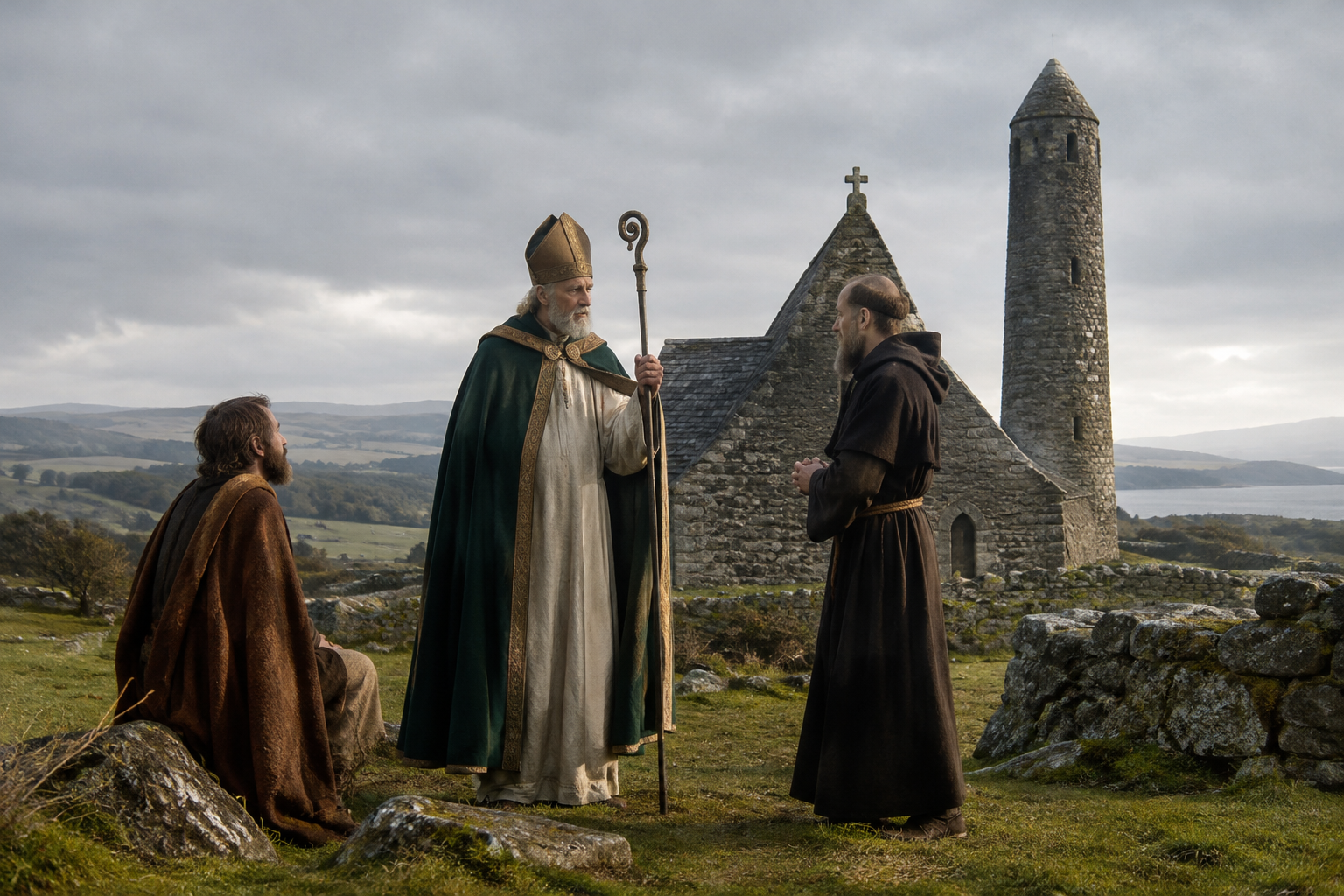
At Kilteasheen in County Roscommon, archaeologists uncovered an early medieval burial ground associated with an important church site and an episcopal seat. One of the men buried there, sample KIL016, dated to around AD 650, has been associated here with the Y-DNA haplogroup R1b1a1b1a1a2c1a2b2a. That is a very narrow paternal label, far more specific than the broad R1b umbrella so common in western Europe, and it matters because it places a direct male line inside a real historical landscape: Christian Ireland in the centuries when monasteries, churches, and regional lordships were being reshaped together.
The interest of KIL016 is not that one burial can stand for all of Ireland. It cannot. The interest is that a precisely identified paternal branch turns up at a named early medieval ecclesiastical centre, in a region that sat within networks of power, learning, kinship, and devotion. Y-DNA traces one direct paternal line only, but when that line appears in an excavated burial with a date and place, it stops being an abstract code and becomes part of history.
Kilteasheen was not an anonymous patch of ground. It was an ecclesiastical site in medieval Ireland, and the reference to a bishop's seat signals the sort of institutional setting that mattered in the seventh century. This was the period when churches were not just spiritual centres but landholders, patrons, burial places, and nodes in local political society. A man buried here belonged, at the very least, to that world.
That makes KIL016 especially useful for anyone trying to understand a paternal lineage in historical terms. We are not looking at a stray prehistoric bone from an uncertain context. We are looking at an individual placed in a recognisable early Christian Irish setting, in a county whose later history would remain deeply tied to church foundations, regional dynasties, and learned communities.
A genetic study of medieval Irish burials and related populations has helped show how powerful such contexts can be when archaeology and DNA are read together, and Kilteasheen belongs to that larger effort to map the human reality behind early Irish history: https://www.ncbi.nlm.nih.gov/pmc/articles/PMC6026117/.
R1b1a1b1a1a2c1a2b2a is a downstream branch within the much wider R1b family. That distinction is crucial. The broad parent lineage has a long and complicated history across Eurasia and western Europe, but a narrow subclade like this one should not automatically be given the whole biography of R1b as though nothing changed along the way. Branches split, expanded, stalled, and reappeared in very different settings over time.
So the safest reading is also the most interesting one: this branch, or a reported association with it, appears in early medieval Ireland through KIL016. That does not by itself prove where the branch first formed, nor does it turn one Roscommon burial into the founder of every modern tester with a similar result. What it does provide is a firm archaeological anchor for the lineage in Ireland by the seventh century.
In other words, the value here is historical placement. If your own paternal line falls close to this branch, the Kilteasheen burial suggests that one strand of that ancestry was present in Gaelic Christian Ireland during the period when monasteries and local kingdoms were closely entangled.
One of the easiest mistakes in popular DNA history is to treat Y-DNA as if it identified ethnicity all by itself. But the more revealing question is often social rather than ethnic: what sort of institution or community held the dead? In KIL016's case, burial at Kilteasheen places him in an environment shaped by the church. That could include clerics, patrons, dependants, local elites, or communities attached to the site. The burial context matters because it narrows the historical setting without pretending to tell us everything about the man.
Early medieval Irish church sites were woven into local power structures. Families endowed them, clerical dynasties could persist across generations, and burial near an important ecclesiastical centre was itself meaningful. So although we should not invent status for KIL016, neither should we flatten him into a mere dot on a haplogroup map. He lived in a society where sacred places, family interests, and regional authority met in the same landscape.
There is a habit, still surprisingly common, of writing early medieval Ireland as though it stood apart while the rest of Europe got on with history. The archaeology says otherwise. Seventh-century Ireland was busy: churches expanded, manuscript culture flourished, kingdoms competed, and people moved through maritime and overland networks linking Ireland to Britain and beyond.
That wider setting matters for a lineage like R1b1a1b1a1a2c1a2b2a. A paternal branch found in Roscommon around AD 650 belongs to a world that was local and connected at the same time. The man buried as KIL016 was part of an Irish community, but that community was not sealed off. Christian practice, political contacts, exchange, and learned culture all tied Ireland into the broader early medieval north Atlantic zone.
This is why comparisons with work on neighbouring regions can be helpful, provided we keep categories straight. Studies of post-Roman and early medieval Britain, for example, remind us that lineages, identities, and language shifts do not always move in lockstep. A Y-chromosome branch can persist through enormous cultural change without carrying a single simple label such as "Celtic," "Gaelic," or "Germanic."
Some readers may wonder whether a single named ancient sample is enough to say much at all. Fair question. The answer is that one sample is rarely enough to define an entire population, but it can be enough to establish a point of presence with real archaeological weight. KIL016 is useful precisely because he is dated, located, and contextualised.
That is often how ancient DNA advances: not by offering a grand instant solution, but by pinning one lineage to one documented place and time. Once that happens, family historians and population geneticists alike can ask better questions. Was this branch common in the region or relatively rare? Does it appear in other early medieval Irish burials? Does it connect more strongly to later Irish surname groups, or to broader western British and Atlantic patterns? Those are good questions because they begin with evidence rather than legend.
The clearest supported insight for R1b1a1b1a1a2c1a2b2a is not a sweeping migration saga but something more concrete and, in its way, more satisfying. Through KIL016 at Kilteasheen, this paternal branch is tied to an early medieval Irish ecclesiastical setting in County Roscommon around AD 650. For anyone researching this line today, that offers a genuine historical foothold: a direct male lineage present in the Ireland of monasteries, regional kingships, and church-centred communities, where ancestry was lived not as a code but as membership in a place.






Comments