Haplogroup R1b1a1b1a1a2c1a2a2a

– 6 min read


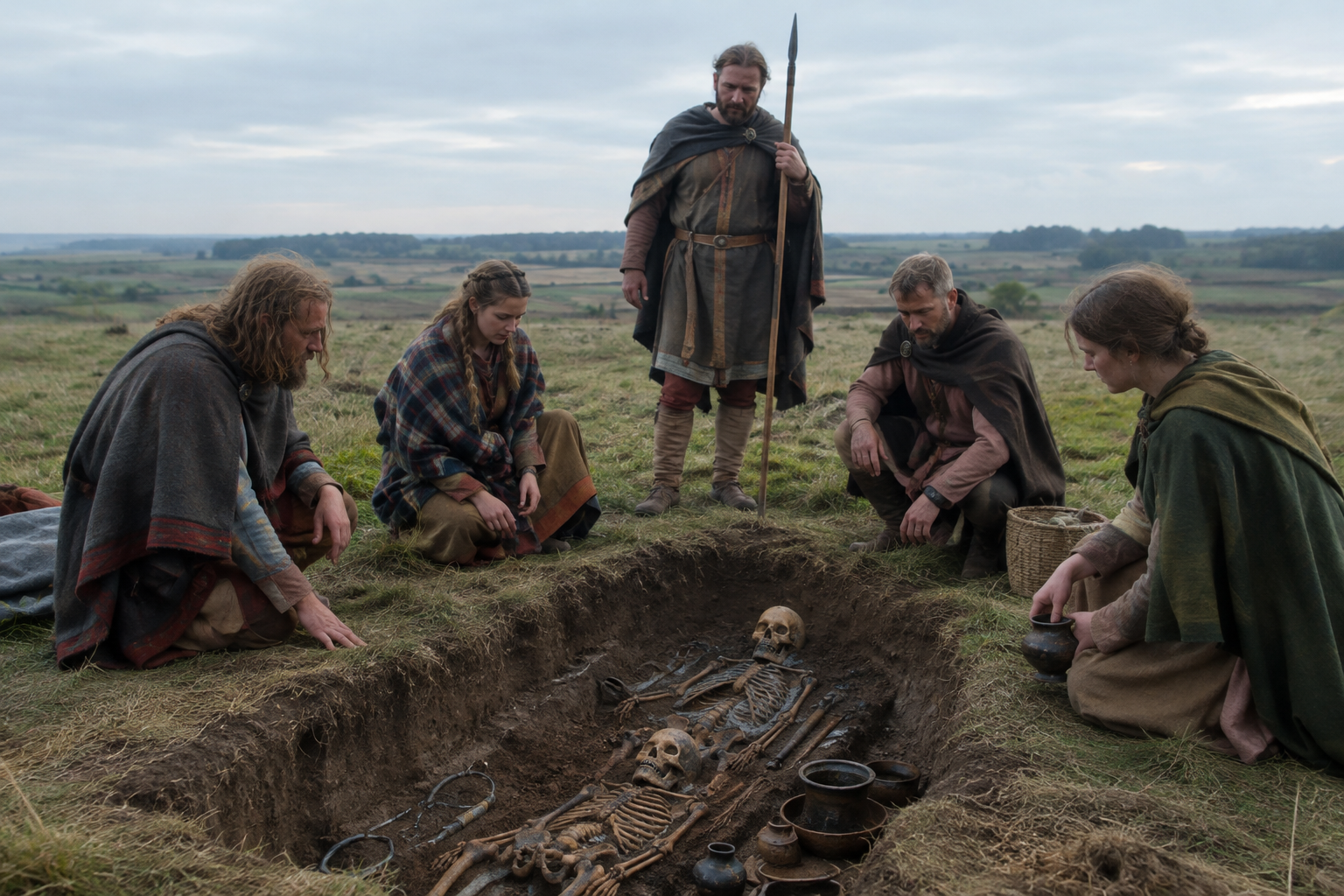
Some Y-DNA lineages are famous because they turn up in royal tombs or in sweeping theories about migrations across Europe. Others are more interesting for a quieter reason: they appear in real communities we can place on an archaeological map. The Y-DNA branch R1b1a1b1a1a2c1a2a2a belongs to that second category. It sits deep inside the wider R1b family, one of the major paternal lineages found in western Europe, but this very specific branch is historically intriguing because the evidence supplied here places it in Iron Age Britain, among communities linked to the Celtic world.
That point is worth pausing over. Y-DNA traces a direct paternal line: father to son to son across generations. It is powerful for studying one narrow line of ancestry, but it is not a picture of a person's whole family tree. Nor does sharing a haplogroup prove close kinship, noble descent, or membership in a named people. What it can do, when paired with archaeology, is show us that a particular paternal lineage was present in a particular place, at a particular time, among people living very recognisable historical lives.
The long string of letters and numbers in R1b1a1b1a1a2c1a2a2a marks it as a downstream branch of the broader haplogroup R1b. Broadly speaking, R1b lineages are deeply important in the later prehistory of western Europe, especially from the Bronze Age onward. But one must be careful here: the history of the broad parent haplogroup is not automatically the history of this exact subclade. A narrow branch can have a much more local and historically specific story.
In the material supplied for this article, that more local story points toward Iron Age southern and eastern Britain. That is already fascinating. Instead of speaking in vague continental generalities, we can watch this paternal line turn up in the cemeteries of people associated with the Arras Culture in East Yorkshire and in an Iron Age Briton from East Kent. These are not abstractions. They are burials, landscapes, and communities.
For readers interested in the bigger archaeological backdrop to ancient paternal lineages, MyTrueAncestry has also explored the wider field in Ancient DNA and the Rise of Archaeogenetics.
The strongest cluster of evidence comes from East Yorkshire, in the territory associated with the Celtic Parisi. This is the country of the Arras Culture, known for distinctive Iron Age burials, including chariot burials and carefully furnished graves. It is one of those corners of Britain where archaeology gives us a vivid regional identity long before medieval chronicles begin fussing about kings and earls.
At Wetwang Slack, several individuals anchor the story. I36970, described as a Celtic Parisi individual from Iron Age England, East Yorkshire, Wetwang Slack, comes from an Arras Culture Flat Grave Burial dated to 225 BC. Alongside him are I31009 and I30904, also from Wetwang Slack and also dated to 225 BC. Even without claiming that these men were close relatives, the repetition matters. It suggests that this paternal branch, or a very closely related part of the same lineage cluster, was not a one-off curiosity. It belonged within the male landscape of Iron Age East Yorkshire.
Then there is I21615 from Pocklington, dated to 295 BC, and I28929 from Burton Fleming, dated to 115 BC. Taken together, these East Yorkshire samples stretch across a significant slice of the British Iron Age. They hint at continuity in the region rather than an isolated arrival represented by a single burial.
This is where ancient DNA becomes especially useful. Written history tells us almost nothing directly about the paternal lineages of the men buried in these graves. Genetics does not tell us what language they spoke in any exact sense, nor does it prove tribal labels in the simplistic way popular writing sometimes pretends. But it does let us say that a recognisable paternal branch was present among these Iron Age communities, across sites and across generations.
If you want to dig further into how genetics is reshaping our understanding of Celtic-speaking worlds, see MyTrueAncestry's discussion of Ancient DNA Reveals Central European Origins and Spread of Celtic Languages.
The picture broadens with I13730, listed as an Ancient Individual:Celtic Briton East Kent England Year:300 BC. This matters because East Kent is not East Yorkshire. It lies on the other side of the country, closer to the Channel, to continental contacts, and to the old crossing points between Britain and northern Gaul.
One sample does not prove a neat migration route, and it would be irresponsible to claim that the same narrow paternal line swept across all of southern Britain in some single dramatic movement. But the presence of this branch in both East Yorkshire and East Kent does suggest that it belonged within a broader Iron Age British world rather than one tiny isolated pocket. The lineage appears in more than one region connected to networks of exchange, marriage, warfare, and status.
That is the sort of pattern archaeologists increasingly look for: not a cartoon map of arrows, but a set of overlapping regional histories. Some paternal lines persist locally. Some spread through elite networks. Some move with small groups. Some become common in one place and vanish in another. Ancient DNA gives us glimpses of these processes, but only glimpses.
It is tempting to jump from Iron Age burials straight to medieval clans and say: there, that is the story. History, maddeningly, is not so tidy. Still, geography matters. The supplied noble connection takes us to Clan Kennedy and Dunure Castle on the Ayrshire coast in southwest Scotland. That is a later world, and a very different one: lordship, feuding, crown politics, stone fortresses, church patronage, and the brutal calculations of power in late medieval and early modern Scotland.
We cannot claim that the Kennedys were proven carriers of R1b1a1b1a1a2c1a2a2a merely because this haplogroup appears in the article's input. Nor can we say that the Iron Age men of East Yorkshire were direct ancestors of the family at Dunure. What we can say is that both belong to the long paternal history of Britain, and that ancient DNA offers the deep background against which medieval family histories later unfold.
For readers interested in that later Scottish setting, MyTrueAncestry has a dedicated article on Clan Kennedy, which helps place the family in its proper historical context.
Dunure Castle stands on a rocky headland on the Ayrshire coast, and the site seems to begin in the late 13th century with the first stone tower, perhaps raised over an earlier place of importance. In the 15th and 16th centuries it became a stronghold of the Kennedy family, one of the major powers of the region. This was not a peaceful domestic residence in the modern sense. It was part fortress, part political statement, part instrument of local dominance.
The castle is particularly remembered for the murder of the Commendator of Crossraguel Abbey in 1570, when Gilbert Kennedy tried to force him to hand over church lands and revenues. It is a grim little episode, but also a useful reminder that noble history was often less about romance and more about coercion, property, and survival. By the 17th century Dunure was declining, and later it fell into ruin. Yet its shattered walls still preserve the memory of Kennedy ambition on the Scottish coast.
Castles like Dunure do not prove haplogroups. They do something subtler. They pin families to landscapes. They show how, in the medieval and early modern periods, power became rooted in stone, lineage, and territory. Ancient DNA, by contrast, reaches behind charters and ruined towers into periods with no family archive at all. One gives us names; the other gives us depth.
For a wider look at how genetics and historical populations interact in Britain after antiquity, see Genomic History and Natural Selection in Roman and Early Medieval Britain.
Explore Britain's Later DNA History
So what does R1b1a1b1a1a2c1a2a2a reveal? First, it shows how a very specific paternal lineage can be tied to real archaeological contexts in Iron Age Britain, especially among the Celtic Parisi of East Yorkshire. Second, it reminds us that haplogroups are most valuable when treated modestly. They do not hand us ready-made ethnic labels, and they do not magically connect ancient burials to every later family in the same islands.
But they do let us ask better questions. Was a paternal line regionally stable? Did it appear in multiple communities? Does it show up in areas later famous for particular kingdoms, clans, or noble houses? In this case, the answer is that the lineage belongs firmly within Britain's older paternal landscape, visible in the graves of Iron Age men long before castles rose over the Scottish coast.
If your own DNA includes a lineage somewhere within the wider R1b world, ancient matches can offer a striking sense of historical placement. Not proof that you descend from a specific buried warrior or a medieval lord at Dunure, of course - but a meaningful connection to the populations among whom your paternal line once moved.
Upload your DNA to MyTrueAncestry to explore whether your results show links to ancient individuals like I36970, I31009, I30904, I21615, I28929, or I13730, and to see how archaeology and genetics together can widen your view of the past.






Comments