Haplogroup R1b1a1b1a1a2c1a1l

– 6 min read


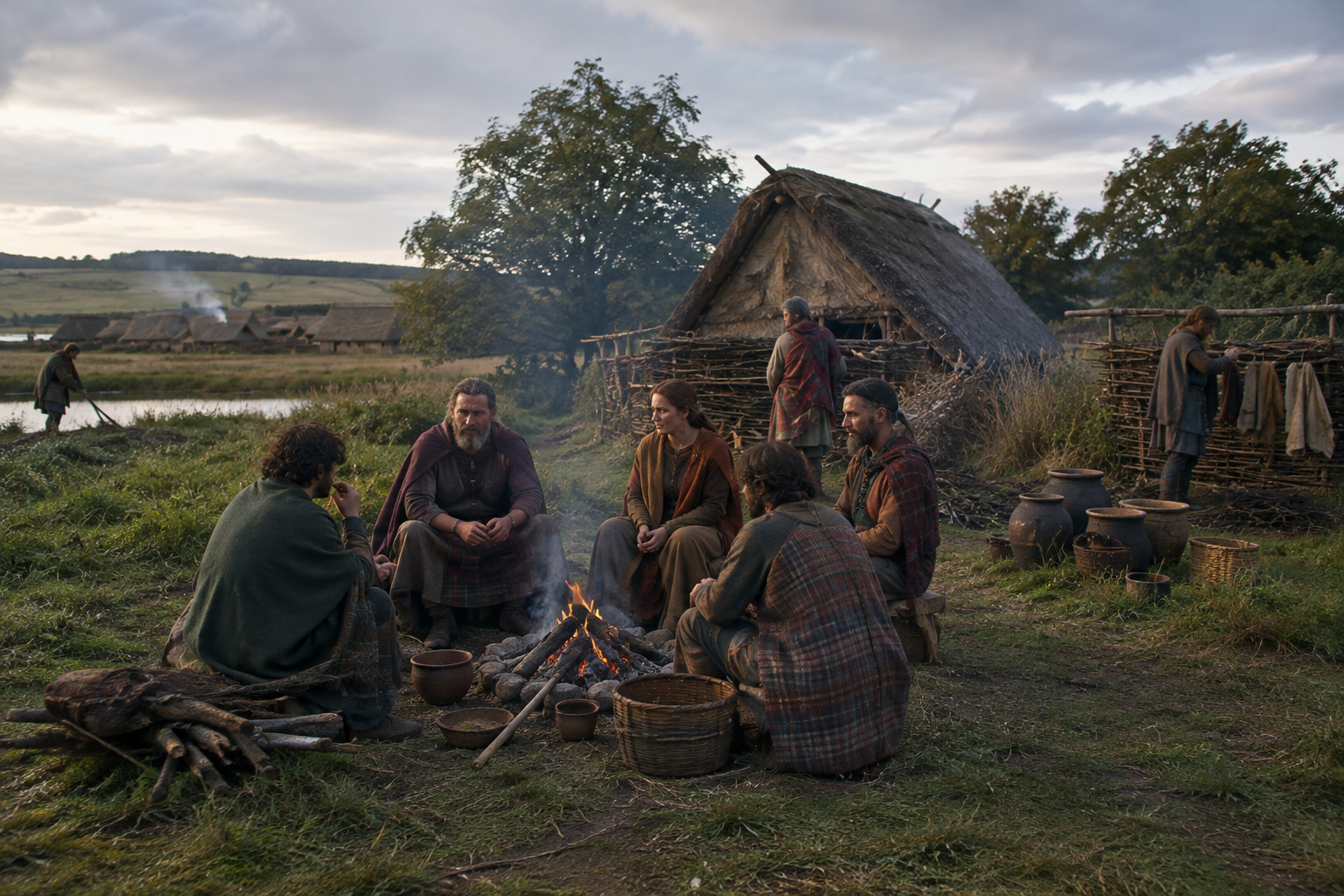
Some Y-chromosome lineages turn up once or twice in the ancient DNA record and leave us guessing. Others appear often enough, and across enough centuries, that they begin to tell a more complicated story about place, continuity, and movement. Haplogroup R1b1a1b1a1a2c1a1l belongs to that second category. It is a very specific branch within the larger R1b tree, and what makes it historically interesting is not that it can be reduced to a single people or a single migration, but that its ancient matches cluster so strikingly in Britain while also appearing elsewhere in later Roman and early medieval Europe.
That is worth pausing over, because Y-DNA can be both powerful and misleading if oversimplified. A Y-chromosome haplogroup traces one direct paternal line only: father to father to father. It does not represent all of a person's ancestry, still less an entire identity. But when a branch shows up in Bell Beaker and Bronze Age Britain, in Iron Age communities of Yorkshire and Dorset, and again in Roman and post-Roman settings, it becomes a useful thread for following how some paternal lines endured through enormous cultural change.
The broad parent haplogroup R1b is one of the major Y-chromosome lineages of western Europe, and its deeper history is tied to prehistoric population shifts that reshaped much of the continent in the late Neolithic and Bronze Age. That much is well established. What requires more care is the narrower branch in front of us. A downstream lineage such as R1b1a1b1a1a2c1a1l should not simply be handed the entire grand story of all R1b men across Eurasia.
What the supplied ancient evidence does support is a long presence of this branch, or very close relatives within it, in Britain from the Beaker and Bronze Age onward. Bell Beaker Wiltshire Upavon sample I4950, dated to 2300 BC, offers one early sign. So too does I2417 from Bronze Age Amesbury Down, Wiltshire, also 2300 BC. These are not trivial finds. They place this paternal line in southern Britain very early in the archaeological horizon often associated with major demographic change.
Later Bronze Age evidence broadens the picture rather than narrowing it. We see I3256 at Trumpington Meadows, Cambridge, dated to 2100 BC; I5377 from Early Bronze Age England Thames, 1800 BC; dfb001 and dfb002 from Down Farm Pond Barrow, Cranborne Chase, Dorset, both 1900 BC; and even the striking northern island example KD061 from Bronze Age Orkney, Westray Links of Noltland, dated to 1498 BC. Add I5473 from Boatbridge Quarry, South Lanarkshire, Scotland, dated to 2250 BC, and the line looks less like a local curiosity than part of a wider paternal landscape across Britain.
For readers interested in the larger archaeological debate around how Celtic-speaking worlds emerged from earlier continental and British population histories, this community article is a useful companion.
Explore Celtic language origins
If the Bronze Age gives us the early footprint, the Iron Age gives us density. And density matters. One or two graves may be chance. A repeated appearance across cemeteries begins to look like continuity in local paternal lines.
The most remarkable cluster here comes from East Yorkshire and the world archaeologists associate with the Parisi and the Arras culture. At Wetwang Slack alone, the lineage appears in a large number of individuals dated around 225 BC: among them I36889, I36880, I36885, I36974, I36976, I37332, I37335, I37336, I37342, I37344, I36867, I36869, and I36870. The same site and cultural setting also include I36843 and I36844 from the Arras culture, the primary barrow burial I36972, and the elite Celtic Parisi chariot burial I36995.
This is exactly the kind of evidence that brings archaeology alive. Wetwang Slack is not just a name in a database. It is a cemetery landscape of barrows, status display, burial custom, and local social worlds. The fact that this paternal line appears in ordinary and elite contexts alike suggests not a single intruder or exceptional migrant, but a lineage embedded within that society.
Nearby Pocklington adds more: I21978, I14100, I14102, I14104, I21644, I5509, I13753, and I13760. Elsewhere in Iron Age England the branch turns up in I21182 at Yarnton, Oxfordshire, dated to 200 BC, I11991 at Worlebury, Somerset, dated to 150 BC, I21309 from Battlesbury Bowl hillfort, dated to 57 BC, and HI2 from Hinxton, dated to 45 BC.
That spread matters. It suggests this was not confined to one corner of Britain, even if East Yorkshire gives the most dramatic concentration.
If you want to dig further into the family structures and burial patterns of these communities, this related piece is particularly apt.
Then the Romans arrive, and as ever the tidy schoolbook version begins to wobble. Roman rule did not wipe the population slate clean. Nor did it leave everything untouched. The supplied samples show both continuity in Britain and appearances farther afield in the Roman world.
In Dorset, a series of Durotriges-era individuals from Duropolis at Winterborne Kingston, dated to 125 AD, carry this lineage: WBK12, WBK20, WBK29, WBK41, WBK05, WBK30, WBK43, WBK06, WBK08, WBK18, and WBK191. This is another heavy cluster, and it is tremendously useful because it sits in Roman Britain while still rooted in a recognizably local population context.
But the lineage is not only British in the data. We also see I26776 from Imperial Roman Era Zadar, Croatia, dated to 200 AD, R10488 from Late Roman Conimbriga, Portugal, dated to 330 AD, and R10656 from Late Roman Klosterneuburg, Lower Austria, dated to 407 AD. Later still come IND013 from a Merovingian grave in Alt-Inden, North Rhine-Westphalia, dated to 600 AD, and Belgian samples ST2025 and ST1308 from Sint-Truiden, dated to 900 AD.
This does not prove a single neat migration trail from one place to another. Roman and post-Roman Europe was full of movement: soldiers, traders, administrators, dependants, settlers, and local communities adapting to empire and its aftermath. What these samples show is that the broader paternal branch had a footprint extending from Britain into continental Europe across late antiquity and the early medieval period.
Readers interested in how Roman rule reshaped ancestry without erasing local populations may enjoy this related article.
Explore Roman and early medieval Britain
What, then, of later noble history? Here caution is essential. A historical association between a family and a haplogroup is not the same as proof that every Beaumont male belonged to R1b1a1b1a1a2c1a1l, nor do these ancient burials prove direct ancestry for any medieval or modern house.
Still, noble estates preserve something that genetics alone cannot: regional memory. The House Beaumont is linked here with Coleorton Hall in Leicestershire, a site whose story begins as a medieval estate associated with the Beaumont family. Over time it passed through different hands, and the present hall was built in the early nineteenth century for Sir George Beaumont, the noted art patron and collector. This is not a grim frontier fortress but something perhaps more revealing about long English continuity: a landed estate reshaped across centuries, from feudal manor into Georgian and Regency improvement.
Coleorton Hall also became a meeting place for cultural figures including William Wordsworth and Samuel Taylor Coleridge. There is something wonderfully English in that transformation. A landscape once tied to medieval lordship becomes a setting for art, poetry, and polite society, yet remains anchored to an older parish church and a much deeper local past.
That is where the ancient DNA becomes suggestive in the best sense. Leicestershire sits within a country where this paternal lineage appears repeatedly in prehistoric and later burials. That does not make the Beaumonts descendants of any one excavated individual. But it does place their estate within a landscape where certain paternal lines had been present for a very long time before surnames, heraldry, or manor houses entered the record.
For more on the historical family itself, this related article is the obvious next stop.
Discover the House of Beaumont
R1b1a1b1a1a2c1a1l is interesting precisely because it resists easy slogans. The ancient evidence points strongly toward a long-running presence in Britain from the Bell Beaker and Bronze Age through the Iron Age and into Roman and post-Roman centuries. At the same time, related appearances in Croatia, Portugal, Austria, Germany, and Belgium remind us that paternal lineages travel through far more than one tribal label or national story.
Ancient DNA is especially good at exposing that complexity. Written genealogy usually begins late and privileges the literate, the wealthy, and the commemorated. Archaeogenetics, by contrast, lets us glimpse men buried in barrows, cemeteries, towns, and roadside worlds who never expected to be remembered at all. Their Y-chromosomes do not hand us a family tree from prehistory to the present. But they do reveal persistence, regional structure, and the tangled human background behind later historical society.
If this branch appears in your own results, the most sensible conclusion is not that you "are Parisi" or "are Beaumont." It is that one direct paternal line of yours may belong to a lineage with a notably deep and well-attested presence in ancient Britain, and with wider links across parts of Europe as well.
Upload your DNA to MyTrueAncestry to explore whether your results show connections to ancient individuals such as I4950, KD061, I36995, or the Durotriges men of Winterborne Kingston. These comparisons can offer a remarkable view into ancient paternal ancestry, even when they do not prove direct descent from any specific ancient person or noble house.






Comments