Haplogroup R1b1a1b1a1a2c1a1k

– 7 min read


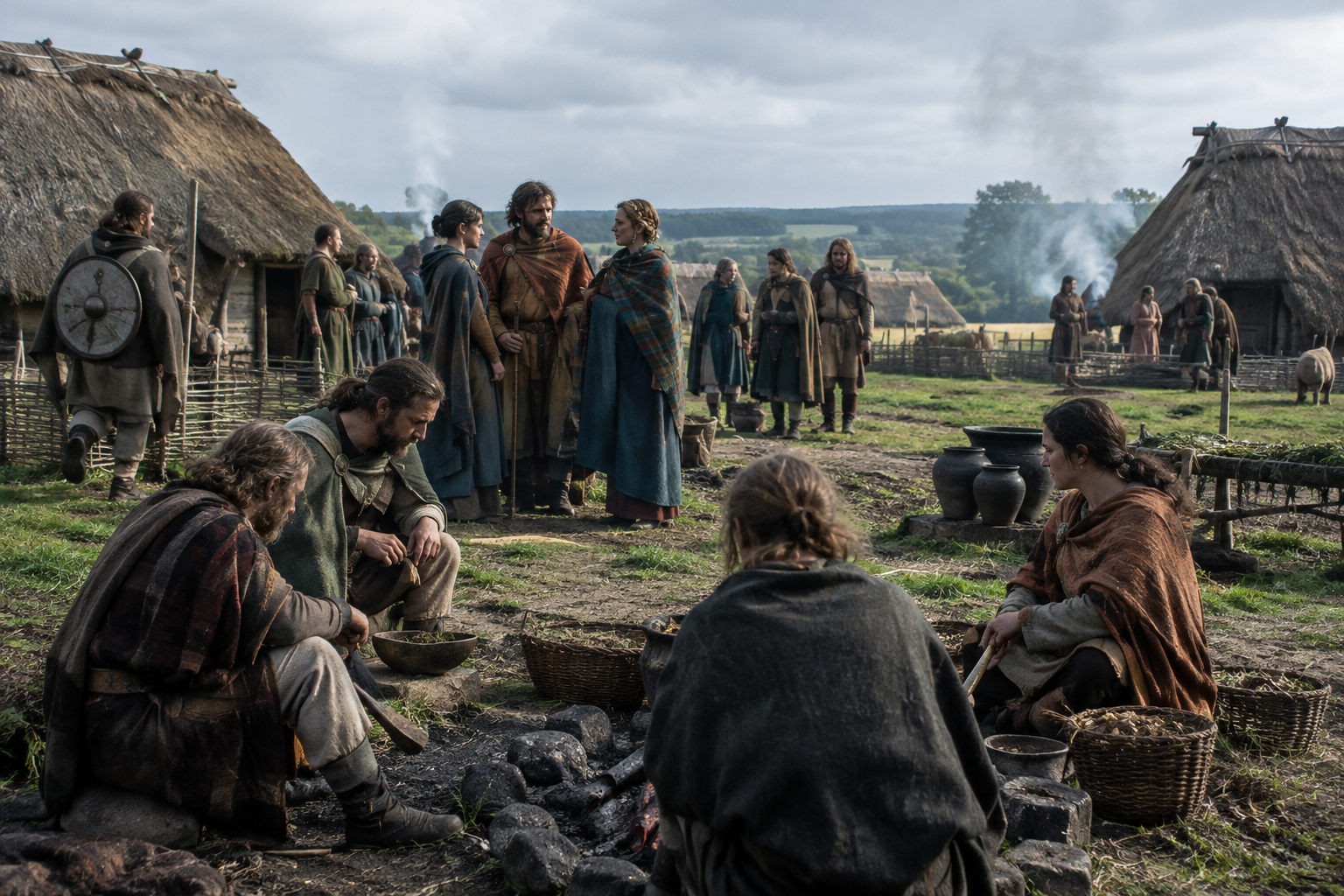
Some Y-DNA haplogroups announce themselves with a neat historical label. This one does not. R1b1a1b1a1a2c1a1k sits deep within the large and famously widespread R1b family, but what makes it interesting is not a tidy slogan. It is the way closely related paternal lines appear across a long arc of European history: in Bronze Age Britain, among Iron Age communities in Yorkshire and southern England, in Roman and post-Roman settings, and even in later regions associated with noble houses and borderland clans.
That is worth pausing over. A Y-DNA haplogroup traces one direct paternal line only: father to son, back through time. It does not describe a person's whole ancestry, culture, language, or identity. But when ancient DNA repeatedly places related paternal lines in particular landscapes, it gives us something wonderfully concrete. Suddenly the male line is not an abstraction on a chart. It is attached to men buried in barrows, hillfort communities, Roman towns, island settlements, and medieval regions that would later grow castles and noble pedigrees.
R1b1a1b1a1a2c1a1k is a very specific downstream branch within the broader R1b tree. The wider R1b family is one of the major Y-chromosome groupings in western Europe, but it would be careless to pour the entire history of broad R1b straight into such a narrow subclade. Better to say this: the evidence supplied here places related paternal lines especially strongly in Britain, while also showing appearances in continental Europe from the Iron Age through the early medieval world.
The chronological spread is striking. Samples linked to this branch or its close context range from the Bell Beaker and Bronze Age worlds of Britain, through Iron Age Celtic-speaking regions, into Roman mobility and later medieval populations. That does not prove one uninterrupted dynasty of fathers and sons. What it does suggest is that this paternal lineage belonged to populations that were part of the making of later northwestern Europe.
For readers interested in the bigger archaeological picture behind such lineages, the spread of Celtic-associated ancestry is explored in this related article.
Explore Celtic Origins in Ancient DNA
If you want the deep background, Britain offers some early anchors. A Bell Beaker individual from Wiltshire, I4950, dated to 2300 BC at Upavon, stands near the beginning of this story. So too does I2417 from Amesbury Down, also in Wiltshire and also dated to 2300 BC. These are not just old samples. They belong to the age when Britain was being reshaped by migrations, new burial customs, and new paternal lineages.
Other early and middle Bronze Age examples widen the map. I3256 from Trumpington Meadows, Cambridge, dated to 2100 BC; I5377 from Early Bronze Age England Thames, dated to 1800 BC; dfb002 from Cranborne Chase Down Farm Pond Barrow in Dorset, dated to 1900 BC; and KD061 from Westray Links of Noltland, Orkney, dated to 1498 BC. Add I5473 from Boatbridge Quarry, South Lanarkshire, Scotland, dated to 2250 BC, and the picture is of a paternal line spread across much of Britain by the Bronze Age.
That matters when we later meet Iron Age communities in Yorkshire, Somerset, Oxfordshire, Dorset, and beyond. The simplest reading is not that every later carrier was descended from one famous founder, but that related paternal lines had been present in Britain for a very long time.
If the Bronze Age gives us foundations, Iron Age Yorkshire gives us density. The list from Wetwang Slack, Pocklington, Melton, and Burton Fleming is almost embarrassingly rich. It includes I36889, I36880, I36885, I36974, I37335, I37336, I37342, I37344, I36855, I36867, I36869, I36870, and many more from the Celtic Parisi and Arras Culture world around 225 BC.
This is the sort of evidence archaeologists dream about: not one isolated skeleton, but a cluster of men from a recognisable regional culture. Wetwang Slack is famous for its burials, including high-status graves and the broader Arras tradition. Among the supplied samples is I36995, described as an Elite Celtic Parisi Chariot Burial from Wetwang Slack, dated to 225 BC. Chariot burials are among the most discussed features of Iron Age East Yorkshire, and they immediately raise questions about rank, kinship, and local power.
Yet genetics has a useful way of puncturing our assumptions. Shared Y-lineages can appear among elites and non-elites alike; a paternal branch is not a title deed. What these Yorkshire burials do show is that this paternal heritage was thoroughly at home in Iron Age eastern Britain.
Readers who want more on how genetics illuminates British Iron Age communities may enjoy this related piece.
Discover Iron Age Britain Through DNA
The branch is not confined to Yorkshire. Southern Britain is well represented too. There is a remarkable cluster from Duropolis, Winterborne Kingston in Dorset among the Celtic Durotriges, all dated to 125 AD: WBK12, WBK20, WBK29, WBK41, WBK05, WBK30, WBK43, WBK06, WBK08, WBK18, and WBK191. By then Britain was under Roman rule, but the Durotriges had deep pre-Roman roots in the region. The cluster hints at substantial local paternal continuity into the Roman period.
Other British Iron Age and late pre-Roman samples reinforce that wider distribution: I13680 from Ham Hill Fort, Somerset, dated to 270 BC; I21305 from Weston-super-Mare, Somerset, dated to 200 BC; I21181 and I21182 from Yarnton, Oxfordshire, dated to 200 BC; I11991 from Worlebury, Somerset, dated to 150 BC; and I21309 from Battlesbury Bowl, dated to 57 BC.
Then the map opens out. I26776 from Imperial Roman Era Zadar, Croatia, dated to 200 AD, shows a related paternal line in Roman Dalmatia. So do later continental examples such as R10656 from Late Roman Klosterneuburg, Lower Austria, dated to 407 AD, R10488 from Late Roman Conimbriga, Portugal, dated to 330 AD, IND013 from a Merovingian grave in North Rhine-Westphalia, dated to 600 AD, and ST2025 from Early Medieval Sint-Truiden, Belgium, dated to 900 AD.
That is precisely the sort of distribution one expects in a Europe shaped by both continuity and movement. Some branches stayed rooted in local landscapes for centuries; others travelled through armies, trade, marriage, migration, and settlement.
For a closer look at the Roman and post-Roman reshaping of Britain, this related article is a useful companion.
Read Roman and Early Medieval Britain
By the time we reach the documented world of noble families, genetics and history are doing different jobs. DNA can show that paternal lines persisted in a region. Written history can show who held land, built houses, and left their names on the landscape. The two are related, but not identical.
The House Willoughby belongs to that later story. At Wollaton Hall in Nottingham, built between 1580 and 1588 for Sir Francis Willoughby, one of the richest men in Elizabethan England, we are in a very different world from Wetwang Slack or Bronze Age barrows. This is not a fortress in any serious medieval sense but a Renaissance statement of wealth and confidence, set in a deer park with older medieval roots. Later the estate passed through the Willoughbys and then the Middletons, before Nottingham City Council bought it in 1925. The hall survives as a public landmark and museum, an unusually visible reminder that aristocratic power eventually becomes civic heritage.
In Scotland the mood changes altogether. Clan Waugh is linked here with Cakemuir Castle in East Lothian, a fortified tower house probably built in the late 15th or early 16th century by a branch of the Hepburn family. Its setting was shaped by local rivalries, defense, and the practical realities of minor lordship. Unlike Wollaton Hall's elegant display, Cakemuir belongs to a harder-edged political landscape. Altered into a laird's residence and later reduced to a roofless ruin, it still preserves the scale of everyday noble life far better than many grander monuments do.
It is tempting to turn such places into genetic proof. We should resist that temptation. A noble family associated with a haplogroup in a community context does not mean every man of that surname carried the same Y-line, still less that a medieval or early modern family can be directly tied to an Iron Age burial. What the connection offers is regional and historical texture: a way of seeing how old paternal landscapes could later become the territories of houses, clans, halls, and castles.
If you would like to follow one of those later family stories directly, this companion article is the obvious next stop.
Explore the House of Willoughby
R1b1a1b1a1a2c1a1k is interesting precisely because it refuses to stay in one box. Its ancient evidence is strongly British, especially in Iron Age Yorkshire and Roman Dorset, yet it also appears in a broader European frame that includes Gaul, the Low Countries, Austria, Portugal, Croatia, Germany, Belgium, Ireland, and Scotland. Samples such as Rathlin2B from Ireland Copper Age, dated to 1880 BC, and CGG107746 from the Batavi Germanic Tribe at Valkenburg in the Netherlands, dated to 112 AD, remind us that paternal history is seldom confined by later national borders.
In practice, this haplogroup points to a long-lived paternal presence in the making of Atlantic and northwestern European populations. Ancient DNA lets us watch that line move from barrows and island settlements to tribal regions, Roman provinces, and medieval territories. Castles and noble estates then preserve the memory of those later regions, even when they cannot by themselves prove a genetic line.
That is part of the pleasure of archaeogenetics. It does not replace history. It complicates it, corrects it, and sometimes makes it more human. Behind every branch name is a succession of actual men, most of them anonymous, who lived in communities that left graves, houses, tools, and landscapes for us to puzzle over.
If your own Y-DNA falls near this branch, or if your autosomal results connect you to these ancient populations, MyTrueAncestry can help you explore those links. Not as a claim that you descend from a particular chariot warrior, Durotrigan townsman, Willoughby landowner, or Waugh clansman, but as a way of placing your ancestry in the long and often surprising history revealed by ancient DNA.






Comments