Haplogroup R1b1a1b1a1a2c1a1i3b

– 6 min read


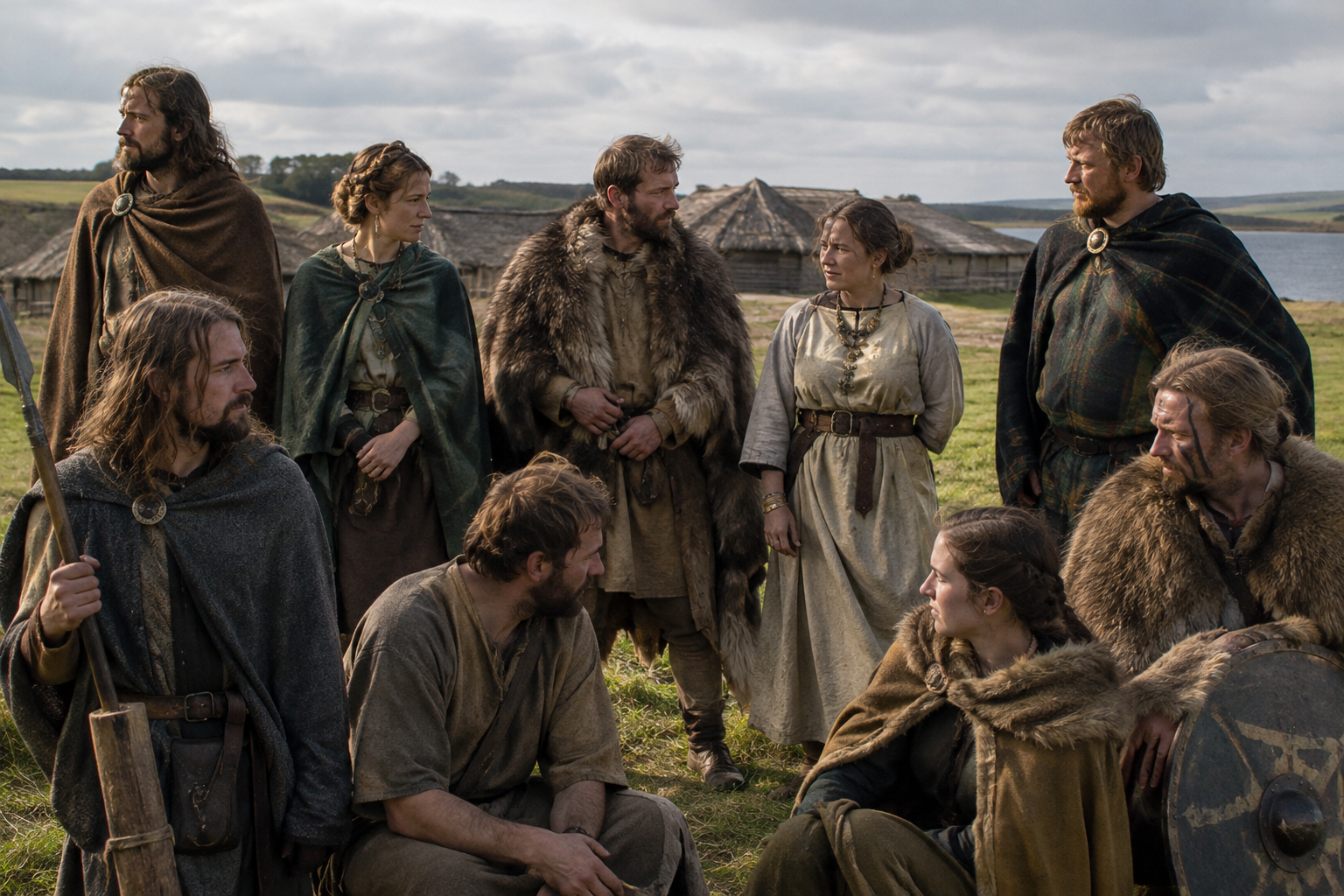
Some Y-DNA haplogroups arrive with trumpets. Others turn up more quietly, in graves, churchyards, and a few stubborn male lines that have lasted through political collapse, language change, and the odd invasion. Haplogroup R1b1a1b1a1a2c1a1i3b belongs to that second category: a very specific paternal branch whose interest lies not in grand claims, but in how it helps pin particular lines of descent into the long history of Britain and, especially, the North Sea world.
As ever with Y-DNA, a warning is also part of the fascination. A Y haplogroup traces only one line: father to father to father. It does not describe a person's whole ancestry, still less a whole people. But because that single line can sometimes be followed across archaeology and history, it can illuminate something unusually concrete: the persistence, movement, and reshaping of paternal descent across centuries. In this case, the supplied ancient DNA points us repeatedly toward Britain, from the Bronze Age through the Iron Age and into the early medieval period, before the story brushes against later Scottish historical memory at Dunfermline.
R1b1a1b1a1a2c1a1i3b is an extremely narrow branch within the larger R1b family, one of the major Y-chromosome groupings found across western Eurasia and especially well represented in later prehistoric and historic western Europe. That broader R1b story is often associated, in very general terms, with Bronze Age expansions and with later prominence in Atlantic Europe. But one has to be careful here: the history of a broad parent lineage is not automatically the history of every tiny downstream twig.
What the evidence supplied here does support is that this branch, or a very near part of its paternal neighborhood, appears in ancient individuals from England and northern Scotland across an impressive time range. That matters because it suggests not a single dramatic episode, but repeated visibility in the British Isles over many centuries. Instead of one neat migration tale, we may be looking at a lineage that became established in Britain early and then persisted through very different cultural worlds: Bronze Age communities, Iron Age groups often described as Celtic, Roman-period Britain, Pictish northern Britain, and the early Anglo-Saxon age.
If you want the wider archaeological backdrop to how ancient DNA has transformed such questions, MyTrueAncestry's overview of the field is worth a look.
Explore ancient DNA and archaeogenetics
The earliest supplied anchor is I2598, from Bronze Age Amesbury Down, Wiltshire, England, dated 2048 BC. Amesbury Down sits in one of the most archaeologically loaded landscapes in Britain, close to Stonehenge and a district that saw major social and population changes in the Bronze Age. Any paternal lineage turning up here immediately places us in a world after the great Neolithic monuments but still deep in prehistory, when burial custom, mobility, and social identity were all in flux. One sample cannot speak for all Britain, but it tells us that this paternal line, or one very close to it, had already entered the island's story by the early Bronze Age.
Then the trail becomes clearer in Iron Age eastern Yorkshire. Three men from Wetwang Slack - I36821, I36753, and I36896 - all dated 225 BC and identified as Celtic Parisi Iron Age England East Yorkshire - are joined by I21648 from Pocklington, also 225 BC. This is not an isolated appearance. It is a cluster. And clusters are where Y-DNA becomes especially interesting, because they hint that a paternal line was not merely present, but embedded in a local community.
The Parisi of East Yorkshire have long intrigued archaeologists because of their distinctive burial traditions, including chariot burials. Genetics does not magically solve all arguments about identity, language, or tribal labels, but these East Yorkshire men do show a durable paternal presence in the region during the Iron Age. They remind us that "Celtic Britain" was never a blur of undifferentiated ancestry. It was made up of real local populations, with family structures and male lines that can now sometimes be recovered.
Readers interested in that wider question of Britain in the Iron Age will enjoy this related piece on maternal and family structure in the period.
Discover Iron Age Britain through ancient DNA
The pattern does not stop in Yorkshire. I11144 from Iron Age North Perrott, Somerset, England, dated 40 BC, places a related paternal signal in southwest Britain too. That matters because it widens the geography. We are no longer dealing with one eastern enclave. We are seeing this line, or its close relatives, in both northeastern and southwestern England before Rome. That does not prove a single coherent "tribal" identity, but it does suggest a branch with some breadth across late prehistoric Britain.
And then comes one of the most revealing samples of all: VK203, a Pre-Viking Pict from Buckquoy, Orkney Mainland, dated 361 AD. Here the setting has changed dramatically. We have moved from Iron Age England to northern Britain in late antiquity, into a world of Pictish society and island connections across the northern seas. Yet a related paternal thread still appears. That is historically exciting not because it proves direct descent from the Yorkshire Parisi or the Somerset Iron Age man - it does not - but because it shows how some paternal branches could span very different cultural labels and landscapes inside Britain.
The final supplied ancient sample, HAD001 from Hatherdene Close, Cambridgeshire, England, dated 500 AD and assigned to the Early Anglo Saxon Period, brings us into another famous argument: how much continuity, and how much newcomer ancestry, shaped early medieval England?
This sample is a useful corrective to over-simple narratives. The early Anglo-Saxon period in England was not just a story of replacement, nor simply one of unbroken continuity. Ancient DNA has shown a complicated picture of migration, mixture, and regional variation. A paternal branch appearing in an early Anglo-Saxon-period burial does not by itself tell us whether the individual's recent paternal ancestors came from continental North Sea regions or belonged to a line already long rooted in Britain. But it does show that this lineage persisted into the centuries when new political identities were being formed.
For a broader look at that problem, the MyTrueAncestry article on the formation of the early medieval English gene pool is especially relevant.
Explore Anglo-Saxon migration and DNA
Taken together, the supplied samples suggest something rather sturdy: a paternal lineage visible in Britain from the Bronze Age, prominent in parts of Iron Age England, still present in late Roman or sub-Roman northern Britain, and surviving into the early Anglo-Saxon period. That is not proof of uninterrupted father-to-son continuity from one sample to the next. It is, however, strong evidence that this paternal branch belongs in the long local history of Britain rather than being treated as a fleeting intruder.
The later historical association supplied here is Clan Ged, linked with Dunfermline Abbey in Fife. Now, one must be precise. A clan's appearance beside a haplogroup in a modern heritage context does not prove that every historical bearer of the name Ged shared this exact Y-DNA line, nor that the medieval family can be directly connected to any ancient sample above. But the pairing is historically evocative, because Dunfermline is one of the great sites of Scottish royal memory.
Dunfermline Abbey began as a royal church associated with Queen Margaret in the late 11th century and was transformed by her son, King David I, into a major Benedictine abbey in the 12th century. It became one of medieval Scotland's richest and most important religious houses, and a favored burial place of Scottish kings and queens. The tomb of Robert the Bruce gave it a still deeper hold on the Scottish imagination. Architecturally too, the abbey preserves that long life: Romanesque nave, later Gothic additions, then the fracture of the Reformation in 1560, after which much of the monastic complex fell into ruin. Yet the place never stopped meaning something.
That is exactly the sort of place where lineage, memory, and legitimacy were performed. Abbeys like Dunfermline did not preserve DNA, of course, but they preserved something nearly as potent in medieval terms: the public story of descent. For a clan such as Ged, association with Dunfermline places the family in a landscape where royal patronage, sacred burial, and local identity all overlapped.
Readers who want to follow that family connection more directly can continue with the related clan article.
The interest of R1b1a1b1a1a2c1a1i3b is not that it hands us a fairy-tale pedigree from a Bronze Age grave to a named medieval clan. It does something better, and more reliable. It places a very specific paternal lineage within a long British sequence: I2598 at Amesbury Down, the East Yorkshire Iron Age cluster of I36821, I36753, I36896, and I21648, I11144 in Somerset, VK203 in Pictish Orkney, and HAD001 in early Anglo-Saxon Cambridgeshire.
That spread shows how genetics can complement history. Written records only begin late, and when they do begin they tend to favor elites, monasteries, and kingdoms. Ancient DNA reaches back before that. It shows that some paternal lines moved through the making of Britain not as abstractions but as biological continuities carried by actual men in actual communities. Later castles, abbeys, and clans belong to a different kind of evidence: they tell us how those communities remembered, ranked, and narrated descent once they started writing it down.
If this haplogroup appears in your own Y-DNA results, the most responsible conclusion is not "I am descended from the Parisi" or "I belong to Clan Ged." It is that your direct paternal line may belong to a branch with a documented presence in ancient Britain and later resonance in the historical landscapes of England and Scotland. That, frankly, is interesting enough.
Upload your DNA to MyTrueAncestry to explore whether your paternal line shows connections to ancient individuals like I2598, VK203, or the East Yorkshire Iron Age burials. These matches can offer remarkable historical context for your ancestry, while still stopping short of proving direct descent from any one ancient person or noble family.






Comments