Haplogroup R1b1a1b1a1a2c1a1i3

– 6 min read


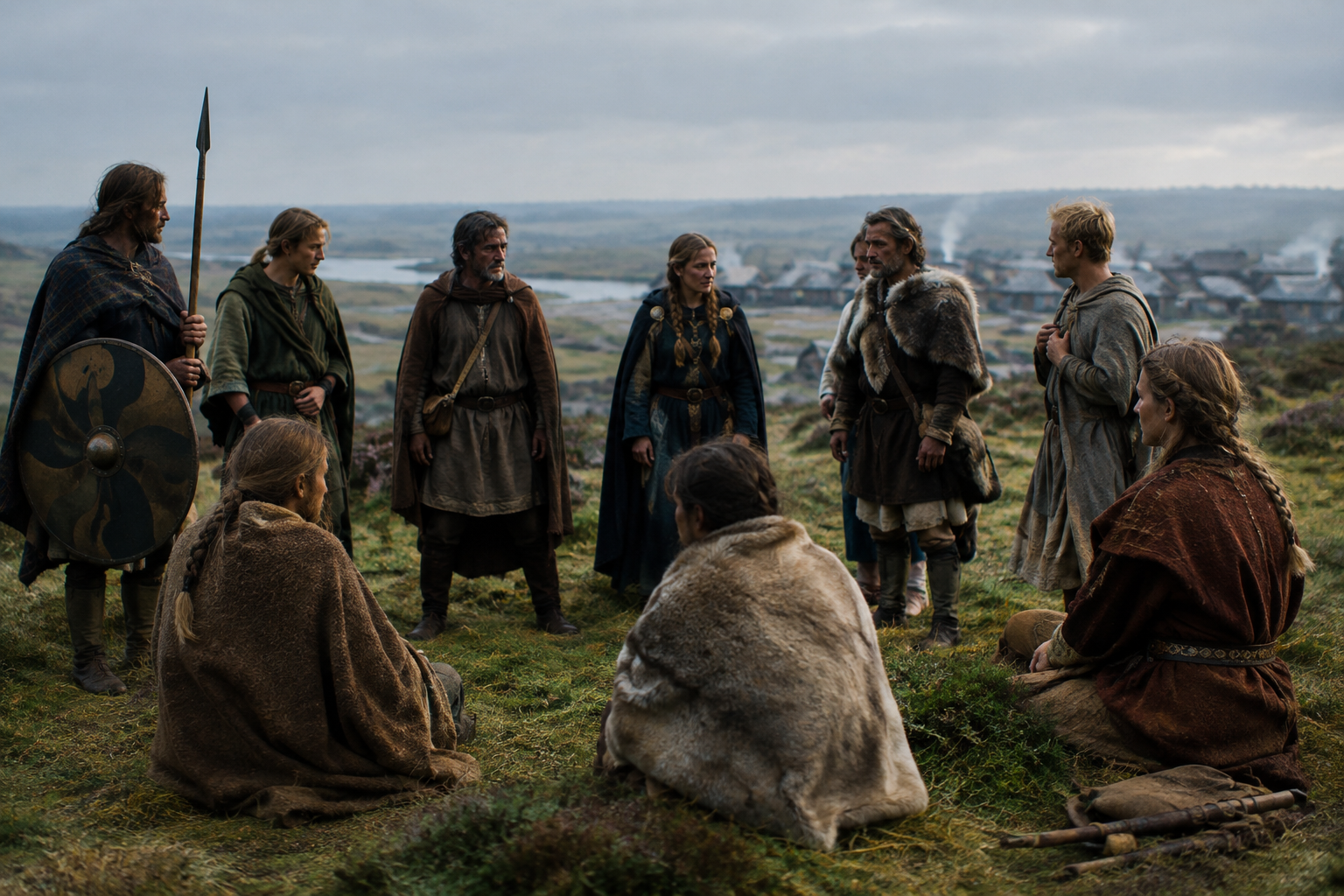
Some Y-chromosome lineages announce themselves with grand continental patterns. Others are more interesting because they seem to sit quietly inside a particular historical landscape and then, once ancient DNA begins to accumulate, they turn out to have been there for a very long time. Haplogroup R1b1a1b1a1a2c1a1i3 belongs to that second kind of story.
This is a very specific branch on the Y-chromosome tree, nested deep inside the wider R1b family. That matters because Y-DNA traces only one line of ancestry: the direct paternal line, from father to son to son. It does not describe a person's whole ancestry, ethnicity, or identity. Still, paternal lineages can be extraordinarily useful for reconstructing movement, continuity, and change across centuries, especially when ancient burials begin to show the same or closely related branches appearing in the same broad regions over time.
At the broadest level, R1b is one of the major Y-chromosome families found in western Europe today, but that broad fact should not be carelessly projected onto a narrow subclade like R1b1a1b1a1a2c1a1i3. The deeper we go down the tree, the more local and historically specific the picture may become. For a branch this detailed, the most responsible approach is not to invent a dramatic origin story, but to look closely at where the ancient evidence places it.
And here the pattern is striking. The supplied ancient individuals cluster overwhelmingly in Britain, with a particularly strong presence in Iron Age England and later appearances in early medieval eastern England and northern Scotland. That does not prove the branch originated in Britain, but it does suggest that by later prehistory and into the historic era, closely related paternal lines were well established there.
That makes this haplogroup especially interesting for anyone studying the long story of Britain after the Bronze Age: the survival of older paternal lines, the arrival of new peoples, and the fact that cultural change does not always mean simple population replacement.
Explore Celtic language origins
The earliest sample in the list is I2598 from Amesbury Down, Wiltshire, England, dated to 2048 BC. Amesbury sits in a landscape famous for monuments, burial mounds, and the dense ceremonial world of Bronze Age southern Britain. One sample, by itself, does not map an entire population. But when a lineage connected to this haplogroup appears that early in southern England, it offers a valuable anchor: paternal lines of this kind were present in Britain long before Roman rule, long before Anglo-Saxon kingdoms, and long before medieval clan traditions.
Then the evidence becomes much thicker in the Iron Age. East Yorkshire stands out. At Wetwang Slack, three individuals dated to 225 BC - I36821, I36753, and I36896 - are all associated with the Celtic Parisi. Nearby at Pocklington, another Parisi-period individual, I21648, is also dated to 225 BC. This is exactly the kind of pattern archaeogeneticists notice: not an isolated occurrence, but repeated appearances in one regional cultural setting.
The Parisi of East Yorkshire have long fascinated archaeologists because of their burial customs, including chariot burials and elite funerary display. Genetics does not reduce them to a haplogroup, of course, but these Y-lineages help show that paternal continuity could run through Iron Age communities with distinct local identities. Here, the story is not just "Celtic Britain" in the abstract. It is a specific corner of Britain, with its own customs, landscapes, and kin networks.
Other Iron Age samples broaden the map. I21182, a Celtic Briton from Yarnton, Oxfordshire, England, dated to 200 BC, places the lineage in the Thames valley region. I11144 from North Perrott, Somerset, England, dated to 40 BC, extends it into the southwest. These are useful reminders that this was not merely an East Yorkshire curiosity. Related paternal lines seem to have been present across multiple parts of Iron Age Britain.
Discover Iron Age Britain through DNA
One of the most revealing things about ancient DNA is that it lets us test what happened after the Roman period without relying only on the later written sources. Did earlier paternal lines vanish? Were they overwhelmed? Or did many persist beneath changing languages, political loyalties, and burial fashions?
The sample HAD001 from Hatherdene Close, Cambridgeshire, England, dated to 500 AD and described as Early Anglo Saxon Period, is a good example of why the answer is rarely simple. By the 5th and 6th centuries, eastern England was undergoing major cultural transformation associated with Anglo-Saxon settlement. Yet the presence of a lineage tied to this haplogroup in that context reminds us that early medieval communities were not genetically uniform and that older British paternal lines may have persisted, mixed, or been incorporated into new social identities.
Further north, VK203 from Buckquoy, Orkney Mainland, dated to 361 AD and described as Pre-Viking Pict, opens another fascinating window. Orkney before the Viking Age was part of a northern world often associated with Pictish culture, maritime contacts, and strong regional traditions. A related paternal branch in this setting suggests that the wider family of lineages connected to R1b1a1b1a1a2c1a1i3 was not confined to southern Britain. It also had a place in the far north, in landscapes that later sagas and chronicles would present as separate and distinctive.
This matters because it helps bridge the gap between prehistoric Britain and medieval regional identities. Ancient DNA does not prove that Iron Age men in Yorkshire were ancestors of Picts in Orkney, or that either group fathered specific later dynasties. But it does show that related paternal lines could appear across very different British regions and historical settings.
Read about Roman and early medieval Britain
By the medieval period, the story shifts from excavated graves to named families, castles, and political memory. The supplied historical association here is Clan MacAlpin, linked with Dunstaffnage Castle near Oban in Argyll. This is where one has to be both imaginative and careful: castles preserve historical landscapes and family traditions, but they are not genetic proofs.
Dunstaffnage is one of Scotland's oldest stone castles, built around the mid 1200s by the MacDougalls, powerful lords descended from Norse-Gaelic rulers. It occupied a strategic position, guarding an important sea route on Scotland's west coast. In other words, this was not a romantic ruin at the edge of nowhere. It was a hard political instrument in a contested maritime world.
After Robert the Bruce defeated the MacDougalls in the early 1300s, the castle passed to the Scottish crown and became a royal stronghold. Later it was held by royal keepers, especially the Campbells, and its history included conflict, siege, and shifting importance. The nearby chapel, along with the tradition that the Stone of Scone was once kept here, adds another layer of historical prestige, even if that story remains uncertain.
What has this to do with a Y-DNA haplogroup? Not proof of descent, certainly. But it does place the haplogroup within a recognizably British and particularly Scottish historical frame. When ancient DNA shows related paternal lines in Britain from the Bronze Age through the Iron Age and into the early medieval north, it becomes easier to see how later clan regions could sit atop much older demographic foundations. The men who built, held, attacked, and inherited places like Dunstaffnage belonged to societies shaped by many centuries of population continuity and movement.
R1b1a1b1a1a2c1a1i3 is historically interesting not because it can be made to explain all of British history, but because it appears in a sequence of ancient contexts that are genuinely revealing: Bronze Age Wiltshire, Iron Age Yorkshire, Oxfordshire, Somerset, early Anglo-Saxon Cambridgeshire, and pre-Viking Orkney. That is a long and varied record.
It suggests a paternal lineage family with deep roots in Britain and a presence across different cultural worlds: Bronze Age communities, Iron Age Britons, the Parisi of East Yorkshire, early medieval populations in the east, and Pictish-era Orkney in the north. The broad lesson is an important one. Languages change. Kingdoms rise and fall. Burial customs shift. Castles are built by one lord and taken by another. Yet some paternal lines can persist through all that turbulence.
Still, caution is essential. Sharing a haplogroup does not make two people close relatives in any ordinary genealogical sense. It does not prove direct descent from an ancient sample. And it certainly does not prove membership in a noble family. What it does offer is something more subtle and, in its way, more interesting: a documented place in the long human history of a region.
For readers drawn to the northern British setting of this lineage, the transition from ancient populations to later seafaring societies is also worth exploring in the wider community.
If your paternal line falls within a branch like R1b1a1b1a1a2c1a1i3, ancient DNA can place it in a remarkable historical setting: among Bronze Age burials, Iron Age Britons, early medieval communities, and the regional worlds that later produced clans and castles. That does not automatically make anyone the direct descendant of I2598, I36821, HAD001, or VK203. But it does mean your DNA may preserve connections to the same deep population history.
Upload your DNA to MyTrueAncestry to explore ancient matches, compare yourself to archaeological samples, and see how genetics can add a new dimension to family history.






Comments