Haplogroup R1b1a1b1a1a2c1a1i2

– 8 min read


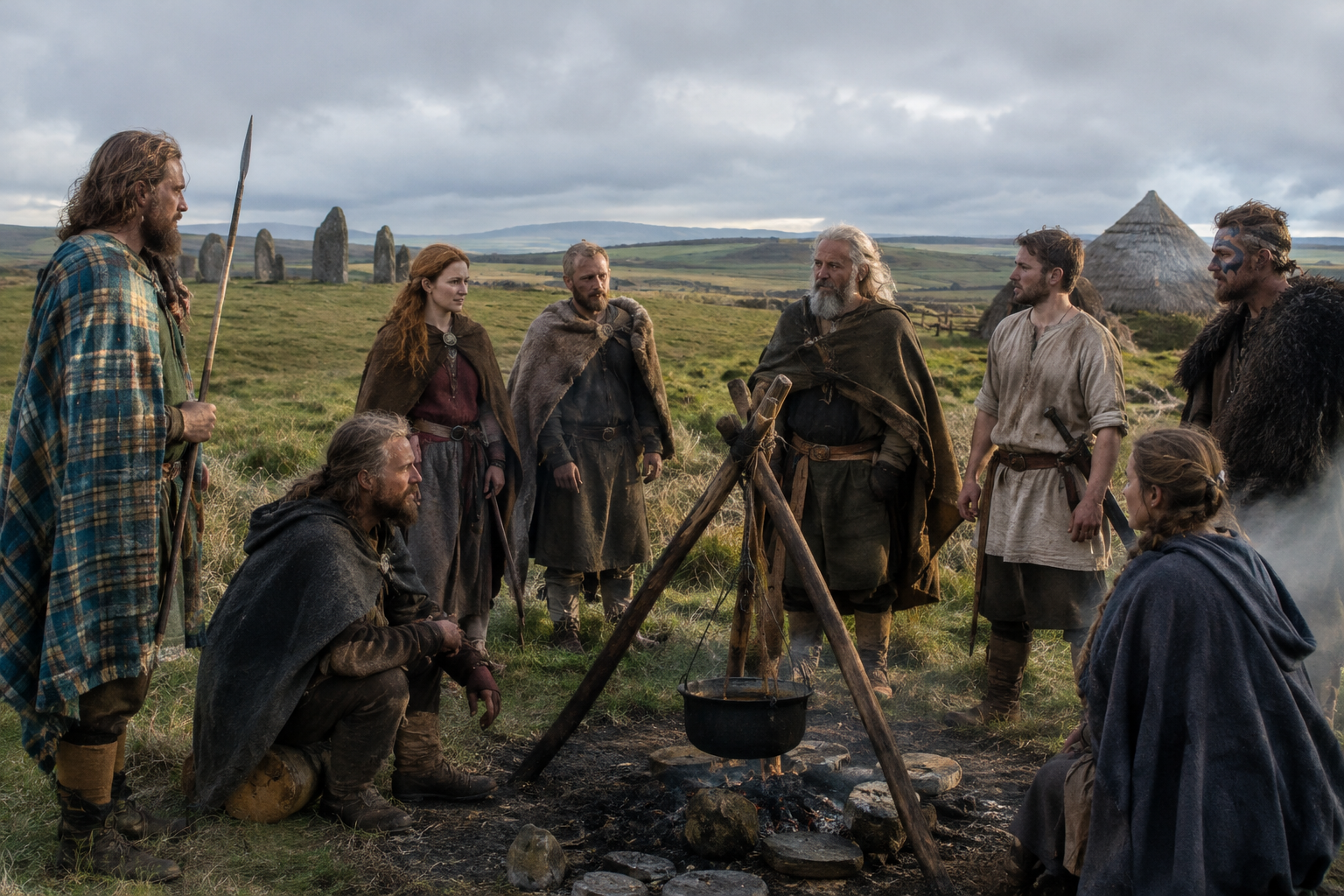
Some Y-chromosome lineages are easy to tell as grand continental stories. Others are more interesting because they force us to stay close to the ground: to barrows, cemeteries, old kingdoms, and the awkward fact that history is rarely a straight line. Haplogroup R1b1a1b1a1a2c1a1i2 belongs in that second category. It sits deep within the wider R1b tree, one of the major Y-DNA lineages of western Eurasia, but this very specific branch is most useful not as a slogan about "a people" but as a clue to paternal continuity and movement across Britain over a very long stretch of time.
That is worth pausing over. Y-DNA haplogroups trace one direct paternal line only: father to father to father. They do not describe a person's full ancestry, culture, language, or identity. But when a rare or highly specific branch appears in ancient burials from different centuries and regions, it can help us see something rather striking: not a single tribe marching through history, but a durable male-line presence appearing in Bronze Age England, Iron Age Britain, early Anglo-Saxon England, and even pre-Viking Orkney.
The wider haplogroup R1b has a long and important history in Europe, especially in later prehistoric and historic western Europe. But we should be careful. The history of broad R1b is not automatically the history of this narrow downstream branch. What we can say more safely is that R1b1a1b1a1a2c1a1i2 belongs to a paternal framework that became well established in Britain by later prehistory, and the ancient samples supplied here place this branch, or a very close paternal relationship to it, in Britain across multiple archaeological settings.
That matters because it shifts the emphasis away from fantasy genealogies and toward something better: patterned evidence. Rather than claiming this lineage "belonged" to one ethnic group, the ancient record suggests that men carrying closely related paternal lines were present among different communities in Britain over many centuries, from Bronze Age landscapes to Iron Age cemeteries and into the early medieval world.
Readers interested in the bigger archaeological background to these paternal developments may enjoy the broader discussion in MyTrueAncestry's article on Bell Beaker and post-Beaker change in northwestern Europe.
Explore Bell Beaker Population Change
One of the earliest anchors in this story is I2598, from Bronze Age Amesbury Down Wiltshire England, dated 2048 BC. Amesbury Down sits in one of the most archaeologically charged landscapes in Europe, close to Stonehenge and the dense ceremonial world of Wessex prehistory. A paternal lineage related to this haplogroup appearing there is a useful reminder that Y-chromosome history is often embedded in places long famous for quite different reasons - monuments, burials, prestige goods, ritual landscapes.
We should not turn I2598 into a mascot for the entire haplogroup, nor pretend that one burial explains later Britain. Still, it provides an early southern British point in the record. It shows that this paternal thread was already present in Bronze Age England, in a region central to wider discussions about mobility, elite exchange, and the reshaping of British populations after the third millennium BC.
For a wider look at how archaeologists and geneticists now reconstruct such long population histories, see MyTrueAncestry's introduction to the field itself.
Learn How Archaeogenetics Reconstructs the Past
By the Iron Age, the evidence becomes especially vivid. In East Yorkshire, several individuals connected with the Celtic Parisi appear in the dataset: I36821, I36753, and I36896 from Wetwang Slack, all dated 225 BC, and I21648 from Pocklington, also dated 225 BC. This is not a stray appearance. It is a cluster.
That cluster matters because East Yorkshire's Iron Age archaeology has long stood out. Chariot burials, carefully furnished graves, and distinctive regional practices have made the Arras culture famous. The Parisi have often attracted debate about local development versus continental connections. The Y-DNA evidence does not solve every argument, but it does add an important layer: closely related paternal lines were present among men buried in this eastern British Iron Age milieu.
And then there is I21182, a Celtic Briton Oxfordshire Yarnton England individual dated 200 BC. Yarnton lies well away from East Yorkshire, in the upper Thames region. This suggests that the paternal story was not confined to one corner of Britain. It appears, instead, in more than one Iron Age regional setting. That does not prove a single tribe or dynasty spanning both places. But it does suggest that related male-line ancestry was distributed across different British communities before the Roman conquest.
If you want to follow that question further - how genetics illuminates social structure and local relationships in Iron Age Britain - there is an especially relevant MyTrueAncestry article on the subject.
Discover Iron Age Britain Through Ancient DNA
The later samples make the story more, not less, interesting. VK203, from Pre-Viking Pict Buckquoy Orkney Mainland, dated 361 AD, places this paternal thread in northern Britain, in an Orcadian setting associated with the Pictish world before Scandinavian settlement. That alone should make us cautious about tidy ethnic labelling. The same broad paternal story touches Wessex, East Yorkshire, Oxfordshire, and Orkney. Britain was politically fragmented, culturally varied, and regionally distinct, yet paternal continuity could cross all of that.
Then we have HAD001, from the Early Anglo Saxon Period Hatherdene Close Cambridgeshire England, dated 500 AD. Here again, caution is essential. A shared haplogroup does not make an Iron Age Briton and an early Anglo-Saxon burial into close kin, and it certainly does not erase the documented migrations and social changes of the fifth and sixth centuries. But HAD001 does show that this paternal branch, or one extremely close to it, also appears in early medieval eastern England. That is precisely the sort of finding that complicates old binaries between "native Briton" and "incoming Anglo-Saxon."
The better way to put it is this: Y-DNA can reveal both mobility and persistence. Some paternal lines moved. Some endured locally. Some likely did both, as families merged into new political and cultural orders while preserving older male-line ancestry.
For readers who want more on that unsettled period, the MyTrueAncestry community has a strong companion piece on the formation of the early medieval English gene pool.
Read About Anglo-Saxon Migration and English DNA
Beyond the burials and laboratory data, there is also the later world of documented families and named lineages. That evidence is different in kind from ancient DNA and should not be collapsed into it. Even so, it can be a useful extension of the story, because it shows how paternal identity was remembered, claimed, and embedded in the medieval landscapes of Britain.
The principal later family association supplied here is Clan Riddell. In historical terms, that matters less as a claim of neat biological continuity and more as an example of how paternal lines enter the realm of record, heraldry, and family tradition. A clan or surname association can suggest that a haplogroup has been reported among men linked to that lineage, but it does not prove that every bearer of the name belonged to the same exact Y-DNA branch, still less that all earlier archaeological samples were part of a single documented family history.
Even with those cautions in place, Clan Riddell offers a useful bridge between prehistory and the medieval world. The name belongs to the later historical landscape of Britain, where kinship, landholding, and status were expressed through enduring family identities. In that sense, the Riddells stand in a very different archive from the men of Amesbury Down, Wetwang Slack, Yarnton, Buckquoy, or Hatherdene Close. Those ancient individuals survive to us through burial archaeology; a clan survives through memory, record, and the social importance attached to descent in the male line.
That is precisely why such associations interest people exploring Y-DNA. A narrow paternal haplogroup can appear first as an archaeological trace and then, much later, in connection with families whose identities were shaped by the politics of lordship, service, and inheritance. The value lies not in pretending that the gap has been genealogically closed, but in seeing how one kind of paternal evidence shades into another as Britain moves from prehistory into the age of named lineages.
The place associated here with Clan Riddell is Battle Abbey, one of the most resonant historical sites in England. It was founded by William the Conqueror on the site of the Battle of Hastings in 1066, both as a memorial to the dead and as a conspicuous statement of Norman victory. That alone gives it an unusual place in the historical imagination: not simply a religious house, but a monument planted directly onto the landscape of conquest.
The abbey later became a wealthy Benedictine monastery, part of the ecclesiastical and political fabric of medieval England. In other words, it was not merely a place of prayer. It stood within the machinery by which conquest was remembered, sanctified, and woven into royal authority. For readers interested in later paternal lineages and family associations, this makes Battle Abbey a particularly fitting historical setting. It evokes the world in which noble families, clan traditions, and claims of descent were shaped by the aftermath of 1066.
After the Dissolution of the Monasteries under Henry VIII, much of the abbey was destroyed, though parts survive today as a historic site. That partial survival is worth noting. Sites like Battle Abbey do not prove genetic ancestry, but they offer something tangible alongside the abstractions of haplogroup nomenclature: a real place, still visitable, where the medieval memory of lineage, power, and upheaval can be set against the much deeper timescale revealed by ancient DNA.
The later historical association supplied here is Clan Riddell, linked with Battle Abbey. That is a splendidly evocative place to bring genetics and history into the same frame, because Battle Abbey stands on the site of one of the most written-about defeats in English history: King Harold's fall before William of Normandy in 1066. William later founded the abbey as both commemoration and penance, and tradition held that the high altar marked the spot where Harold died.
For centuries a Benedictine community flourished there, and later the site passed through the transformations that carried so many English religious houses into post-medieval life: dissolution under Henry VIII, partial survival, reuse as a country house and school, and eventual preservation as one of the most resonant historical landscapes in England.
What does that have to do with this haplogroup? Not proof of descent, certainly. We should be scrupulous about that. The historical association of Clan Riddell with this haplogroup does not demonstrate that every Riddell male carried this exact branch, nor that ancient individuals from Wetwang Slack, Yarnton, Buckquoy, or Amesbury were ancestors of the family in any documented genealogical sense.
But Battle Abbey does offer a fitting setting for the larger lesson. Medieval lineages, castles, abbeys, and clan traditions belong to the world of written memory. Ancient DNA belongs to the world beneath that memory: burials, bone, and the accidental survival of paternal signatures. When the two are considered together, not confused with one another, they can illuminate the same landscapes from different angles. A place like Battle Abbey reminds us that conquest changes chronicles overnight; genetics reminds us that populations are seldom replaced so neatly.
Readers interested in the clan context can continue with the MyTrueAncestry piece specifically devoted to the family association mentioned here.
So what does R1b1a1b1a1a2c1a1i2 reveal? In the evidence supplied here, it points above all to long-term paternal presence in Britain. From I2598 in Bronze Age Wiltshire, through the Iron Age Parisi burials of East Yorkshire and I21182 in Oxfordshire, to VK203 in Orkney and HAD001 in early Anglo-Saxon Cambridgeshire, this lineage appears in strikingly different places and periods.
That does not make it the "haplogroup of the Celts," or of the Parisi, or of the Picts, or of the Anglo-Saxons, still less of Clan Riddell. Those labels belong to cultural and historical worlds more complicated than any single Y-chromosome branch. What the haplogroup does offer is something subtler and, in its way, more rewarding: evidence that one narrow paternal line can pass through very different archaeological and historical settings while the societies around it change dramatically.
That is one of the quiet revolutions of ancient DNA. It does not replace history. It makes history messier, more human, and often more interesting.
If you have tested your DNA, MyTrueAncestry can help you explore whether your results show similarities to ancient individuals like I2598, I21648, I21182, VK203, or HAD001, and place your paternal ancestry in a deeper archaeological setting. Those matches do not by themselves prove direct descent or noble-family membership, but they can open a remarkable window onto the older history behind your family line.

Comments