Haplogroup R1b1a1b1a1a2c1a1i

– 6 min read


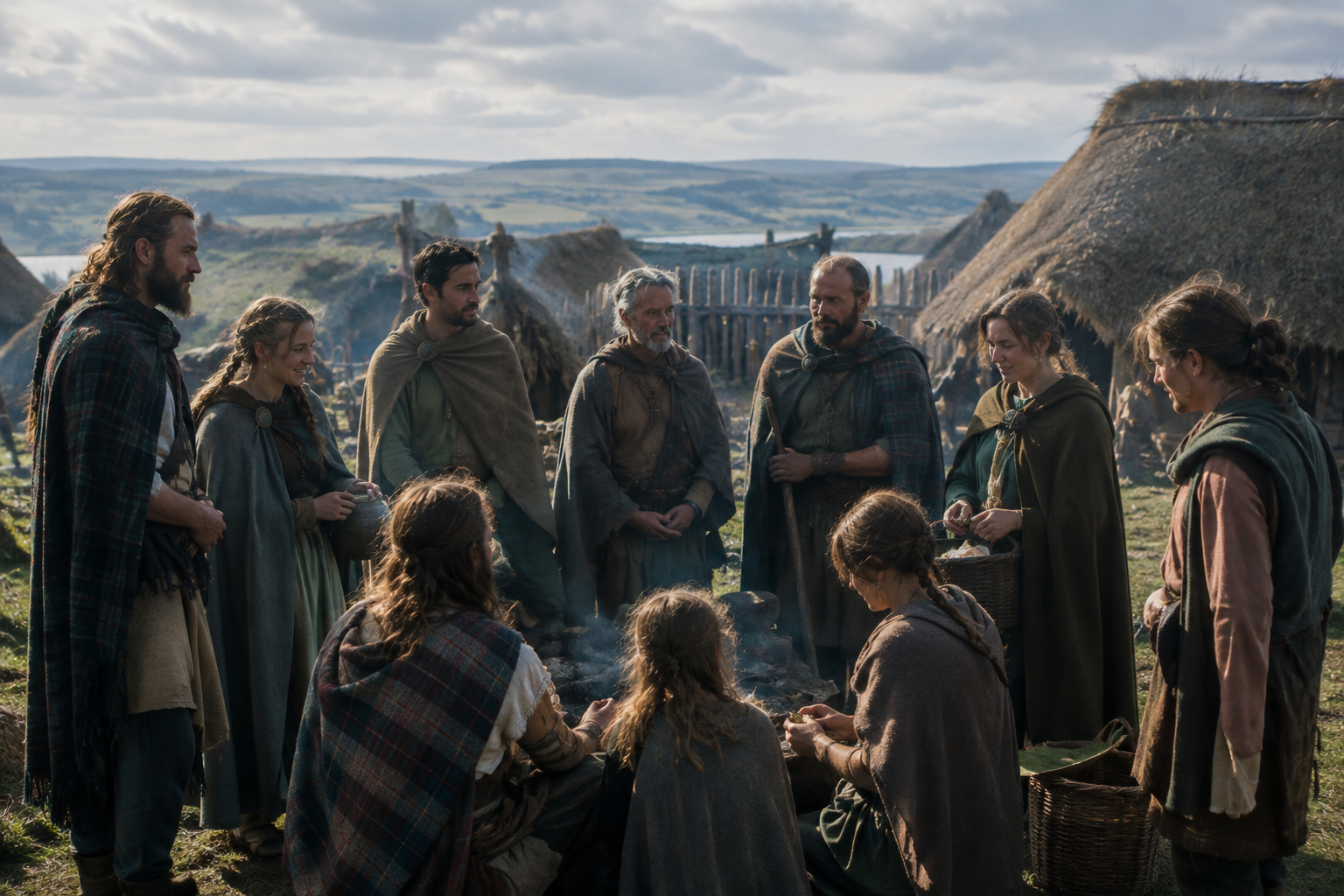
Some Y-chromosome lineages appear in ancient DNA only once or twice, like a fleeting face in a crowd. Others show up again and again, across burial grounds, changing cultures, and whole political worlds. Haplogroup R1b1a1b1a1a2c1a1i is historically interesting for precisely that reason. In the evidence supplied here, it sits in a striking pattern that stretches from Bronze Age Britain into Iron Age communities of eastern and southern England, then onward into Roman and early medieval Europe.
That does not mean one simple, unbroken family story. Y-DNA traces only a direct paternal line, not a person's full ancestry, identity, or social history. Still, paternal lineages can be wonderfully revealing. They let us ask where certain male lines were present, how long they persisted in a region, and how they moved through the worlds of barrows, hillforts, Roman towns, manor villages, and later noble memory.
This haplogroup belongs within the wider R1b family, one of the major Y-chromosome lineages found across much of western Europe. For a narrow branch such as R1b1a1b1a1a2c1a1i, caution matters. We should not simply pour the entire history of broad R1b into this one twig of the tree. What the sample set does support, however, is a strong association with later prehistoric and historic western European contexts, especially Britain, with additional appearances in continental and Mediterranean settings.
In practical terms, this means the lineage is best approached not as a badge of ethnicity, but as a clue to long-term paternal continuity and mobility. Its story seems to touch Bell Beaker and Bronze Age Britain, Iron Age Celtic-speaking communities, Romano-British landscapes, and parts of the Roman world beyond Britain.
Readers interested in the bigger archaeological background to how ancient DNA transformed these questions may enjoy this wider introduction to the field.
The earliest anchors in this sample set lie in Bronze Age Britain. At Upavon in Wiltshire, the Bell Beaker sample I4950 is dated to 2300 BC. Nearby and later in the same broad region are I2417 from Amesbury Down, also 2300 BC, and I2598 from Amesbury Down at 2048 BC. Then there is dfb002 from Down Farm Pond Barrow on Cranborne Chase in Dorset, dated to 1900 BC. These are not random dots on a map. They place this paternal line in the ritual and funerary landscapes of southern Britain early on.
Further north and west, the same wider pattern appears again. KD061 from Links of Noltland on Westray, Orkney, is dated to 1498 BC. I5473 from Boatbridge Quarry in South Lanarkshire is earlier still at 2250 BC. Rathlin2B from Copper Age Ireland, dated to 1880 BC, adds an Irish dimension. None of this proves a single clan roaming the islands, of course. But it does suggest that paternal lines close to this branch were established across a broad British and Irish zone by the Bronze Age.
There are also southern European hints. GMO015 from Grotta della Monaca, Sant'Agata di Esaro in Calabria, dated to 1300 BC, shows that comparable paternal ancestry was not confined to Britain. That matters because it reminds us that lineages travel through networks of migration, exchange, and local persistence, not through tidy modern national boxes.
For readers interested in the deeper British context behind these early finds, this article on Bell Beaker population change in northwestern Europe is a useful companion.
If the Bronze Age gives us the opening act, the Iron Age gives us the cast list. The most remarkable concentration in the supplied data comes from East Yorkshire, especially Wetwang Slack and Pocklington, in the territory associated with the Parisi and the Arras Culture.
Here the lineage appears over and over: I36889, I36880, I36885, I36974, I37335, I37336, I37342, I37344, I36867, I36869, I36870, I36843, I36844, and I36972, all tied to Wetwang Slack and dated around 225 BC. Add to them I36995, the Elite Celtic Parisi Chariot Burial from Wetwang Slack, also dated to 225 BC, and the picture becomes even more evocative.
This is exactly the kind of evidence ancient DNA specialists get excited about. We are no longer dealing with a solitary outlier. We are looking at a paternal lineage embedded in a real regional society, one famous archaeologically for barrow burials and, in some cases, chariot graves. The presence of the lineage in an elite burial such as I36995 does not mean every bearer was aristocratic, nor that later noble lines descend from him. But it does show that this paternal branch was present within the social fabric of Iron Age eastern Britain at more than one level.
Pocklington reinforces the point. There we have I14100 dated to 320 BC, along with I14102, I14104, I21978, I21644, I21648, I13753, I13760, and I5509, mostly around 225 BC. Elsewhere in Iron Age England the lineage appears in I21182 from Yarnton in Oxfordshire, I11991 from Worlebury in Somerset, I21309 from Battlesbury Bowl, I11144 from North Perrott, and HI2 from Hinxton.
What emerges is not a neat "tribal marker" but a broad and durable paternal presence in Iron Age Britain, especially strong in Yorkshire and southern England.
If you want to follow that British evidence further, this related article looks closely at family and social structure in Iron Age burials.
Then the map widens. In Dorset, the Durotriges samples WBK12, WBK20, WBK29, WBK41, WBK05, WBK30, WBK43, WBK06, WBK08, WBK18, and WBK191 from Duropolis, Winterborne Kingston, are dated to 125 AD. This is a powerful sign of continuity in southern Britain from earlier prehistoric contexts into the Roman era.
But Roman rule also connected Britain to a much larger world. Outside Britain, the lineage appears in I26776 from Imperial Roman Era Zadar, Croatia, dated to 200 AD, and in R10488 from Late Roman Conimbriga, Portugal, dated to 330 AD. Another late Roman case, R10656 from Klosterneuburg in Lower Austria, dated to 407 AD, pushes the story into the Danubian zone. These finds do not prove one simple migration route. They do, however, fit the known Roman habit of moving people, soldiers, traders, and families across long distances.
After Rome, the lineage remains visible. I11580 from Worth Matravers, Dorset, dated to 600 AD, suggests post-Roman persistence in southern England. HAD001 from Hatherdene Close, Cambridgeshire, dated to 500 AD, places it in an early Anglo-Saxon period context. On the continent, IND013 from Alt-Inden in North Rhine-Westphalia and ST2025 and ST1308 from Sint-Truiden in Belgium, around 900 AD, show the branch still turning up in early medieval northwestern Europe.
That combination, persistence in Britain and appearances across Roman and post-Roman Europe, is one of the most interesting features of this haplogroup's archaeological footprint.
The later historical associations supplied here are modest but suggestive. House Cundell is linked to Cundall Manor in North Yorkshire, a place recorded in Domesday Book in 1086. The village lies by the River Swale, in a landscape where settlement, farming, and lordship reach deep into the early medieval period and almost certainly earlier. The present manor belongs to later Georgian and Victorian rebuilding, but the site itself preserves an older grammar of power: manor, church, cultivated land, and remembered tenure.
That Yorkshire setting is especially intriguing because the ancient DNA evidence for this haplogroup is so dense in East Yorkshire. That is not proof that the House of Cundell carried this exact lineage. It is, rather, a geographical parallel worth noticing. The same broad region that gives us Wetwang Slack, Pocklington, Melton, and Burton Fleming later becomes a landscape of named manors, documented lords, and hereditary estates.
The other supplied association, Clan Jardine, comes with an unexpected modern building rather than a medieval fortress: Jardine Hall in Saskatoon, Saskatchewan. Begun in 1912 as the first building of the University of Saskatchewan, it was designed in Collegiate Gothic style and became the symbolic heart of the campus. Renamed in 2024 after Freda Ahenakew and Andrew Ahenakew Jardine, it now carries not just a family name but a broader story about memory, recognition, and public history. In a way, that is fitting. Haplogroups too are about memory, though biological rather than architectural memory, and always more complicated than a single surname.
Readers curious about the family side of this picture can continue with the community features on these houses and clans.
So what can we responsibly say about R1b1a1b1a1a2c1a1i? First, this is a paternal lineage with a notably strong archaeological footprint in Britain, especially from the Bronze Age onward. Second, the concentration in East Yorkshire Iron Age burials suggests that it was well established in local male lines before the Roman conquest. Third, Roman and early medieval samples from Croatia, Portugal, Austria, Belgium, Germany, and England show that related paternal lines also belonged to wider European histories of continuity and movement.
What we cannot say is equally important. A shared haplogroup does not prove that an Iron Age man from Wetwang Slack was the ancestor of a medieval lord at Cundall Manor, still less of every modern bearer of a surname. Genetics and genealogy overlap, but they are not the same discipline. Ancient DNA gives us population history, regional continuity, and unexpected connections across time. Written pedigrees give us named families, property, alliances, and memory. The two are most useful when they illuminate each other without pretending to do the same job.
If your own paternal line belongs somewhere near this branch, that places you in a fascinating historical conversation: one that runs from Bell Beaker Wiltshire and Bronze Age Orkney to Celtic Yorkshire, Roman Dorset, and the layered manor landscapes of medieval England.
Upload your DNA to MyTrueAncestry to explore whether your results show similarities to ancient individuals such as I4950, KD061, I36995, or the Durotriges samples from Winterborne Kingston. Those matches will not prove direct descent from any one ancient person or noble family, but they can offer an extraordinary new perspective on the deep history behind your ancestry.






Comments