Haplogroup R1b1a1b1a1a2c1a1f1

– 6 min read


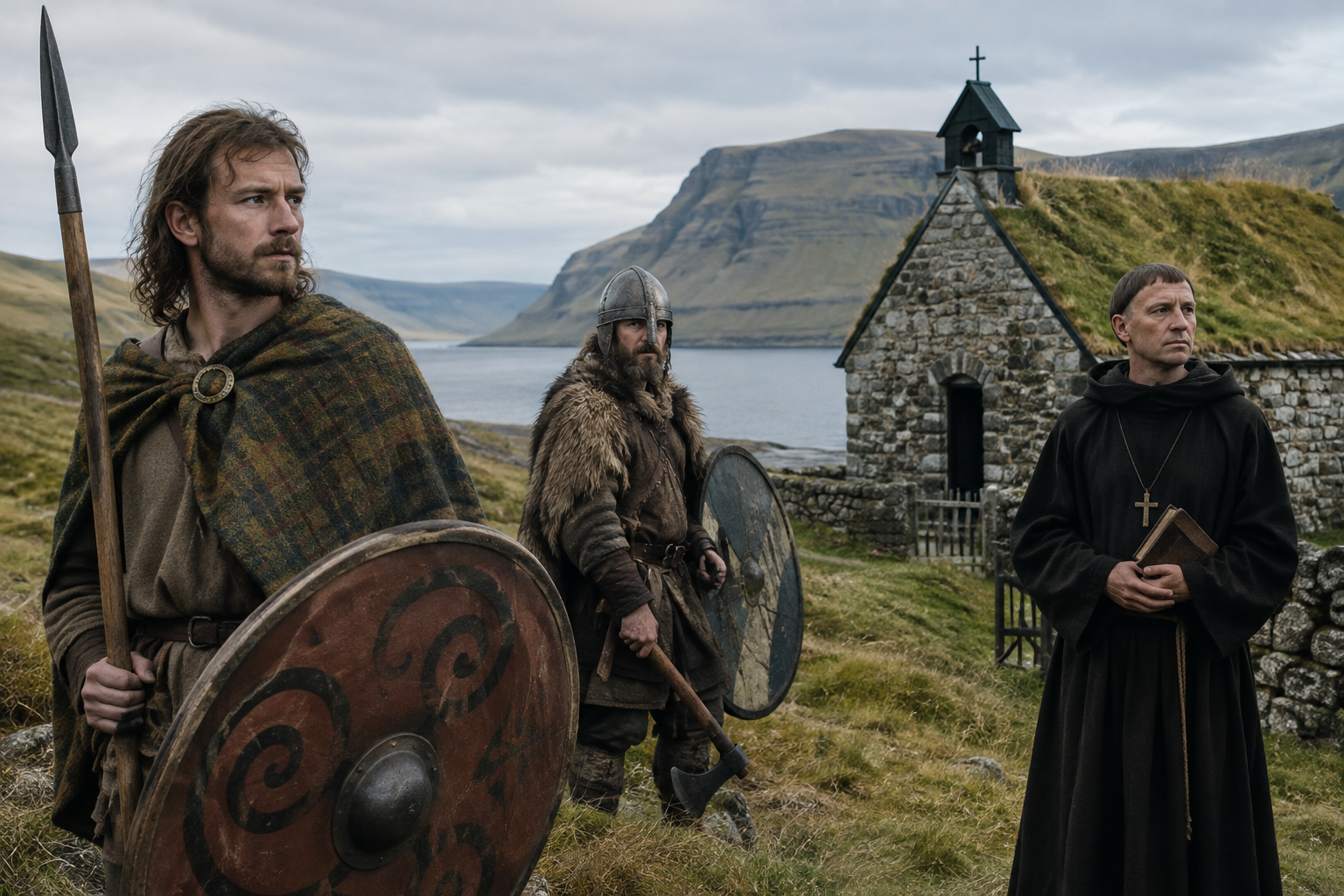
Some Y-chromosome lineages are famous because they are broad and common. Others are interesting because they let us watch history narrowing into something more local, more human, and more traceable across real landscapes. Haplogroup R1b1a1b1a1a2c1a1f1 belongs in that second category: a very specific paternal branch within the wider R1b family, a lineage complex deeply important in the genetic history of western Europe.
That immediately calls for one important caution. Y-DNA tracks only a direct paternal line: father to son to son to son. It does not describe a person's whole ancestry, culture, language, or identity. Still, because surnames, lordship, and dynastic memory have often followed paternal lines in many parts of Europe, Y-DNA can offer a particularly intriguing way into the past. In a branch such as R1b1a1b1a1a2c1a1f1, what matters is not only the big story of R1b in Europe, but the smaller and more revealing question of how a narrower male lineage appears across Iron Age Britain, Viking Age Scandinavia, and the North Atlantic world.
The wider haplogroup R1b is one of the major Y-chromosome lineages of western Europe today, and its deeper history is usually discussed in connection with later prehistoric population changes, especially those that followed Bronze Age movements linked to steppe-derived ancestry. But we should not lazily pour the whole story of broad R1b into one tiny downstream branch. A subclade like R1b1a1b1a1a2c1a1f1 represents a much more specific twig on a large paternal tree, and its own history may have become regional long after the wider R1b expansion had already happened.
What the supplied evidence does suggest is an Atlantic and northern European setting. One sample places this paternal line in Iron Age Britain, another in Viking Age Norway, and another in the Faroe Islands in the early modern period. That does not prove a single uninterrupted pedigree linking them all, but it does show that this lineage, or very near relatives of it, belonged to the kind of male networks that moved between Britain, Scandinavia, and the northern seas over many centuries.
Readers interested in the bigger prehistoric background behind western European paternal lineages may also enjoy this broader look at early population change:
The most vivid way to approach this haplogroup is through actual individuals. Ancient DNA is so arresting because it takes what might seem an abstract string of letters and plants it in a grave, a valley, a churchyard, or a farmstead.
One especially important anchor is I21182, described as a Celtic Briton from Yarnton, Oxfordshire, England, dated to 200 BC. This places the lineage in southern Britain before the Roman conquest, in an Iron Age setting usually associated with local British communities rather than later medieval or early modern identities. It is a useful reminder that paternal lines later found in Scotland, Scandinavia, or the North Atlantic may already have been part of Britain long before Rome, let alone the Vikings. That does not make I21182 the ancestor of anyone in particular. It does, however, show that this branch had a place in pre-Roman Britain.
Then there is VK386, a Viking Age Warrior from Oppland, Norway, dated to 900 AD. Here the same narrow paternal world turns up in a very different historical setting: inland Norway during the Viking Age, the age of raiding, trade, lordship, and maritime expansion. A sample like VK386 does not tell us that the lineage was "Viking" by essence; haplogroups are not ethnic badges. But it does show that men carrying this paternal branch were present in Scandinavian society at precisely the period when Norse mobility reshaped the North Atlantic.
Finally, VK242 from Sandoy Church, Faroe Islands, dated to 1600 AD, shows the lineage in the later North Atlantic world. By that date, the Faroe Islands were long settled, Christian, and woven into a Norse-derived maritime culture with layers of contact reaching back to Norway, the British Isles, and beyond. The appearance of this branch there fits very neatly with what historians already know about North Atlantic settlement patterns: sea routes did not merely move goods, but also families, households, and paternal lines.
If you would like to explore that island context further, this community article offers a good companion piece:
Taken together, these three samples suggest something historically quite elegant. The lineage appears first in Iron Age England, then in Viking Age Norway, then in the Faroe Islands centuries later. One must be careful here. This sequence does not prove that the branch moved in a simple one-way line from Britain to Norway to the Faroes. Ancient DNA rarely gives us such tidy stories. The traffic between Britain and Scandinavia was complicated, and some paternal branches may have circulated around the North Sea long before they ever entered our datasets.
Still, the pattern is meaningful. It fits a world in which the North Sea and the North Atlantic were not barriers but busy corridors. Men carrying closely related Y-lines could belong to British Iron Age communities, Norse warrior society, and later island populations. Genetics does not flatten those societies into one people. Rather, it reveals how male lineages can persist while languages, kingdoms, religions, and political loyalties change around them.
For a wider look at this mobile Scandinavian setting, there is a natural companion here:
That brings us to Scotland, where paternal memory, place, and family identity often became tightly bound together. The supplied associations point to Clan Buchanan and Clan MacGregor, not as genetically proven carriers of this exact haplogroup in every case, but as historically resonant families rooted in the same broad northern British world where such paternal branches might matter to readers tracing ancestry.
Buchanan Auld House in Stirlingshire was the old seat of the chiefs of Clan Buchanan, near the village of Buchanan. It began as a tower house and was later enlarged, serving for centuries as the center of the Buchanan estate and of local authority. By the nineteenth century the family had long moved on, and the old house declined into ruin before eventual demolition in the twentieth century. There is something almost painfully apt about that. A Y-line survives in test results and ancient burials; the house that once symbolized power can disappear almost entirely. Genetics and archaeology often preserve what masonry forgets.
The site matters because it stood in the Lennox, a region where lordship, kinship, and territorial identity were once intensely local. For readers carrying a paternal branch associated with this wider historical zone, places like Buchanan Auld House are not proof of descent, but they are part of the historical stage on which later paternal histories unfolded.
Likewise Meggernie Castle in Glen Lyon, Perthshire, linked here with Clan MacGregor, preserves another side of Highland history. It began as a laird's house in the late sixteenth century, probably built by the Menzies family around 1570, and was strengthened in the early seventeenth century with a thick-walled tower and barmkin in a region still shaped by rivalry and cattle raiding. In 1644, during the wars of Montrose, it was attacked and burned by Archibald Campbell of Glenlyon, then later rebuilt and enlarged. Over the eighteenth and nineteenth centuries it became a more comfortable country house without losing its defensive core.
That is not just castle romance. It is a reminder that paternal lines persisted through turbulence: feud, rebuilding, movement between old tower houses and newer residences, the rise of one branch and the fading of another. The historical clans of Scotland were never genetically uniform tribes, but they did preserve a strong sense that family and land belonged together.
For readers drawn to that Scottish context, this related article offers a closer look:
R1b1a1b1a1a2c1a1f1 is historically interesting because it sits at the meeting point of several worlds: Iron Age Britain, Viking Age Norway, the island societies of the North Atlantic, and the later clan landscapes of Scotland. That does not mean everyone with this haplogroup today is "Celtic," "Viking," or descended from a named clan chief. Haplogroups are lineages, not ready-made identities.
What they do offer is a disciplined way of thinking about continuity. A direct paternal line can outlast shifts in language, religion, and political allegiance. Ancient DNA shows us that this kind of lineage can appear in very different historical settings, while castles and clan traditions show how later societies organized memory around fathers, sons, land, and inheritance. The result is not a fairy tale of perfect descent, but something better: a sober, evidence-based glimpse of how deep male ancestry sometimes intersects with the written and architectural record.
If you would like another British comparison point for how genetics illuminates early populations without reducing them to slogans, this is well worth reading:
If your own Y-DNA falls within a branch like R1b1a1b1a1a2c1a1f1, MyTrueAncestry can help you place that paternal line into a much wider historical frame, comparing your DNA with ancient individuals such as I21182, VK386, and VK242, and with the populations among whom they lived. Those matches can offer remarkable clues and context, even when they do not prove direct descent from a particular ancient person, clan, or noble family.
Upload your DNA and see where your paternal story meets the archaeological record.






Comments