Haplogroup R1b1a1b1a1a2c1a1e

– 6 min read


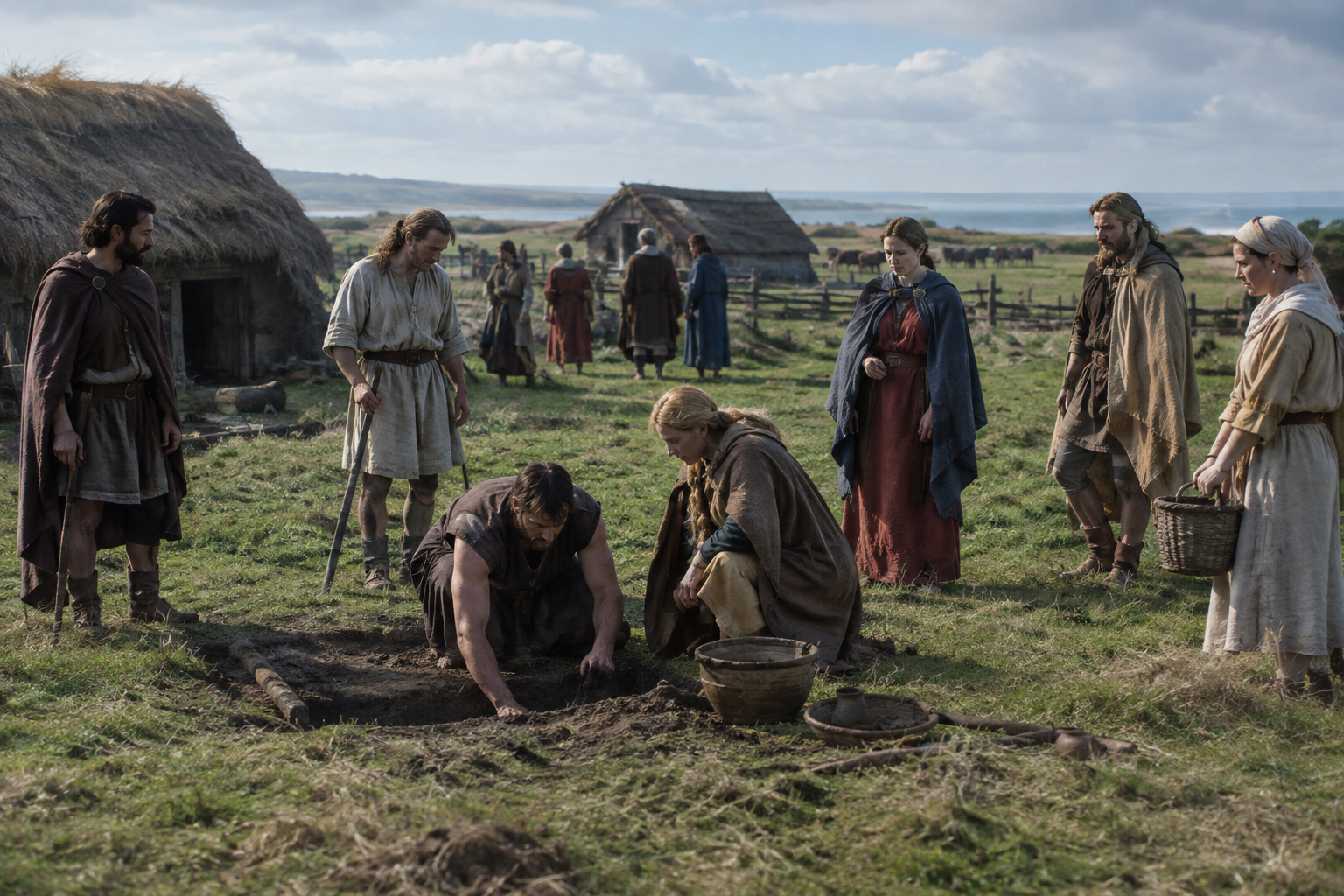
Some Y-DNA haplogroups announce themselves with famous royal pedigrees or sweeping migration legends. R1b1a1b1a1a2c1a1e is more interesting for a different reason: it appears not as a neat dynastic badge, but as part of a long and rather human story spread across prehistoric Britain, Iron Age communities, Roman-era movement, and later medieval landscapes. That makes it especially useful for MyTrueAncestry readers, because it reminds us what a Y-chromosome lineage really is: a direct paternal thread, one line among thousands in the making of any real person.
This branch sits within the wider R1b family, one of the major Y-chromosome groupings in western Europe. For a lineage this specific, caution matters. We should not simply pour the whole history of broad R1b into this narrower branch as if nothing changed along the way. Still, the ancient DNA evidence supplied here suggests a pattern worth following: strong appearances in Britain from the Bronze Age into the Iron Age, further presence in Roman and post-Roman contexts, and links across the North Sea world and parts of continental Europe. That is not proof of one tribe, one ethnicity, or one noble bloodline. It is something better: a map of where one paternal branch turns up in the historical record.
The earliest supplied samples already place this paternal line in strikingly old contexts. We see it in Bell Beaker and early Bronze Age Britain, including I4950 from Bell Beaker Wiltshire Upavon England dated 2300 BC, I5379 from Bell Beaker Canada Farm Dorset England dated 2383 BC, and I2417 from Bronze Age Amesbury Down Wiltshire England dated 2300 BC. Add I3256 from Bronze Age Trumpington Meadows Cambridge England dated 2100 BC, I5377 from Early Bronze Age England Thames dated 1800 BC, and dfb002 from Bronze Age England Dorset Cranborne Chase Down Farm Pond Barrow dated 1900 BC, and a picture begins to emerge of deep time continuity in southern Britain.
That does not mean this exact subclade originated in every one of these places, nor that all Beaker-associated men carried it. But it does show that paternal lines within this part of the tree were established in Britain very early indeed. The presence of Rathlin2B from Ireland Copper Age dated 1880 BC and I5473 from Bronze Age Boatbridge Quarry South Lanarkshire Scotland dated 2250 BC pushes the story west and north across the Irish Sea zone too.
If you want a wider archaeological backdrop for how lineages like this became so prominent in western Europe, the community article on Bell Beaker population change is a useful companion.
Explore Bell Beaker population change
Where this haplogroup really comes alive is Iron Age Britain. The supplied list is packed with men from East Yorkshire, especially the Parisi and the Arras culture world around Wetwang Slack and Pocklington. There is an almost dizzying cluster here: I36889, I36880, I36885, I36974, I37335, I37336, I37342, I37344, I39724, I36993, I36867, I36869, I36870, I36843, I36844, I36845, I36972, I36819, I36827, I36922, I36923, I36791, I36805, I36765, I31019, I31515, I31008, I31010, I37175, I30989, I30992, I30970, and many more from Wetwang Slack, Pocklington, Melton, and Burton Fleming, mostly around 225 BC.
This concentration matters. It suggests that paternal lines within this branch were not isolated curiosities, but part of the social fabric of Iron Age eastern Yorkshire. The elite sample I36995, described as an Elite Celtic Parisi Chariot Burial Iron Age England East Yorkshire Wetwang Slack Year:225 BC, is particularly evocative. Not because he can be turned into a tribal king from a schoolbook, but because he places the lineage in a burial tradition associated with status, ceremony, and local identity.
Yet the same paternal branch is not confined to Yorkshire. There is I21182 from Celtic Briton Oxfordshire Yarnton England Year:200 BC, I11991 from Iron Age Worlebury Somerset England Year:150 BC, and I21309 from Iron Age Hillfort Battlesbury Bowl England Year:57 BC. Then, in Dorset, a substantial group appears among the Durotriges at Duropolis Winterborne Kingston around 125 AD: WBK12, WBK20, WBK29, WBK41, WBK05, WBK30, WBK43, WBK06, WBK08, WBK18, and WBK191. That spread across Yorkshire, Oxfordshire, Somerset, Wiltshire, and Dorset makes nonsense of any simplistic idea that one Y-line equals one tribe.
For readers interested in how archaeogenetics is changing our understanding of Celtic-speaking Britain, this related article is well worth a look.
Read about Celtic origins and spread
One of the most revealing features of this haplogroup is that it does not stop at Iron Age Britain. KNF006 from Roman Era England Knobbs Farm Somersham Year:200 AD shows the lineage still present in Roman Britain. That by itself need not imply dramatic migration; it may simply reflect local continuity under Roman rule. But other samples broaden the map considerably.
I26776 from Imperial Roman Era Zadar Croatia Year:200 AD places the branch on the eastern Adriatic in a Roman imperial setting. R10488 from Late Roman Conimbriga Portugal Year:330 AD carries it to Iberia, while R10656 from Late Roman Era Klosterneuburg Lower Austria Year:407 AD shows it on the Danubian frontier. Then come post-Roman and early medieval finds such as SZL013 from Post Roman Period Szeleste Savaria Pannonia Prima Hungary Year:525 AD, IND013 from Merovingian Grave North Rhine-Westphalia Germany Year:600 AD, ST2025 from Early Medieval Belgium Sint-Truiden Groenmarkt Year:900 AD, and ST1308 from Medieval Belgium Outsider Sint-Truiden Onze-Lieve-Vrouwekerk Year:900 AD.
This is exactly the sort of evidence that ancient DNA handles well and old-fashioned ethnic labels handle badly. A paternal lineage can persist locally, travel through military service, spread through marriage networks, or arrive with smaller-scale movement that leaves little trace in chronicles. In other words, a haplogroup is not a nationality. It is a clue to male-line history.
If Roman-period mobility interests you, especially across western provinces, readers may also enjoy this broader look at Iberia under Roman rule.
Explore Roman Hispania's legacy
How, then, do we connect such ancient finds to later noble houses? Carefully. The supplied families and castles are best understood as historical settings in regions where long-lived paternal lineages could persist, divide, and reappear, not as proof that a particular chieftain at Wetwang Slack fathered a medieval lord of Normandy or Argyll.
Take Scotland first. The Bronze Age and later British evidence makes the Scottish material especially suggestive in regional terms. Clan MacColl is associated here with Loch Fyne, that long sea loch in Argyll which functioned for centuries as a route of travel, fishing, and power. It is exactly the kind of landscape where old lineages might endure while absorbing new identities over time. Clan Dundas brings us eastward to Dundas Castle near South Queensferry, with its fifteenth-century tower house and later Gothic additions, a reminder that medieval lordship often sat on sites with much older roots. Clan Abercrombie's Airthrey Castle near Stirling, though largely an eighteenth-century house, stands in another ancient corridor between Lowland and Highland worlds. Clan Watson, represented by George Watson's College in Edinburgh, points not to a fortress but to urban continuity, education, and the way family memory can be preserved in institutions as much as in battlements.
On the other side of the Channel stands the House de Harcourt and Chateau de Harcourt in Normandy, one of the oldest surviving medieval castles in France. Its layered earthworks and stone defenses belong to a world transformed by the Norman period, but Normandy itself was never cut off from the deeper prehistoric and Iron Age history of northwestern Europe. The same is true of House Stapleton at Carlton Towers in North Yorkshire, where the medieval manor later became a dramatic Gothic revival house, and of the House of Liddell at Ravensworth Castle in the border country near Gateshead, a region long shaped by warfare and shifting loyalties. House Devereux at Chartley Castle in Staffordshire adds a Tudor chapter, famously linked to Mary Queen of Scots and the Babington Plot.
What unites these places is not a proven shared Y-chromosome. It is that they occupy regions where ancient paternal lines had been circulating for millennia before surnames, heraldry, and castles were invented. Genetics gives us the deep background; family history gives us the later costume.
Readers curious about one of these families can follow the Stapleton story further in the community archive.
R1b1a1b1a1a2c1a1e seems, from the evidence supplied here, to be a lineage with a strong footprint in Britain from the Beaker and Bronze Age onward, a remarkable density in Iron Age eastern Yorkshire, and a later presence across Roman and early medieval Europe. That pattern fits a world of both continuity and movement: old male lines rooted in local landscapes, yet perfectly capable of turning up in ports, frontier towns, forts, churchyards, and noble territories far from their earliest known appearances.
And that, perhaps, is the most useful lesson. Y-DNA can illuminate one direct paternal line with extraordinary clarity, but it does not define a whole people, a whole nation, or a whole family. A shared haplogroup can show that two men belong somewhere on the same paternal branch of the human tree. It does not, without much closer evidence, prove recent kinship or descent from the same medieval lord.
MyTrueAncestry lets you explore precisely these kinds of connections: not fairy-tale claims of instant nobility, but the much more interesting question of where your ancient genetic parallels appear in the archaeological record. Upload your DNA and see whether your results resonate with individuals like I36995 in Iron Age Yorkshire, KNF006 in Roman England, or even later samples from Belgium, Germany, Hungary, and beyond. The comparison may not identify a direct ancestor, but it can place your paternal story in the real landscapes of the past.






Comments