Haplogroup R1b1a1b1a1a2c1a1d7

– 6 min read


Some Y-chromosome lineages are famous because they turn up in royal tombs or in sweeping migration stories across half a continent. Others are interesting for a quieter reason: they appear again and again in one region, across long stretches of time, reminding us that history is not only conquest and replacement but also persistence. That is a useful way to approach the Y-DNA haplogroup R1b1a1b1a1a2c1a1d7.
This is a very specific paternal branch within the much larger R1b family, a major Y-chromosome lineage found widely in western Europe today. With a subclade this narrow, caution matters. We should not simply pour the entire story of broad R1b into this one twig on the tree. What ancient DNA can do, however, is place this lineage in a meaningful setting. The supplied evidence points strongly toward Britain, especially Iron Age and later medieval England, and that makes this haplogroup historically interesting for anyone exploring paternal ancestry in the British Isles. As always, Y-DNA traces one direct father-to-son line only; it does not describe a person's whole ancestry.
In broad terms, R1b lineages are deeply important in later prehistoric and historic western Europe. But when we narrow down to R1b1a1b1a1a2c1a1d7, the safest thing is to focus on what the evidence in front of us actually suggests: a lineage with visible roots in ancient and medieval Britain, especially in England.
That matters because Britain has become one of the best laboratories for archaeogenetics. Ancient burials now let us compare paternal lines from the Bronze Age, Iron Age, Roman period, and Middle Ages, not as abstract populations but as actual men buried in caves, cemeteries, monastic grounds, and formal graves. In that sense, this haplogroup sits at the meeting point of genetics and local history. It is not merely a label on a tree; it is part of the story of how male lines endured, shifted, and reappeared across centuries.
Explore Celtic Origins and DNA
The most striking thing about the supplied ancient samples is their concentration in England and their spread across time. They do not give us a single dramatic founding event. They give us something more valuable: a series of snapshots.
The earliest is I16469, from Late Bronze Age Raven Scar Cave North Yorkshire England, dated 995 BC. Cave contexts always make one pause. They can preserve remains in unusual ways and they often hint at practices outside the ordinary village burial ground. This sample places the paternal background associated with this haplogroup, or a closely related branch, in northern England before the classic La Tene-flavored Iron Age world of chariots and tribal names. It suggests that whatever later Iron Age societies emerged in Yorkshire, they were not built from nowhere.
Then we move into East Yorkshire and into one of the most evocative archaeological landscapes in Iron Age Britain: the territory associated with the Celtic Parisi. At Wetwang Slack, three individuals stand out: I36883, I36762, and I30965, each dated 225 BC. Wetwang Slack is famous because it sits in a region where burial customs, including chariot burials, have long attracted attention. These men are not just data points; they belong to a society that was visibly expressing status, identity, and local tradition in the ground.
Nearby there is also I28778, from Celtic Parisi Iron Age England East Yorkshire Melton, dated 270 BC. Together, the Melton and Wetwang Slack finds make East Yorkshire look less like an isolated archaeological curiosity and more like a place where particular paternal lines were established over generations. That is not proof that all Parisi men shared the same lineage, still less that a later family descended directly from them. But it does support the idea of regional continuity in male lines across pre-Roman Britain.
Further south, I21182 from Celtic Briton Oxfordshire Yarnton England, dated 200 BC, broadens the map. Now the signal is not confined to Yorkshire. The lineage appears in central-southern England too, in a different local context. That kind of distribution is important. It suggests that this paternal branch, or very near relatives, belonged not to one tiny isolated enclave but to a wider British population network in the Iron Age.
Discover Iron Age Britain Through DNA
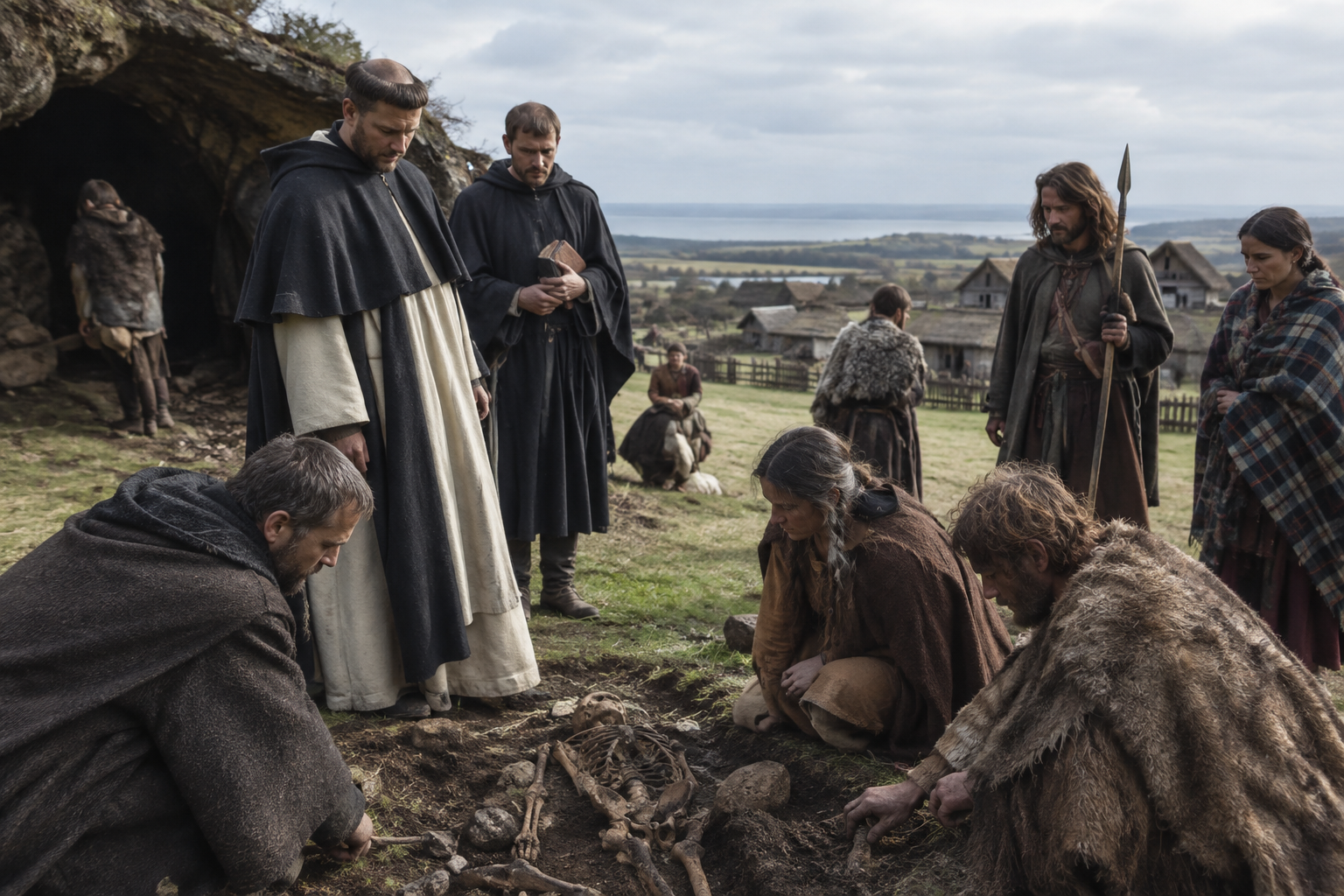
The medieval samples are perhaps the most revealing of all, because they show this paternal signature surviving into a documented historical world. Two individuals, ATP_PSN_512 and ATP_PSN_520, are listed as Medieval England Augustinian Friars, dated 1290 AD.
There is something almost deliciously inconvenient here for old-fashioned genealogy. Friars are not the sort of people who leave obvious dynastic descendants. Yet they are immensely useful to genetic history. They show us that a paternal lineage seen in Iron Age and earlier Britain could still be present in medieval English male populations, now living under the institutional structures of the Church, the crown, and town life. In other words, the same broad paternal thread can run from tribal burial grounds to monastic communities without needing a romantic family saga to connect them.
This is exactly why ancient DNA matters. Written pedigrees usually begin late and favor the powerful. Genetics reaches far below that level. It catches ordinary and semi-ordinary men as well as elites, and it allows us to ask whether a lineage stayed rooted in a region through Roman rule, Anglo-Saxon settlement, Viking activity, and Norman lordship. In this case, the pattern is consistent with deep British continuity, though the exact route from Bronze Age Yorkshire to medieval friars can never be reconstructed person by person.
Read About Roman and Early Medieval Britain
How does this connect to later noble history? Carefully, and with proper restraint.
The supplied family connection is Clan Tuite and Crover Castle in County Cavan. The site, near Lough Sheelin, seems to have begun as an early fortified house or castle and later became part of a larger landed estate shaped by the upheavals of plantation-era Ireland. As so often in Ireland, one place contains several layers of history at once: medieval defense, shifting landholding, changing political power, and eventually the development of a grander country house nearby as fashions changed.
That layered story makes Crover interesting in the context of a British and Irish paternal lineage. A castle or fortified house is not genetic proof of anything. It does not certify that every man associated with Clan Tuite carried this haplogroup, nor does it demonstrate direct descent from any of the ancient English samples. But it does anchor the conversation in a real historical landscape where male lineages, inheritance, lordship, and memory mattered enormously.
County Cavan itself sits in a region where Gaelic, Anglo-Norman, and later settler worlds overlapped uneasily. A family seat such as Crover reminds us that paternal ancestry is not only about prehistoric migrations. It is also about the medieval and early modern habit of rooting authority in land, walls, water, and name. By the time the old castle faded and a larger estate house emerged nearby, the site had already lived several lives. That is rather like a haplogroup: the lineage persists, but its social meaning changes with the centuries.
Explore the Story of Clan Tuite
So what does R1b1a1b1a1a2c1a1d7 reveal? First, it points us toward a paternal story with strong roots in Britain, supported here by samples from North Yorkshire, East Yorkshire, Oxfordshire, and medieval England. Second, it shows how ancient DNA lets us follow a male line across very different societies: Late Bronze Age communities, Iron Age Britons including the Parisi sphere, and Christian religious life in the Middle Ages.
What it cannot do is prove that a present-day tester descends from a named Iron Age man, or from Clan Tuite, or from the builders or holders of Crover Castle. Shared haplogroups indicate shared paternal ancestry somewhere back in time, but often at a depth far older than surnames, castles, or written pedigrees. That is not a disappointment. It is the point. Genetics and history answer different questions, and when handled properly, they make each other more interesting.
If your own Y-DNA falls on a branch like this one, the excitement lies in context. Your direct paternal line may connect, at least distantly, to the same broad population world as men buried at Wetwang Slack, Melton, Yarnton, Raven Scar Cave, or the Augustinian friaries of medieval England. That is a historical connection, not a certificate of noble descent, and it is fascinating precisely because it is real.
Upload your DNA to MyTrueAncestry to explore whether your results show links to ancient individuals, archaeological cultures, and historic populations like those discussed here. Those matches cannot by themselves prove direct descent from a specific ancient person or noble family, but they can open a remarkably vivid window onto your deep paternal past.






Comments