Haplogroup R1b1a1b1a1a2c1a1d1a

– 6 min read


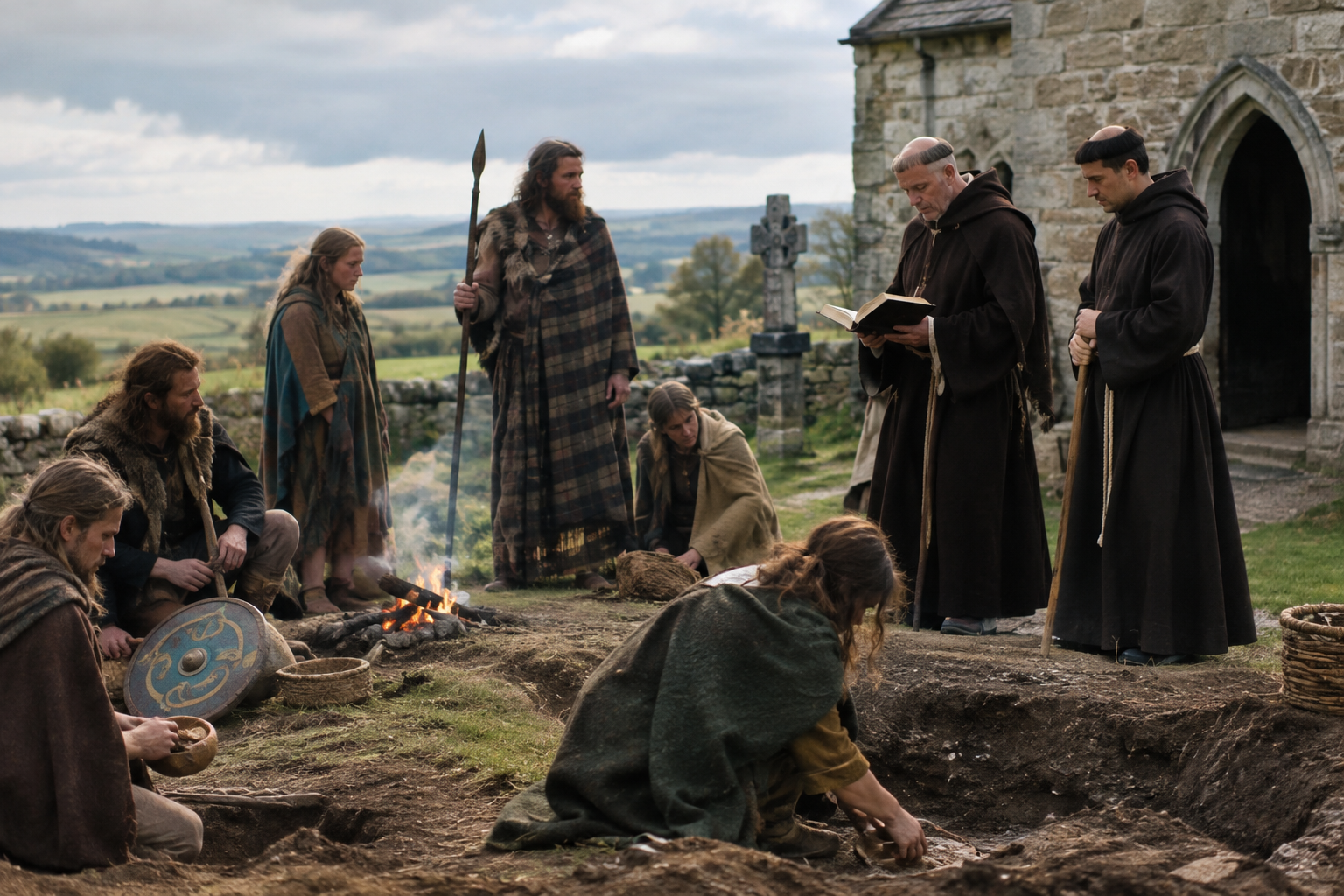
There is something wonderfully awkward, in the best historical sense, about a very specific Y-chromosome label such as R1b1a1b1a1a2c1a1d1a. It looks forbidding, almost machine-made, yet behind it lies a very human story: fathers and sons, burials and battlefields, monasteries and marches, caves and castles. A Y-DNA haplogroup traces one narrow line of paternal inheritance only, not a person's whole ancestry, but that narrow line can still illuminate surprising stretches of the past.
In this case, the most striking evidence supplied for this lineage clusters in Britain, especially northern and eastern England, with later historical associations reaching into Scotland and the Anglo-Scottish border world. That does not mean everyone in those regions shared this exact paternal line, nor does it allow us to assign a single ethnicity, dynasty, or language to it. What it does offer is a rare chance to watch one paternal thread appear in archaeology from the Late Bronze Age to the Middle Ages, and then to set that thread beside the later landscapes of houses such as Stewart, Beauclerk, and Clan Monteith.
This haplogroup belongs to the vast Y-chromosome family known as R1b, one of the major paternal lineages in western Europe. That broad statement is well established. But caution matters here: the long downstream branch R1b1a1b1a1a2c1a1d1a is not identical to all of R1b, and we should not simply pour the whole history of western European R1b into this one narrow subclade as if nothing changed along the way.
Still, the wider R1b framework helps. Ancient DNA has shown that different branches of R1b became important in later prehistoric Europe, especially during and after Bronze Age population shifts. For a lineage like this one, the safe historical approach is to look not for a grand single-origin legend, but for where it is actually turning up in dated remains. Here, the supplied evidence points toward long-standing paternal continuity in parts of Britain, especially Yorkshire, across very different archaeological worlds.
Readers interested in how ancient genetics has transformed this kind of historical reconstruction may enjoy a broader introduction to the field.
The earliest supplied glimpse comes from I16469, a Late Bronze Age individual from Raven Scar Cave, North Yorkshire, England, dated to 995 BC. Even without inventing more than the evidence allows, the setting is evocative. Cave contexts in later prehistory often remind us that the dead were not always placed in neat cemeteries or churchyards. This was a world before Roman towns, before medieval shires, before any Stewart king looked down from Stirling. Yet the paternal line represented here belongs to the same deep family tree as the later examples.
Then the record sharpens dramatically in Iron Age East Yorkshire. We have I28778 from Melton, dated to 270 BC, and a cluster from Wetwang Slack, dated to 225 BC: I36883, I36762, and I30965. These are associated with the Celtic Parisi of Iron Age England. That label itself needs careful handling: it is an archaeological and historical designation, not a genetic essence. But it does place these men in a recognisable regional society of later prehistoric East Yorkshire.
What makes this so interesting is not merely that one sample appears, but that several do. A repeated paternal signal in one region across multiple Iron Age burials suggests that this lineage, or closely related branches of it, was not some passing curiosity. It had become part of the local paternal landscape.
If you want to place these Yorkshire finds in the wider debate over Iron Age Britain, kinship, and burial practice, this related article is a natural next step.
By the time we reach the Middle Ages, the setting has changed almost beyond recognition. The dead are no longer in Iron Age cemeteries of East Yorkshire but in a Christian religious environment: ATP_PSN_512 and ATP_PSN_520, both from Medieval England Augustinian Friars, dated to 1290 AD. Here the paternal line appears in a literate, institutional, urbanising society, one full of monastic orders, legal records, and named lordships.
This is precisely where ancient DNA is so useful. Written genealogy tends to begin with people important enough to record. Genetics notices the uncelebrated as well. A friar, an Iron Age burial, a cave deposit: these are not footnotes to kings so much as alternate archives. The recurrence of this paternal branch in England across such distant periods may reflect regional persistence, though not uninterrupted proof of direct descent from one sampled man to another. Shared haplogroup is evidence of belonging somewhere on the same paternal branch, not of a documented family tree.
For readers who want a broader look at how England changed genetically across Roman and early medieval centuries, there is a useful companion piece here.
Read Roman and early medieval Britain
The historical associations supplied with this haplogroup move us north and west into the worlds of castles, marches, and noble houses. Here one has to be especially disciplined. A family linked with a haplogroup in community tradition or project context is not thereby genetically proven in every branch or every generation. Noble houses were complicated organisms: adoption, illegitimacy, remarriage, cadet lines, and simple documentary gaps all matter. Still, the regional settings are revealing.
House of Stewart brings us to Stirling Castle, perched on its volcanic crag above the River Forth. This was not simply a residence with nice views. It commanded the route between Highlands and Lowlands and became one of the central strongholds of Scottish history. During the Wars of Scottish Independence it stood close to some of the great set pieces of Scottish memory, including Stirling Bridge in 1297 and Bannockburn in 1314. Much of the surviving castle owes its form to the late fifteenth and sixteenth centuries, under James IV, James V, and Mary Queen of Scots, crowned there in 1543. It later became fortress, barracks, and restored monument. In a haplogroup story rooted partly in northern Britain, Stirling is a reminder that geography can outlast dynasties: chokepoints, crossings, and strongholds keep drawing power to themselves.
Clan Monteith, associated here with Talla Castle in Peeblesshire, offers a different register altogether. Not every ancestral stronghold was a royal showpiece. Talla Castle was a smaller tower house in an upland landscape shaped by raiding, kinship, and local authority. Associated with the Talla branch of the Tweedies, it belonged to a border world where survival could matter more than magnificence. Its ruins speak to a historical reality often missed in grand narratives: paternal lineages persisted not only through kings and earls, but through lesser families holding difficult ground.
Then there is the House of Beauclerk and Bestwood Lodge in Nottinghamshire, much later in date, beginning in the 1860s as a Gothic retreat for the Prince of Wales, later Edward VII. It sits within the older history of Bestwood as a medieval deer park and royal forest landscape. This is a useful reminder that aristocratic memory often layers itself over earlier terrain. A Victorian lodge may be newer than a medieval tower or royal castle, yet it still occupies ground long tied to rank, access, and controlled space.
For a closer look at one of these historically associated lineages, readers can follow the Stewart connection directly.
Explore the Royal House of Stewart
So what does R1b1a1b1a1a2c1a1d1a reveal? First, it shows how a paternal lineage can appear repeatedly in Britain across very different periods: I16469 in Late Bronze Age North Yorkshire, I28778 and the Wetwang Slack individuals in Iron Age East Yorkshire, and ATP_PSN_512 and ATP_PSN_520 in medieval England. That is historically significant because it suggests depth in place, not just movement.
Second, it shows why ancient DNA and historical records need one another. Genetics can reveal continuity where documents are silent; documents can reveal castles, offices, and conflicts where skeletons are mute. Put together, they help us see the difference between broad regional association and proven genealogy. A shared haplogroup may connect an Iron Age Yorkshire burial and a medieval friar at the level of deep paternal ancestry, but it does not make them members of the same known family. Likewise, historical links to Stewart, Beauclerk, or Monteith enrich the regional and cultural frame, but they do not by themselves prove exact descent from any sampled ancient man.
That, really, is the pleasure of the thing. History is not diminished by caution. On the contrary, it becomes more interesting when we can say: here is a paternal branch turning up in real people, buried in real places, from prehistoric Yorkshire to medieval England, and later echoed in landscapes of royal castles, border towers, and aristocratic estates across Britain.
If you have tested your DNA, MyTrueAncestry can help you explore whether your own results show connections to ancient individuals, archaeological cultures, and historical populations like those discussed here. Those matches do not automatically prove direct descent from a specific ancient person or noble family, but they can open a remarkably vivid window onto your deeper past.






Comments