Haplogroup R1b1a1b1a1a2c1a1c

– 6 min read


Some Y-chromosome lineages appear in the record only as brief flashes: a burial here, a grave there, a distant echo in a later kingdom. Haplogroup R1b1a1b1a1a2c1a1c is one of those intriguing cases. It belongs to the wider R1b family, a major branch of western Eurasian paternal ancestry, but this very narrow subclade has to be handled with care. A deep branch name can tempt us into grand certainty. Ancient DNA usually teaches the opposite lesson: the smaller the twig on the tree, the more cautious we ought to be.
That said, the pattern in the supplied ancient evidence is genuinely fascinating. This lineage sits within a broader paternal world strongly represented in Bronze Age and Iron Age Britain, and its sample trail stretches from Bell Beaker and early Bronze Age Britain to Iron Age Yorkshire, Roman Dorset, post-Roman southern England, and beyond to Roman and early medieval continental Europe. Y-DNA tracks one direct paternal line only. It does not describe a person's whole ancestry, culture, language, or identity. But as a historical tool, it can be wonderfully revealing.
The larger R1b family is widely associated in ancient DNA studies with major prehistoric and later western Eurasian paternal expansions. For a branch as specific as R1b1a1b1a1a2c1a1c, however, we should not simply pour the entire history of R1b into it as if nothing changed along the way. What we can say more safely is that this lineage appears in a landscape where later prehistoric Britain matters enormously.
Several of the earliest supplied samples place related paternal ancestry in Bronze Age Britain and Ireland. I4950, from Bell Beaker Wiltshire Upavon England Year:2300 BC, is especially important because it sits in the era when new paternal lineages became highly visible in Britain after the Beaker horizon. Nearby in time are I2417 from Bronze Age Amesbury Down Wiltshire England Year:2300 BC, I3256 from Bronze Age Trumpington Meadows Cambridge England Year:2100 BC, I5377 from Early Bronze Age England Thames Year:1800 BC, and Rathlin2B from Ireland Copper Age Year:1880 BC. Together, they suggest that the paternal background from which this later branch emerged was already well established across the islands in the early Bronze Age.
That wider prehistoric setting is worth exploring further in MyTrueAncestry's discussion of language, migration, and archaeology in Ancient DNA Reveals Central European Origins and Spread of Celtic Languages.
Explore Celtic origins in ancient DNA
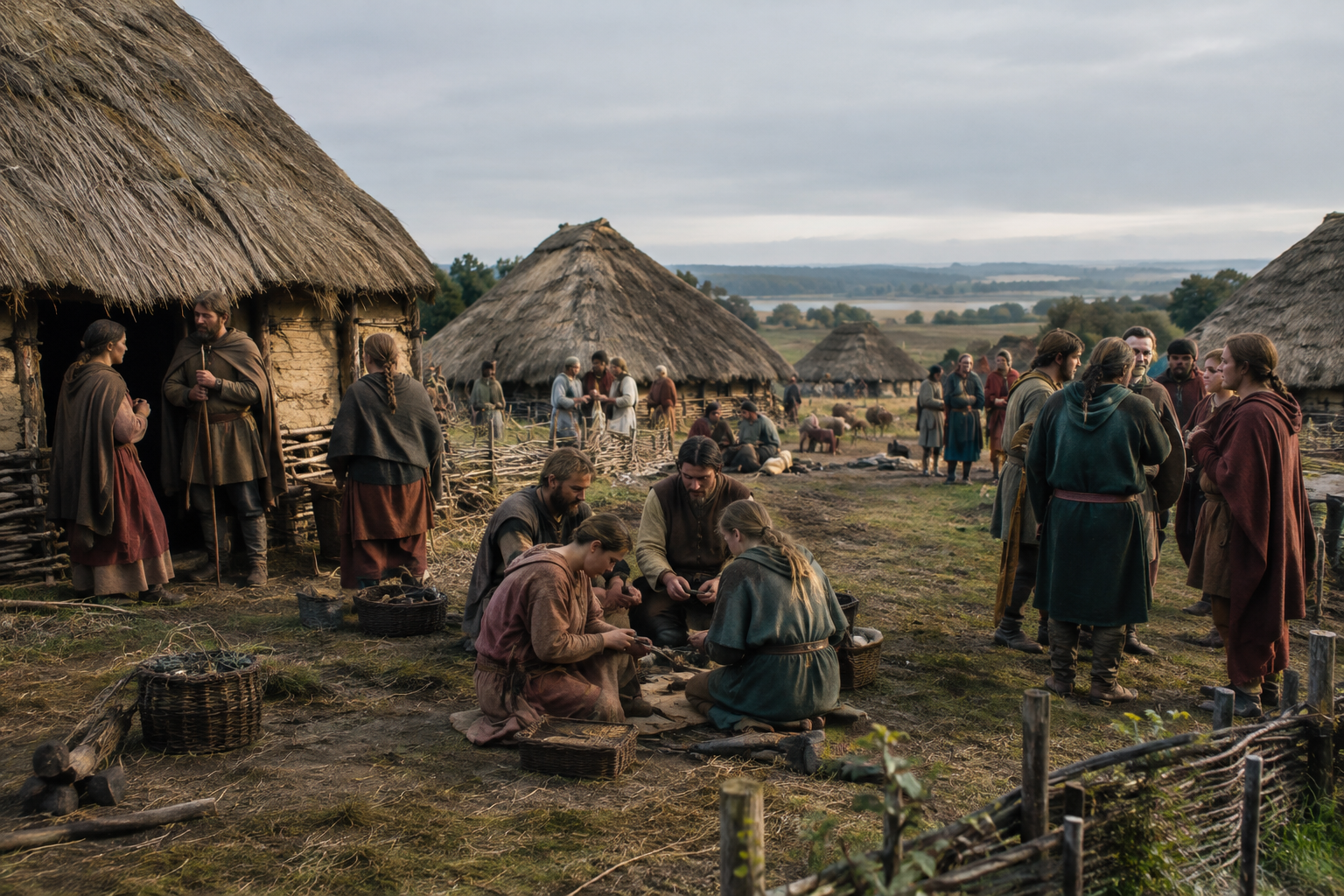
If there is a center of gravity in this sample set, it is Iron Age Britain. East Yorkshire in particular appears almost absurdly rich in evidence. The Parisi and the Arras culture are represented by a cluster of burials from Wetwang Slack, Pocklington, Melton, and Burton Fleming. This is not a trivial point. When a paternal lineage or its close surrounding branches recur in one region across multiple burials, it suggests not a lone traveler but a settled local pattern.
Wetwang Slack provides a remarkable run of individuals dated Year:225 BC: I36889, I36880, I36885, I36974, I37335, I37336, I37342, I37344, I36867, I36869, I36870, I36843, I36844, I36972, I36819, I36827, I36791, I36805, I36765, I31019, I31515, I31008, I37175, I30989, I30992, I30970, I36912, I36916, I36918, I36902, I37130, and I37134. There is also the striking I36995, listed as Elite Celtic Parisi Chariot Burial Iron Age England East Yorkshire Wetwang Slack Year:225 BC. Chariot burials are the sort of finds that make archaeologists sit up straight. They speak of status, local custom, and public display.
Nearby sites reinforce the point: I14100 from Celtic Briton Pocklington Yorkshire England Year:320 BC, I14102 and I14104 from Briton Pocklington Yorkshire England Year:225 BC, I21978 from Celtic Briton Iron Age England East Yorkshire Pocklington Year:225 BC, I21644 from Celtic Parisi Iron Age England East Yorkshire Pocklington Year:225 BC, I28771 and I28772 from Celtic Parisi Iron Age England East Yorkshire Melton Year:270 BC, and I28927 from Celtic Parisi Iron Age England East Yorkshire Burton Fleming Year:192 BC.
The effect is rather striking: a paternal signal visible not in one glamorous grave alone, but in a regional society. For readers interested in what kinship and community looked like in that world, the article Ancient DNA and matrilineal kinship in Iron Age Britain makes an excellent companion piece.
Discover Iron Age Britain kinship
Nor is Yorkshire the whole story. Southern and western Britain also appear in the record: I21182 from Celtic Briton Oxfordshire Yarnton England Year:200 BC, I11991 from Iron Age Worlebury Somerset England Year:150 BC, and I21309 from Iron Age Hillfort Battlesbury Bowl England Year:57 BC. Then come the Durotriges samples from Roman-period Dorset, all dated Year:125 AD: WBK12, WBK20, WBK29, WBK41, WBK05, WBK30, WBK43, WBK06, WBK08, WBK18, and WBK191, from Celtic Durotriges England Duropolis Winterborne Kingston. These are especially revealing because they show continuity of local paternal lines into the Roman era rather than a complete replacement by incoming males.
Once Roman power connected Britain to the wider empire, paternal lineages did not stop at provincial boundaries. The supplied evidence includes I26776 from Imperial Roman Era Zadar Croatia Year:200 AD, R10488 from Late Roman Conimbriga Portugal Year:330 AD, and R10656 from Late Roman Era Klosterneuburg Lower Austria Year:407 AD. This does not prove that one tidy male line marched from Yorkshire to Dalmatia to Lusitania to the Danube. What it does show is that the broader paternal branch behind this subclade belonged to a world of mobility extending across Roman Europe.
Even more interesting is the evidence for persistence after Rome. I11580 from Post Roman Era Worth Matravers Dorset England Year:600 AD points to continuity in southern Britain after imperial administration had gone. On the continent, IND013 from Merovingian Grave North Rhine-Westphalia Germany Alt-Inden Year:600 AD, ST2025 from Early Medieval Belgium Sint-Truiden Groenmarkt Year:900 AD, and ST1308 from Medieval Belgium Outsider Sint-Truiden Onze-Lieve-Vrouwekerk Year:900 AD show related paternal ancestry moving through the early medieval northwestern European world.
For readers drawn to that Roman-to-medieval transition in Britain, MyTrueAncestry's Genomic History and Natural Selection in Roman and Early Medieval Britain gives a broader framework for exactly this sort of continuity and change.
Explore Roman and early medieval Britain
This brings us, carefully, to medieval Wales. The supplied noble association is the House of Dinefwr, linked with Dinefwr Castle in Carmarthenshire. The castle stands above the Tywi valley and began as a stronghold of the kings of Deheubarth, with roots in the early medieval Welsh ruling world and especially in the time of Rhys ap Gruffydd in the 12th century. He made Dinefwr one of his chief seats of power.
Here one must keep one's head. A historical association with this haplogroup is not proof that every male in the House of Dinefwr carried R1b1a1b1a1a2c1a1c, nor that ancient Iron Age men in Yorkshire or Dorset were their direct ancestors in a documentary genealogical sense. But the broader point is still arresting. The same paternal landscape that appears repeatedly in prehistoric and Roman Britain forms part of the long biological background from which medieval Welsh dynasties emerged.
Dinefwr Castle itself embodies that continuity of place and power. After the Norman and then English advance into Wales, the site was reshaped as a stone castle in the later 12th and 13th centuries. It became entangled in the long struggle between native Welsh princes and the expanding authority of the English crown. After Edward I's conquest, its military importance faded, though it remained a potent symbol of Welsh lordship. Later the estate passed through noble hands before the nearby great house at Newton was built. Today, as a ruin in a deer park, it still carries the memory of princely Wales.
If you want to place Dinefwr in that wider national setting, the MyTrueAncestry articles on Welsh dynasties are the natural next stop.
Read about the Royal House of Dinefwr
What makes R1b1a1b1a1a2c1a1c interesting is not that it hands us a neat tribal label or a ready-made royal pedigree. Quite the reverse. It shows how a paternal lineage can be visible across very different settings: Bell Beaker and Bronze Age Britain, Iron Age Parisi cemeteries, Durotrigan Dorset under Rome, post-Roman communities, and medieval regions later ruled from places like Dinefwr Castle.
Ancient DNA is especially good at illuminating what written genealogy cannot reach. No medieval chronicler can tell us much about the men buried as I36995 in an elite chariot burial, or WBK12 in Roman Dorset, or KD061 from Bronze Age Orkney Westray Links of Noltland Year:1498 BC. Genetics cannot tell us everything about them either. But it can show that paternal lines persisted, shifted, and resurfaced across centuries in ways that link archaeology, landscape, and later history.
That larger Welsh setting is also worth exploring through MyTrueAncestry's Welsh Royalty, which helps place houses like Dinefwr in their full medieval context.
If this haplogroup appears in your own results, it offers a clue to one paternal line moving through the deep history of Britain and western Europe. It does not make you a Celt, a Roman, or a prince of Deheubarth. But it may place one line of your ancestry in the same long historical landscape as Iron Age chariot burials, Roman provincial towns, and the hilltop seat of Welsh kings.
Upload your DNA to MyTrueAncestry to see whether your results connect with ancient individuals like I4950, I36995, WBK12, or I11580, and to explore how ancient DNA comparisons can add historical depth to your family story, even when they do not prove direct descent from a specific noble house.






Comments