Haplogroup R1b1a1b1a1a2c1a1a2a

– 6 min read


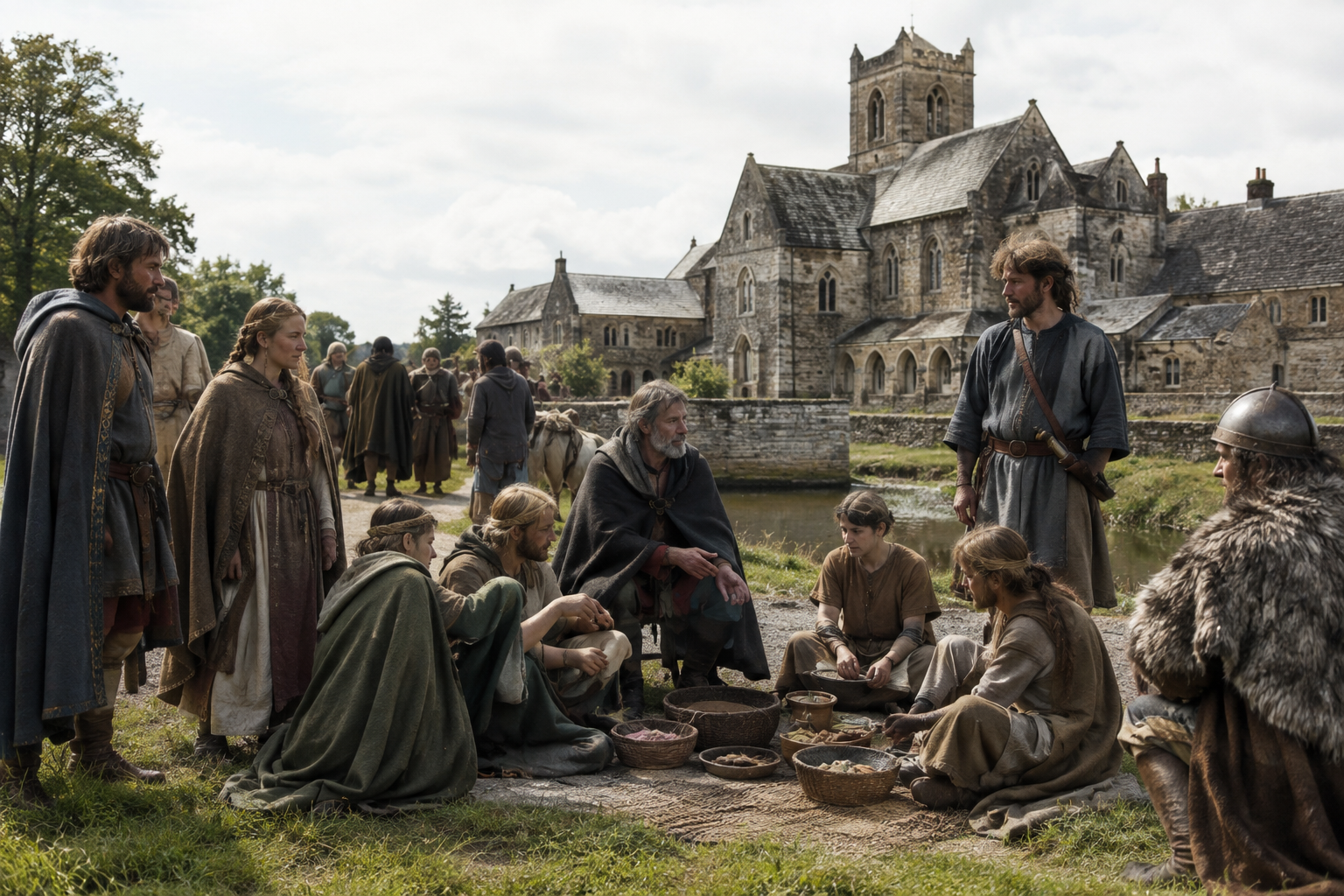
Some Y-chromosome lineages announce themselves in grand continental sweeps. Others are more interesting precisely because they seem, at least from the evidence in hand, to sit quietly inside a particular historical landscape. Haplogroup R1b1a1b1a1a2c1a1a2a belongs to the larger and very widespread R1b family, but the ancient samples supplied here make one point especially hard to miss: this is a paternal line with a striking presence in Iron Age and medieval Britain.
That matters because Y-DNA tells a very particular sort of story. It follows the direct paternal line only: father to son to son across the centuries. It does not describe a person's total ancestry, identity, or ethnicity. But when a lineage turns up repeatedly in excavated burials from the same broad region, it can illuminate patterns of continuity, movement, and social history that written sources alone could never reveal.
The haplogroup named here is a very specific downstream branch within the wider R1b tree. That wider R1b family is one of the major paternal lineages in western Europe today, and many of its branches have deep prehistoric roots tied to major population changes in later prehistory. Still, one must be careful. The full history of broad R1b cannot simply be pasted onto a narrow terminal branch such as R1b1a1b1a1a2c1a1a2a. What we can say responsibly is that this subclade appears in the ancient record provided here among men from Iron Age Britain and later medieval England, suggesting a paternal history embedded in the long human story of the British Isles.
That is already fascinating enough. Instead of chasing fantasies of a single "tribal founder," the better question is how such a lineage came to be present across Yorkshire, Oxfordshire, Bedfordshire, Cornwall, Lothian, Orkney, and medieval Cambridge. The answer is likely to lie in layers of settlement and reshaping over many centuries: the prehistoric arrival of R1b-bearing populations into Britain, later regional differentiation, and then local continuity through the Iron Age and beyond.
Readers interested in the bigger archaeological debate over how Celtic-speaking worlds may have formed will enjoy this related piece on ancient population movements and language spread.
Explore Celtic Origins Through Ancient DNA
The most arresting cluster of evidence comes from East Yorkshire, especially the territory associated with the Celtic Parisi. At Wetwang Slack and Pocklington, this paternal line appears again and again in burials dated to the later Iron Age. That is not a single stray result. It is a pattern.
Among the samples are I37337, I36824, I36784, I31513, I30983, I30978, I36909, I36800, I37136, and I37137, all described as Celtic Parisi Iron Age individuals from Wetwang Slack in East Yorkshire, mostly dated to 225 BC. Alongside them stand the Pocklington individuals I21955 and I21263 dated to 225 BC, and I21863 dated to 88 BC. Then there is one especially evocative burial: I36892, the Elite Celtic Parisi Chariot Burial from Wetwang Slack, dated to 225 BC.
Now, one must not turn a haplogroup into a social title. Sharing a paternal branch does not prove all these men were close kin, let alone one ruling dynasty. But the recurrence of the same lineage in this East Yorkshire setting suggests that at least one paternal line had become well established there by the Iron Age. And the inclusion of an elite chariot burial is a reminder that ancient DNA sometimes lets us glimpse not just populations, but social worlds: rank, burial custom, and the men who inhabited them.
Nor is the evidence confined to Yorkshire. Sample I14807 from Iron Age Thame, Oxfordshire, dated to 290 BC, pushes the story into southern England. I16597 from Broom Quarry, Bedfordshire, dated to 307 BC, does much the same. I16380 from Harlyn Bay, Cornwall, dated to 200 BC, shows the lineage on the far southwestern peninsula. This is not the footprint of one tiny local family. It looks more like a paternal branch distributed across multiple Iron Age British communities.
If you want a wider look at how family structure and burial practice can be reconstructed from British Iron Age genomes, this community article is a natural companion.
Discover Iron Age Britain and Kinship
The northern reach of this lineage is just as intriguing. I16499, from Iron Age North Berwick in East Lothian, Scotland, dated to 190 BC, places it on the eastern Scottish seaboard. I2799, from Iron Age Orkney, Scotland, dated to 25 BC, takes it farther north still. Those two finds matter because they hint that this was not merely an English lowland phenomenon. By the late Iron Age, the lineage appears in very different British settings, from the chalklands and farming districts of England to the island world of Orkney.
Then comes the medieval sample ATP_PSN_68, from Cambridge St Johns Hospital in England, dated to 1250 AD. That single burial cannot prove unbroken descent from any specific Iron Age man, of course. Ancient DNA is not a fairy tale in which one skeleton shakes hands with another across 1,500 years. But taken together, the pattern suggests that this paternal line remained present in Britain across a long span of time, surviving political change from pre-Roman chiefdoms to medieval Christian society.
That kind of long regional persistence is exactly why ancient DNA is so useful. Written genealogy in Britain usually begins late and concerns only a sliver of society. Genetics reaches further back, not to identify surnames in the Iron Age, but to show that some paternal threads endured through immense cultural change.
For a broader look at how these long continuities and shifts played out after Rome and into early medieval Britain, see this related article.
Read About Ancient DNA in Post-Roman Britain
Later historical families do not come with neat genetic labels attached, and it would be irresponsible to pretend otherwise. Still, noble houses and clan territories help us understand how paternal identity became anchored in landscape, memory, and power. In that sense, the supplied associations with Clan Gallagher and Clan Kerr are historically suggestive, even where they are not proofs of exact descent.
In County Donegal, Glenveagh Castle sits dramatically in Glenveagh National Park. Built between 1870 and 1873 by John George Adair, it is a much later castle than the Iron Age burials discussed above, and its history is shadowed by the Derryveagh evictions of 1861, when many tenant families were expelled after the killing of Adair's steward. After Adair's death, his American-born wife Cornelia improved the estate; later, in 1937, Henry Plumer McIlhenny restored it, filled it with art and furniture, and created the famous gardens. In 1975 he gave the estate to the Irish state, and today Glenveagh survives as one of Ireland's great romantic houses.
This is not an Iron Age fort, nor evidence of a Y-chromosome by itself. What it does preserve is regional memory: the later world of Donegal families, estates, displacement, and identity. Readers interested in the family context may want to continue with MyTrueAncestry's piece on the clan itself.
Explore the Story of Clan Gallagher
Far older in martial spirit is Ferniehirst Castle in the Scottish Borders, seat of the Clan Kerr. Built in the late 1400s above the Jed Water, it was shaped by the hard, violent life of the Anglo-Scottish frontier. It suffered attack more than once, including an English assault in 1523, and by the 1590s had become one of the grandest tower houses in the region, with its great keep and bold stair turrets. After the Union of the Crowns in 1603, the old raiding life of the Borders ebbed, and the castle shifted from fortress to family seat before later decline and restoration.
Ferniehirst is a good reminder that paternal history is never just about remote prehistory. The same broad regions where ancient lineages circulated later became border lordships, clan territories, and contested political zones. A haplogroup does not explain the Kerrs. But the long presence of related paternal branches in Britain helps provide the deeper human backdrop against which such families emerged.
So what should we make of R1b1a1b1a1a2c1a1a2a? Not that it belongs to one tribe forever, nor that it proves noble ancestry, nor that anyone carrying it today descends from a chariot-buried aristocrat in East Yorkshire. The evidence says something subtler and, in truth, more interesting.
It points to a paternal lineage present in multiple parts of Iron Age Britain, including a notable concentration among the Parisi burials of East Yorkshire, and still detectable in medieval England. It suggests a line that was part of the making of British populations before, during, and after the worlds later called Celtic, Roman, and medieval. And it shows how archaeology, genetics, and local history can be read together: skeletons from Wetwang Slack and Pocklington; an individual from medieval Cambridge; castles in Donegal and the Borders; all different forms of evidence, all preserving fragments of men's histories.
If you have this haplogroup in your own Y-DNA results, MyTrueAncestry may help you place that paternal line into a wider ancient context. It may reveal genetic similarities to ancient individuals like I36892, I21863, or ATP_PSN_68, while remembering that such matches do not by themselves prove direct descent or membership in any historical clan or noble house.
Upload your DNA and see where your own ancient connections may lead.






Comments