Haplogroup R1b1a1b1a1a2c1a1a1a1a1b

– 6 min read


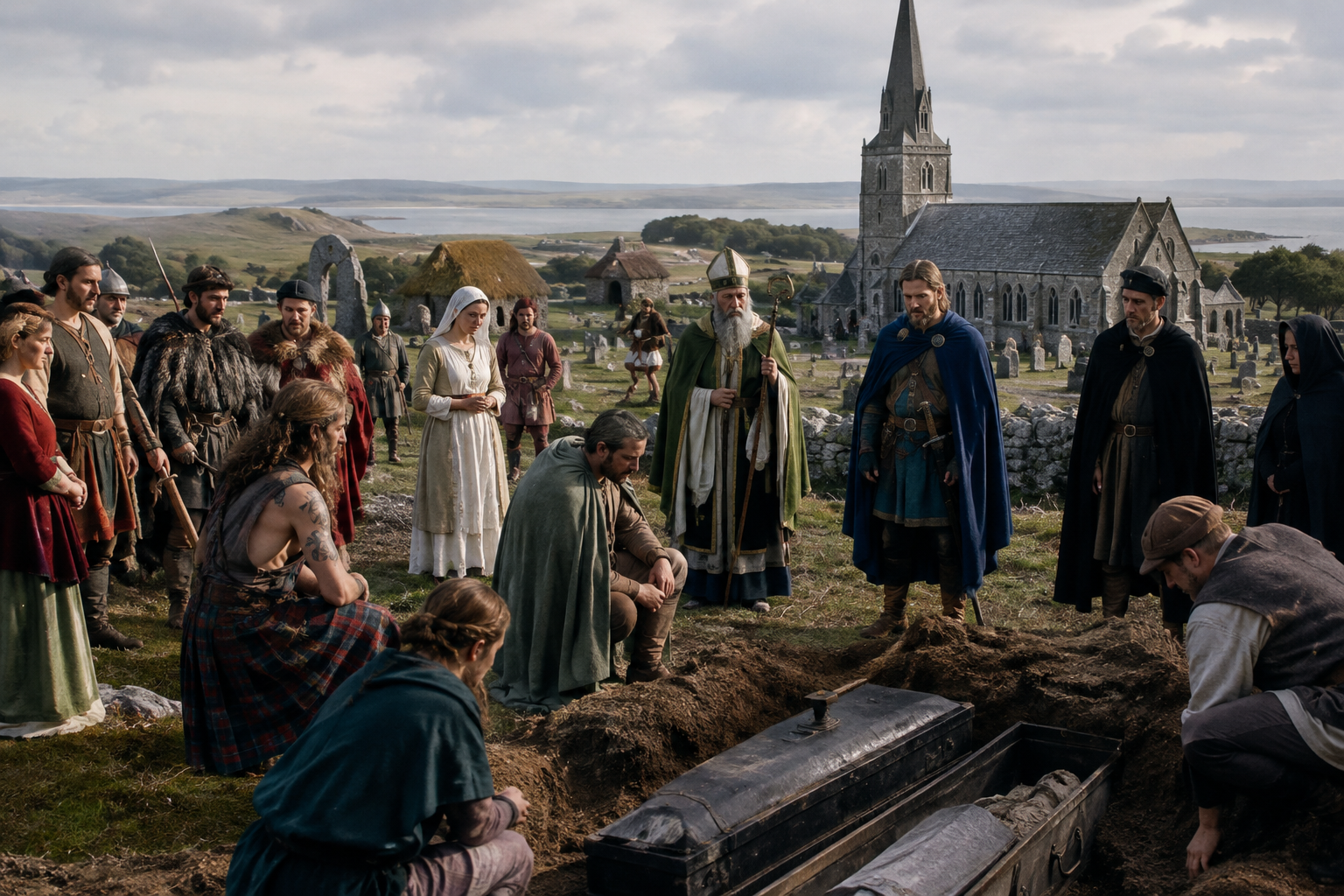
Some Y-DNA lineages announce themselves not through a single royal tomb or one dramatic battlefield burial, but by appearing quietly, persistently, across centuries and coastlines. The haplogroup R1b1a1b1a1a2c1a1a1a1a1b belongs to that sort of story. It sits within the wider family of R1b, one of the major paternal lineages of western Europe, yet this very specific branch should not simply be handed the entire history of R1b as if nothing changed along the way. The trick with a lineage this narrow is to keep both scale and caution in view: broad roots may lie deep in the old expansion of R1b across Europe, while the branch in front of us becomes historically visible much later, in the worlds of Iron Age Britain, early medieval northern Europe, and the North Atlantic.
Y-DNA traces one line only: father to son to son. That makes it powerful for studying direct paternal ancestry, but it is never the whole of anyone's heritage. A man may carry an ancient Y-line while most of his ancestors, like everyone else's, came from many different families and regions. Still, when a particular paternal branch turns up in ancient graves from France, Britain, Ireland, Germany, Denmark, the Faroe Islands, and even colonial Maryland, it gives us something wonderfully tangible: a line of evidence linking real men, real burials, and real historical landscapes.
The safest way to approach this haplogroup is through geography and chronology rather than grand ethnic labels. The samples supplied here point strongly toward a western and northwestern European setting. We find relevant ancient individuals in Iron Age France and Britain, then in early medieval Germany, England, and Ireland, and later in Viking Age and medieval Scandinavian-linked settings. That does not mean the branch "belonged" to one people in the modern sense. It suggests instead that this paternal line was part of the male population of the broader Atlantic and North Sea zone.
That matters because the North Sea was not a barrier. It was a road. Long before modern borders, people moved between what are now France, Britain, the Low Countries, Germany, Denmark, Ireland, and the North Atlantic islands. Trade, raiding, marriage, settlement, military service, monastic networks, and lordship all helped carry paternal lines from one shore to another. A lineage like this may therefore reflect both deep local continuity and repeated episodes of migration.
For readers interested in the bigger prehistoric backdrop behind western European paternal lineages, MyTrueAncestry has also explored the longer arc in Ancient DNA Reveals Central European Origins and Spread of Celtic Languages, which helps place later Iron Age western populations in a wider setting.
The oldest supplied samples are especially revealing because they show this lineage, or a very closely related paternal signal, already present in Iron Age western Europe. PECH8, from Aquitani Pech-Maho France dated to 350 BC, places it in southern France in a region connected to Mediterranean exchange as well as local Iron Age communities. Another French case, I19359 from Iron Age Chemin de Coupetz Marne France dated to 250 BC, moves the picture northward into a very different part of Iron Age Gaul. These are not the same local world, and that is precisely the point: the paternal line was not confined to one tiny pocket.
Across the Channel, I22060 from Iron Age Briton Thornholme East Riding of Yorkshire dated to 180 BC shows the lineage in pre-Roman Britain. That matters because it provides a clear anchor before the Roman conquest and before the later Anglo-Saxon and Viking migrations. If a later medieval man in Britain or Scotland carried a similar paternal branch, that would not by itself prove unbroken local descent, but it would remind us that such lineages were already on British soil centuries earlier.
The early medieval period then gives us a remarkable spread of contexts. DRH026 from the Thuringii Tribe Germany Deersheim Saxony-Anhalt dated to 500 AD, IND007 from a Merovingian Grave North Rhine-Westphalia Germany Alt-Inden dated to 600 AD, and SED005 from Anglo-Saxon Sedgeford England Norfolk dated to 600 AD together place this paternal signature in the migration-period and post-Roman world of Germanic-speaking regions and communities. Yet it would be a mistake to read the haplogroup as uniquely "Germanic." The same broader pattern also includes KIL043 from Medieval Ireland Kilteasheen Roscommon Bishops Seat dated to 650 AD, reminding us that the lineage also sat within Gaelic Christian Ireland.
If you want a wider view of how these centuries reshaped Britain and its neighboring regions, see Ancient DNA in Post-Roman Britain, which nicely complements the story told by SED005 and KIL043.
By the high medieval period, the map grows even more maritime. GRO005 from Carolingian Era Groningen Netherlands dated to 1040 AD points to the Low Countries, a region tied to North Sea trade and political change. VK24 from the Viking Age Faroe Islands Panum dated to 1050 AD carries the story out into the North Atlantic, where settlement depended on sea routes linking Scandinavia, the British Isles, and island communities on Europe's edge. Then CGG100512 from Medieval Jutland Denmark Vor Frue Kirkegard Aalborg dated to 1336 AD shows the lineage still present in Denmark in the later Middle Ages.
One can see the outline here without claiming too much: this haplogroup appears again and again in the connected coastal world stretching from France and Britain to the Low Countries, Germany, Denmark, and the Faroes. Ancient DNA does not give us a ready-made family tree for all these men, but it does show that a paternal line of this kind belonged to the populations who lived around the North Sea and helped make that region what it was.
For the Faroese and North Atlantic angle, readers may enjoy Faroese Genomes Reveal Ancestry and Selection, which broadens the background behind VK24.
That brings us, with due caution, to medieval Scotland. The associated noble context supplied here is Clan Stewart and Dundonald Castle in South Ayrshire. The site itself is older than the surviving ruin. It stands on a hill important long before the present remains were built, perhaps already used in the Iron Age and later as a royal center of the early Scottish kings. That is exactly the sort of place archaeologists love: a commanding landscape where power accumulates layer by layer.
In the late 14th century, Robert Stewart, later King Robert II, built the great tower house that still dominates the hill and made it one of the chief seats of the Stewart dynasty. After his death, Dundonald remained for a time a royal residence, though by the 16th century its political importance had waned as tastes shifted toward newer and more comfortable homes. What survives today is a ruin, yes, but a ruin with attitude: thick walls, commanding position, and the unmistakable ambition of a new royal house.
Now, genetically speaking, one must be careful. The appearance of this haplogroup in an article associated with Clan Stewart does not prove that every Stewart male bore it, nor that any ancient sample named above was a direct ancestor of Robert II. Written genealogy, dynastic politics, illegitimacy, adoption, and simple uncertainty all complicate such claims. What we can responsibly say is that the Stewart world emerged in a region where ancient paternal lineages of northwestern European type had very long histories, and where the same broad North Sea networks seen in the ancient DNA were also central to medieval politics.
Readers interested in the dynasty itself can continue with The Royal House of Stewart, which offers the historical setting for this famous Scottish line.
The final pair of supplied individuals takes the story across an ocean. I2097, the Son of Philip Calvert Lead Coffin Maryland dated to 1682 AD, and 2099, Philip Calvert Coffin Maryland also dated to 1682 AD, show the same paternal thread in colonial North America. Here the historical mechanism is no mystery at all: not prehistoric migration, not tribal movement, but documented early modern colonization. A lineage long established in Europe appears in Maryland because men carried it there.
That is a useful reminder that Y-DNA history operates on many scales at once. One branch can belong to an Iron Age Briton, a Merovingian burial, a medieval Dane, a Viking Age islander, a Gaelic ecclesiastical setting in Roscommon, and a 17th-century colonial family. The continuity is biological, but the identities are historical, and those are never identical things.
So what does R1b1a1b1a1a2c1a1a1a1a1b reveal? Above all, it shows how a paternal lineage can be tracked through the connected worlds of western and northern Europe without being reduced to a single nation, clan, or culture. The evidence points toward a branch at home in the broad Atlantic and North Sea zone, visible from Iron Age France and Britain through early medieval Germany, England, Ireland, the Low Countries, Denmark, and the Faroes, and then onward into the colonial Atlantic.
That is where ancient DNA is at its best. It does not replace history; it sharpens it. Castles such as Dundonald preserve the memory of dynasties. Graves such as I22060, KIL043, DRH026, VK24, and CGG100512 preserve the men themselves. Between them lies the long human business of settlement, ambition, kinship, faith, and movement. Shared haplogroups do not prove direct descent from a king, a clan chief, or an ancient warrior. But they can place your paternal line inside the same historical landscapes.
If your Y-DNA falls on a branch like this one, MyTrueAncestry can help you explore how your direct paternal line fits into the older story of Iron Age Europe, medieval North Sea populations, and later historical migrations. Ancient DNA matches do not by themselves prove direct genealogical descent or noble status, but they can offer a striking new perspective on where your lineage appears in the archaeological record.






Comments