Haplogroup R1b1a1b1a1a2c1a1a1a1a1a1a3

– 6 min read


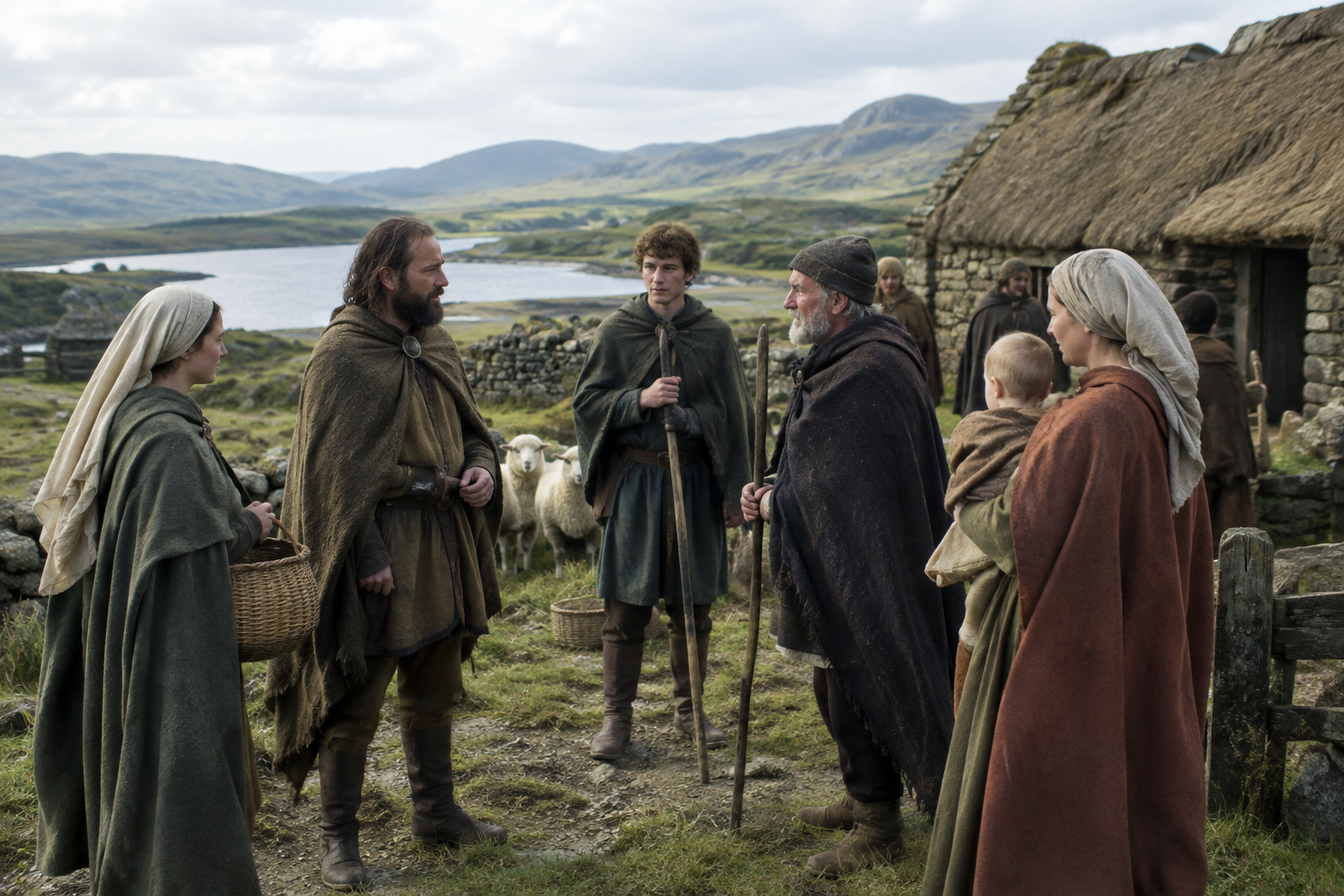
Some Y-DNA labels look almost designed to frighten the casual reader, and R1b1a1b1a1a2c1a1a1a1a1a1a3 certainly belongs in that category. But behind the long string of letters and numbers lies something rather human: a direct paternal line, passed from father to son across many generations, sometimes surviving political collapse, language change, conquest, reform, and even the quiet anonymity of ordinary village life. That is why such a haplogroup matters. It is not a full portrait of ancestry, but it is one narrow and powerful thread in the historical record.
This particular lineage sits within the wider world of R1b, one of the major Y-chromosome families in western Europe. For a very specific downstream branch like this one, scientific caution is essential. We should not casually assign to it the entire history of all R1b men, nor should we pretend that a highly refined subclade comes with a neat label such as "Celtic," "Norman," or "Gaelic." What ancient DNA can do, though, is show us where related paternal lines appear in time and space. In the material supplied here, that story points above all toward medieval Ireland, with an intriguing outpost in later medieval Belgium and a deeper prehistoric backdrop in Neolithic Hungary.
At the broadest level, R1b is one of the most discussed paternal haplogroups in European population history. Many of its branches expanded dramatically in later prehistory and became common across large parts of Atlantic and western Europe. But once we descend into a very narrow subclade such as R1b1a1b1a1a2c1a1a1a1a1a1a3, the picture becomes more local, more historical, and often more dependent on scattered ancient DNA finds than on sweeping generalizations.
What stands out in the evidence here is not a speculative epic migration map, but the remarkable concentration of medieval Irish samples. That suggests that, whatever the deeper prehistoric origins of the parent line, this particular branch or closely related branches had become well established in Ireland by the early medieval and later medieval periods. In other words, by the time written history in Ireland becomes richer, the lineage is already part of the local population story.
Readers interested in the bigger archaeological background behind European paternal lineages may also enjoy this wider survey of early farming and population change.
Explore Europe's Neolithic Expansion
The most striking body of evidence comes from Ballyhanna, County Donegal, Ireland. The supplied sample set includes a great many individuals from this medieval burial ground, especially around 840 AD and 1209 AD. Even a short selection gives the flavour: Sk197a, Sk197q, Sk197an, and HAN197x from 840 AD; then later individuals such as HAN197aq, HAN197ar, HAN197as, HAN197ba, and HAN331al from 1209 AD. The sheer number matters. This is not one isolated man carrying a rare paternal signal. It hints at a lineage present within a living community over centuries.
That is exactly where archaeogenetics becomes so useful. A single sample can be a curiosity. A cluster from one place across time begins to suggest continuity, local family structures, or at least repeated presence of closely related paternal lines in the same region. We must not leap from shared haplogroup to direct kinship between all these men; that would be much too strong. But Ballyhanna does show that this paternal signature belonged to the social fabric of medieval northwestern Ireland.
There is also evidence from Kilteasheen, Roscommon, with samples KIL041, KIL044, KIL033, KIL037, KIL009, and KIL014, dated 650 AD. Kilteasheen, described here as a bishop's seat, places related paternal ancestry in an ecclesiastical setting in the Irish midlands. That is rather revealing. The lineage is not confined to one county in the far northwest; it appears in another important Irish region and in an early medieval Christian context.
Then there is the intriguing continental appearance: STR129, STR129a, STR129b, STR129c, and STR129d from Late Medieval Belgium, St. Rombouts, 1553 AD. One should not overstate this. A Belgian sample does not prove a neat Irish-to-Flemish migration tale, nor the reverse. But it does remind us that paternal lineages do not respect the tidy boxes of later national history. By the late Middle Ages, trade, war, clerical networks, and urban mobility could move people surprisingly far.
If you want to explore how archaeogenetics turns burials into family and community history, this broader article is an excellent companion.
Learn How Ancient DNA Decodes History
The earliest sample in the material is especially tantalizing: Hung331 from Linear Pottery Culture Hungary Fuzesabony-Gubakut, 5300 BC. Here caution must be doubled. A Neolithic Hungarian sample does not mean this exact medieval Irish branch can simply be projected back to 5300 BC unchanged. What it does offer is a deep prehistoric horizon for related paternal ancestry within Europe. It suggests that some ancestral layers relevant to this lineage were already present among early farming populations on the continent long before the medieval Irish evidence becomes visible.
The historical interest of this haplogroup lies in how comfortably it sits inside Ireland's layered past. The early medieval Kilteasheen material and the Ballyhanna cemetery together suggest that related paternal lines were established in Ireland well before and during the great political changes of the High Middle Ages. This was a world of monasteries, local kingdoms, shifting lordships, maritime contact, and later the arrival of Anglo-Norman power.
That is important because Y-DNA does not follow political slogans. A paternal lineage can survive through conversion, dynastic change, new lordship, and even conquest. Men carrying related Y-chromosome branches might speak Irish in one century, serve ecclesiastical communities in another, and live under Norman-built fortifications in the next. Genetics does not erase those distinctions, but it does remind us that populations are not replaced every time the ruling elite changes.
For readers interested in how ancient DNA is reshaping ideas about Celtic-speaking populations and their spread, this article offers useful wider context.
Explore Ancient DNA and Celtic Origins
The supplied family connection brings us to Clan Connor and to one of those buildings that still seems to argue with the landscape: Roscommon Castle in County Roscommon. Built in 1269 by Robert de Ufford on the site of an older Augustinian priory, it quickly became a major Norman stronghold in Connacht. The history attached to it is one of repeated attack, rebuilding, adaptation, and siege, as Gaelic kings and Anglo-Norman lords struggled over the region.
This matters because Roscommon Castle stands in the same wider Irish historical world as the Kilteasheen samples. We should be careful: the castle does not prove a haplogroup, and the clan association does not prove that every Connor male belonged to this exact Y-DNA branch. But the pairing is historically evocative. The genetics points to paternal continuity in medieval Ireland; the castle represents the contested political order into which such lineages were woven.
By the 16th and 17th centuries Roscommon Castle had been strengthened with gun loops and bastions, showing how a medieval fortress tried to survive the age of artillery. It was besieged again during the Confederate and Cromwellian wars, badly damaged, and by the 18th century had fallen out of military use. Today, as the supplied description notes, its roofless walls and great towers still dominate the town. It is a monument not to one simple identity, but to conquest, resistance, and long struggle.
That makes it an apt setting for thinking about Y-DNA. Paternal lineages endure through precisely this sort of unstable history, not as proof of noble descent, but as evidence that real families and male lines remained present while regimes rose and fell around them.
Readers who want to follow the historical background of this clan connection more directly can continue here.
R1b1a1b1a1a2c1a1a1a1a1a1a3 is a good example of why narrow Y-DNA branches are historically valuable. They do not hand us a ready-made ethnic label, and they do not magically identify a medieval surname in the year 650 or 840. What they do instead is much more interesting. They let us see continuity across sites such as Kilteasheen and Ballyhanna; they show that paternal lines can persist through dramatic changes in religion and power; and they reveal that local Irish history is part of a wider European story, with related samples appearing as far away as St. Rombouts in Belgium.
In short, this haplogroup offers a window onto the long male-line history of medieval Ireland, viewed not just through annals and ruined castles, but through burials, bone, and sequence data. That is the real thrill of archaeogenetics: it lets the anonymous dead take their place beside lords, castles, and chronicles without pretending they were all one family.
If your own Y-DNA belongs somewhere within the vast R1b world, or if you are simply curious whether your DNA shows links to ancient individuals from places like Ballyhanna or Kilteasheen, MyTrueAncestry can help you explore those connections. Ancient DNA matches can offer remarkable historical perspective, even when they do not prove direct descent from a specific clan or noble house.






Comments