Haplogroup R1b1a1b1a1a2c1a1a1a1a1a1a2

– 8 min read


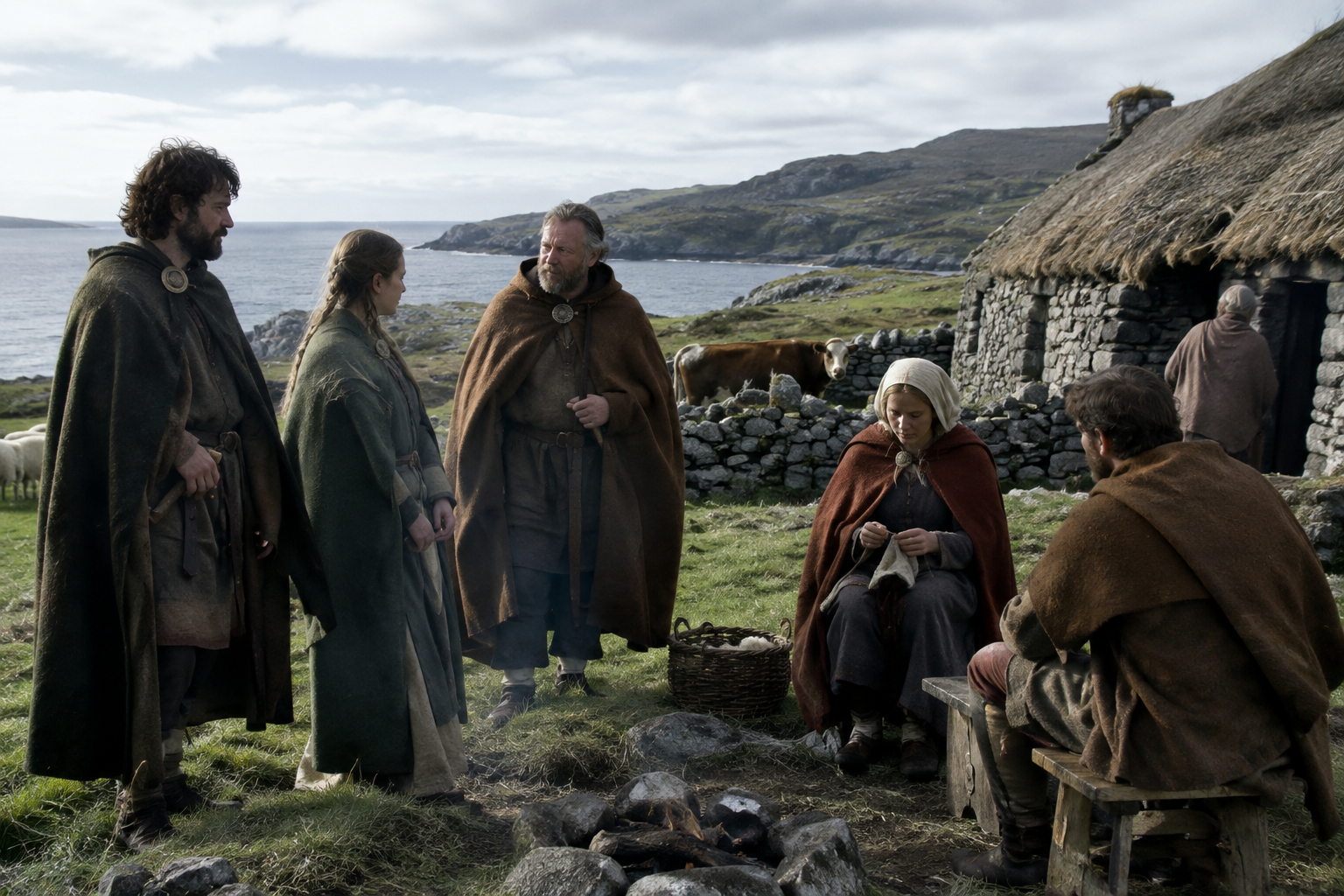
Some Y-DNA haplogroups are famous because they are broad and widespread. Others are historically interesting precisely because they are so narrow. Haplogroup R1b1a1b1a1a2c1a1a1a1a1a1a2 belongs to that second category: a very specific paternal branch within the larger R1b tree, the kind of lineage that reminds us how population history is built not only from sweeping migrations but from the survival of particular male lines in particular places.
That needs one immediate caution. A Y-DNA haplogroup traces only one line: father to father to father. It does not describe a person's whole ancestry, culture, language, or identity. Still, such lineages can be remarkably useful. They help us ask where paternal lines clustered, how they persisted, and how ancient DNA can illuminate regions later known from chronicles, lordships, and castles. In the evidence supplied here, that story is especially tied to Ireland, above all medieval Ulster and Connacht, with one intriguing later appearance in Belgium.
This subclade sits deep inside the wider R1b family, one of the major Y-chromosome lineages in western Europe. The broad history of R1b is usually discussed in connection with later prehistoric population change, especially Bronze Age expansions and the reshaping of paternal ancestry across much of Atlantic Europe. But we must be careful: the full story of the great R1b expansions cannot simply be pasted onto this very narrow downstream branch as if nothing happened in between.
What the specific evidence here suggests, more modestly and more usefully, is that this paternal line had a strong medieval presence in Ireland. The clustering of samples from County Donegal and Roscommon points not to a vague continental tale but to something more local and more human: continuity, kin networks, and the persistence of male lines within Gaelic landscapes.
For readers interested in the deeper background of how ancient DNA changed our understanding of such paternal histories, MyTrueAncestry has a broader introduction worth exploring.
Explore archaeogenetics and ancient DNA
The most striking feature of the sample set is the density of medieval Irish evidence. At Ballyhanna, County Donegal, Ireland, this lineage appears repeatedly in burials dated to 840 AD and 1209 AD. Even a handful of names would be interesting; here we have dozens. Among the earlier set are Sk197an, Sk197y, Sk197q, Sk197am, and HAN197x, all listed at Ballyhanna for 840 AD. Among the later medieval burials are HAN197aq, HAN197ar, HAN197as, HAN197at, HAN197au, and many more from the same site dated to 1209 AD.
That concentration matters. It suggests that this was not a stray paternal signal carried by one mobile outsider. Rather, Ballyhanna seems to preserve a community in which a particular male-line branch was common enough to recur across generations. Genetics alone cannot tell us whether these men were close kin, members of one dominant lineage, or simply part of a larger local population sharing related paternal ancestry. But the repeated appearance of the same narrow branch in the same region across centuries strongly hints at local persistence.
There is also evidence further south and west. At Kilteasheen, Roscommon Bishops Seat, several individuals dated to 650 AD are listed: KIL041, KIL044, KIL033, KIL037, and KIL022, alongside KIL009 and KIL014 from Kilteasheen in the same year. This places the lineage in ecclesiastical Roscommon as well as in medieval Donegal.
That spread between Donegal and Roscommon is historically suggestive. It places the haplogroup in two different but distinctly Gaelic settings: one in the northwest, one in the central-west. It does not prove a single dynasty or family connection, but it does suggest that this paternal branch belonged to the fabric of early and high medieval Ireland, not merely one isolated burial ground.
If you want a wider look at how genetics and burial evidence illuminate early populations in Ireland, this related article makes an excellent companion.
Discover Irish kinship through ancient DNA
There is one more noteworthy cluster in the supplied evidence: STR129, STR129a, STR129b, STR129c, and STR129d from Late Medieval Belgium, St. Rombouts, 1553 AD. This is an arresting detail. A lineage that appears so heavily in medieval Ireland also turns up in a late medieval Belgian setting.
What should we make of that? Not too much, and not too little. It does not, by itself, prove a migration route, mercenary history, noble connection, or direct family tie between Ireland and the Low Countries. But it does remind us that late medieval Europe was not static. Clerics, soldiers, traders, craftsmen, and settlers moved. Ports connected the Atlantic and the North Sea. Irish links with continental Europe were real enough, even if this particular genetic appearance still needs cautious interpretation.
Readers interested in how the wider Rhine-Meuse zone fits into prehistoric and historic population change may enjoy this companion piece.
Explore the Rhine-Meuse region
By this point, the ancient and medieval genetic picture is clear enough in outline: this is a narrow paternal branch with a marked Irish footprint, especially in Gaelic regions. The next question is a different one. What kinds of families, lordships, and strongholds later occupied that same historical landscape?
The families associated with this haplogroup in the supplied material belong overwhelmingly to the world of Gaelic Ireland. The House of ONeill stands at the grandest end of that spectrum: one of the dominant dynasties of Ulster, and among the most powerful Gaelic lordly houses anywhere in Ireland. Their historical center of gravity in Tyrone places them firmly within the northern zone where this lineage appears repeatedly in medieval burials, though that geographical overlap should be treated as context rather than proof of descent.
Further west and south, Clann McGrath reflects another side of Gaelic society. The McGraths were not simply local landholders but an important learned and clerical dynasty, the sort of family whose influence ran through church office, scholarship, and regional patronage as much as through force of arms. In a medieval Irish setting, that mattered enormously. Power was not only held in battlefields and hall houses, but in legal learning, ecclesiastical networks, and long memory.
Clann Mac Diarmada, associated with the old kingdom of Moylurg in County Roscommon, brings us closest to the Roscommon evidence from Kilteasheen. The MacDermot rulers of Moylurg belonged to the durable patchwork of Gaelic kingship that survived for centuries at a local and regional level. Their importance lies not in some romantic fantasy of isolated chieftains, but in the very practical reality that lordship in medieval Ireland was deeply territorial, hereditary, and bound to male-line succession.
The supplied Clan Kelly association sits a little differently in the record, but it still belongs to the same broad western Irish setting. Taken together, these names suggest the kind of historical environments in which a persistent paternal lineage might endure: not a single proven dynasty, but a network of Gaelic families, clerical lineages, and regional lordships spread across Ulster, Roscommon, Galway, and the surrounding world.
The castles linked with these families give that later history a physical setting. Dungannon Castle, in County Tyrone, stood on a hill as the chief stronghold of the ONeill dynasty. This was no minor residence. It was one of the principal seats of Gaelic power in Ulster, and its destruction by Hugh ONeill in 1602 during the Nine Years War, to prevent its capture by English forces, says a great deal about the crisis of the age. The site survives in altered form today in the Hill of The ONeill and Ranfurly House, so the landscape still carries the memory of that lost stronghold.
McGrath Castle represents a rather different but equally revealing world. Linked to the McGrath family, it was a medieval tower house connected with an important learned and clerical dynasty. Its ruin speaks less of one dramatic national episode than of the long, slow erosion of Gaelic local power, church influence, and family possession across the later Middle Ages and after. Even in decline, it remains a useful reminder that families such as the McGraths operated in a world where scholarship, religion, and land were tightly entangled.
In County Roscommon, Moylurg Castle was a stronghold of the MacDermot kings of Moylurg, built in the late medieval period as a symbol of Gaelic authority in the region. It later fell into ruin amid political change and conflict, but it still marks the territory of an older kingdom whose history sits close to the Kilteasheen evidence. One should not collapse archaeology into genealogy, but the geographical convergence is still striking.
Garbally Castle, near Ballinasloe in County Galway, shows a later layer of Irish elite residence. Developed from the seat of the Trench family into the great house later called Garbally Court, it belongs more to the seventeenth- and eighteenth-century estate world than to medieval Gaelic fortification. After a twentieth-century fire, much of it was demolished, and the estate became the site of Garbally College. Its inclusion is a useful reminder that ancestral landscapes are rarely frozen in one period: they are reworked again and again by new families, new fortunes, and new political orders.
Once we move from cemeteries to written history, the landscape changes, but not entirely. The same parts of Ireland that yield these medieval paternal traces later produced the lordships, learned families, and strongholds of Gaelic power.
The House of ONeill is the most obvious example. Dungannon Castle, on Castle Hill in County Tyrone, was one of the chief strongholds of the O'Neill dynasty, the great rulers of much of Ulster in the late medieval and early modern period. The site is especially bound to Hugh O'Neill and the Nine Years War against the English Crown. Burned in 1602 to keep it from Crown forces, then overtaken by the political catastrophe of the Flight of the Earls in 1607, Dungannon became a symbol not just of one family but of the collapse of Gaelic Ulster itself.
There is an important historical parallel here. Ballyhanna in Donegal gives us the graves of men from medieval Gaelic Ireland; Dungannon gives us the later political architecture of that same broad world. The castle is not genetic proof of any specific haplogroup, and no responsible historian should pretend otherwise. But it belongs to the same regional story of enduring lordship, kinship, and male-line succession.
That same caution applies to Clann McGrath. McGrath Castle stands in the world of late medieval Gaelic lords, churchmen, and local power. The McGraths were a learned and clerical dynasty, especially important in the west and north. Their strongholds were not merely defensive structures but statements of status in a society where ancestry, scholarship, and landholding mattered profoundly.
For the west of Ireland, Clann Mac Diarmada and Moylurg Castle in County Roscommon bring us closer still to the Roscommon genetic evidence from Kilteasheen. The MacDermot kings of Moylurg ruled a Gaelic lordship that lasted deep into the later Middle Ages. The tower house was residence, symbol, and political center all at once. Again, we should not claim that the Kilteasheen men were MacDermots, still less that they were direct ancestors of any documented noble line. But archaeology and history here sit in the same geography, and that alone is illuminating.
The supplied Clan Kelly association is more complicated. Garbally Castle near Ballinasloe in County Galway began not as a medieval Gaelic fortress but as the eighteenth-century great house of the Trench family, later enlarged into a romantic, castellated mansion. Its importance in this article is precisely that it shows how Irish landscapes preserve many layers of power: native lordship, Anglo-Irish estate culture, decline, reinvention, and memory.
For a deeper look at one of the great Gaelic dynasties whose world overlapped with this regional history, see the related MyTrueAncestry feature below.
Read about the Royal House of ONeill
So what does haplogroup R1b1a1b1a1a2c1a1a1a1a1a1a2 reveal? First, it shows how a very narrow paternal lineage can become historically meaningful when ancient DNA places it repeatedly in one region. The Ballyhanna and Kilteasheen burials suggest a branch with a notable medieval Irish footprint. Second, the evidence shows how genetics complements, rather than replaces, history. Castles, dynasties, and written records preserve names and politics; cemeteries preserve people who left no chronicles at all.
It also reveals the limits of the method. Sharing a haplogroup does not make two men close relatives in any genealogical sense. It does not prove membership in a clan. It does not turn an archaeological burial into a documented ancestor. But when the same paternal branch appears again and again in medieval Ireland, and when that same landscape later becomes the stage for the O'Neills, the McGraths, and the MacDermots, we begin to see continuity in a broader and more interesting sense: not a family tree we can draw neatly, but a historical population whose male lines endured.
If this article has whetted your appetite for Gaelic lordships and the western Irish world, this is another natural next read.
MyTrueAncestry lets you explore these kinds of ancient connections for yourself by comparing your DNA to archaeological samples and historical populations. You may discover links that place your ancestry in the same broad worlds as individuals like Sk197an, HAN197aq, or KIL041 - not proof of direct descent, and certainly not proof that you belong to a noble dynasty, but a fascinating window into the deep and complicated history behind your paternal line.
Comments