Haplogroup R1b1a1b1a1a2c1a1a1a1a1a1a

– 6 min read


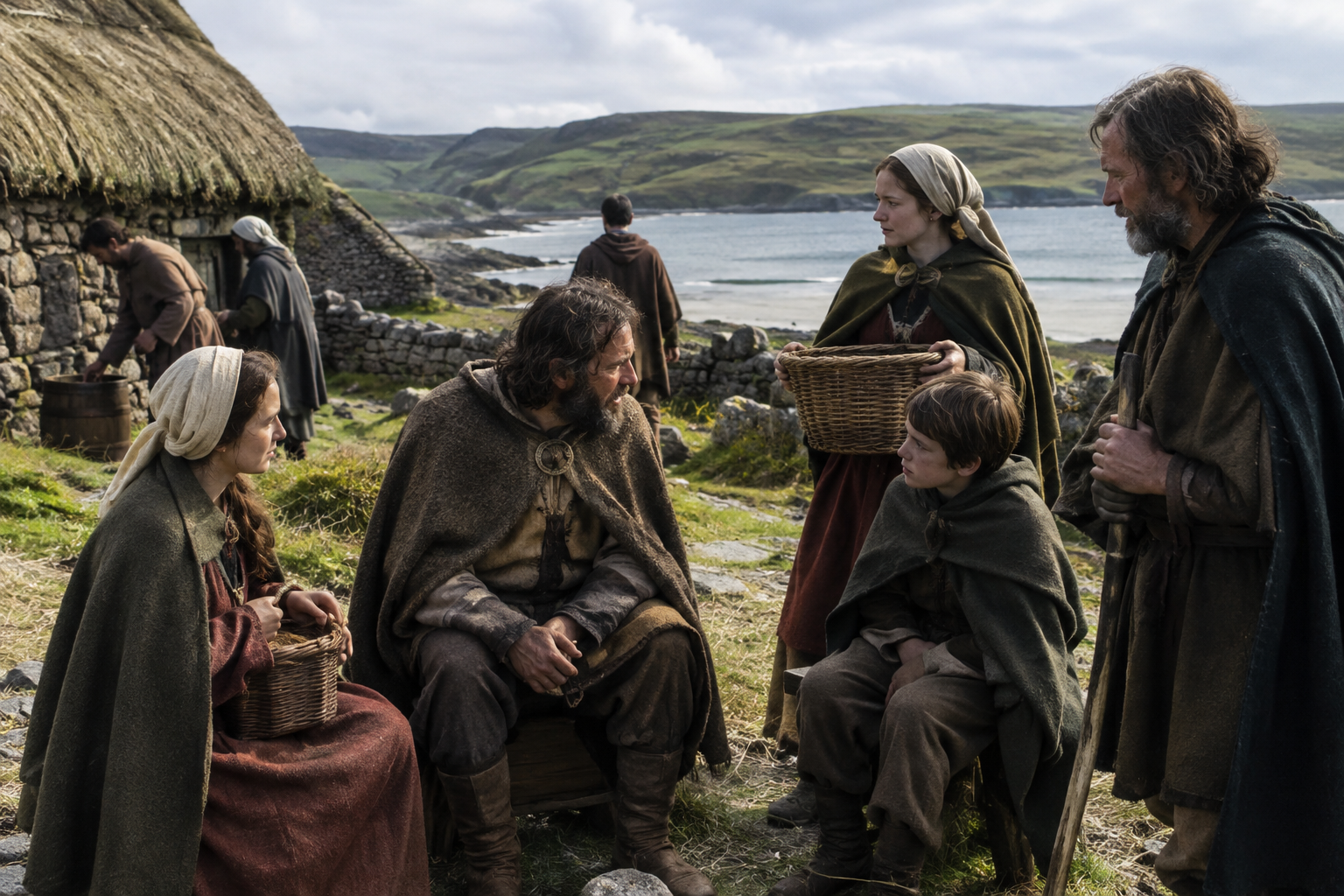
Some Y-chromosome lineages announce themselves with a broad continental story. Others are much narrower, more local, and in some ways more intriguing. Haplogroup R1b1a1b1a1a2c1a1a1a1a1a1a belongs to the second category: an extremely fine-grained paternal branch whose importance lies not in grand sweeping labels, but in what it can reveal about continuity, settlement, and the stubborn survival of male lines across centuries.
That matters because Y-DNA traces one direct paternal line only: father to son to son across time. It is not the same thing as a person's full ancestry, and it cannot by itself prove identity with a clan, dynasty, or medieval surname. But when a narrow branch turns up repeatedly in ancient burials, and especially when it appears in places rich in documented family history, it gives us a rare chance to set genetics beside archaeology, landscape, and written memory and ask how these pieces fit together.
This haplogroup sits deep within the vast R1b tree, one of the major Y-chromosome lineages in western Eurasia and especially well represented in later western Europe. That broad fact, however, should not be carelessly projected onto this very specific downstream branch. A subclade as detailed as R1b1a1b1a1a2c1a1a1a1a1a1a tells a more focused story than the parent lineage. Its historical value lies in where it appears in the evidence we actually have.
And the evidence supplied here points strongly toward the Irish Sea world and adjacent northern Atlantic settings. Medieval Ireland dominates the sample set, with additional appearances in Viking Age Dublin, Iceland, the Faroe Islands, and late medieval Belgium. That is already suggestive. Not proof of a single migration event, certainly, but a pattern worth taking seriously: a paternal line that seems at home in Gaelic Ireland, yet also present in the mobile maritime networks of the North Atlantic and the wider medieval world.
Explore Celtic origins and ancient DNA
The most striking cluster comes from Ballyhanna, County Donegal, Ireland. There are many individuals from this cemetery dated to 840 AD and 1209 AD, including samples such as HAN331f, HAN331g, Sk197a, Sk197q, HAN197aa, HAN197aq, and HAN331y. One must not assume that every one of these men belonged to the exact same ultra-specific branch without further phylogenetic detail. Still, taken together, they make Ballyhanna the great anchor point in this story.
Ballyhanna is not the burial ground of some legendary king whose name survives in chronicles. In a way that makes it even more useful. It offers a cemetery population, real people from a real community in northwest Ireland, living through the centuries when Gaelic lordships, church reform, and Viking contact all overlapped. When a paternal lineage appears again and again in such a setting, the suggestion is not glamour but continuity: a local male-line presence rooted deeply enough to persist across generations.
Other Irish samples widen that picture. At Kilteasheen, Roscommon, the samples KIL041, KIL044, KIL033, KIL037, KIL009, and KIL014, dated to 650 AD, place this paternal signal in an early medieval ecclesiastical landscape. Kilteasheen was a bishop's seat, which reminds us that church sites were not somehow outside ordinary kinship structures. Clerical foundations sat amid local families, patronage networks, and regional power.
Then there is VK545, the Viking Warrior Ship Street Dublin Ireland Year:725 AD sample. One should be cautious here. A Y-line found in a Viking Age burial in Dublin does not magically turn it into a "Viking haplogroup." What it does show is that this paternal branch, or a closely related one, could be part of the mixed and mobile world of early medieval Ireland's east coast, where Norse, Gaelic, and Hiberno-Norse communities interacted intensely.
Read about Irish kinship through ancient DNA
The wider geography is just as interesting. VK95 from Viking Age Hofstadir Iceland Year:1050 AD and VK44 from Medieval Age Faroe Islands Sandoy Church Year:1600 AD show that this paternal line was not confined to Ireland alone. Again, one should not collapse all these appearances into a single simple migration tale. But the Irish Sea and North Atlantic worlds were linked by travel, raiding, trade, settlement, fosterage, marriage, and church connections. A paternal lineage present in Ireland could quite plausibly travel in those circuits without belonging exclusively to any one cultural label.
The late medieval Belgian samples from St. Rombouts in 1553 AD - STR129, STR129a, STR129b, STR129c, and STR129d - add another wrinkle. These do not erase the Irish concentration; rather, they show that by the late Middle Ages related paternal branches could also be found in the Low Countries. Medieval Europe was full of movement, and a Y-line does not require a spectacular invasion to cross the map. Merchants, soldiers, clerics, craftsmen, and small family migrations are enough.
There is also the much earlier sample Hung331 from Linear Pottery Culture Hungary Fuzesabony-Gubakut Year:5300 BC. This is a useful reminder of scale. A very ancient sample appearing in the input should not be treated as proof that the exact same ultra-specific branch already existed there in the Neolithic. What it does underline is that the deeper R1b story, and indeed the broader history of European paternal lines, reaches far behind medieval surnames, kingdoms, and castles.
Discover Viking Age genetic networks
If the ancient DNA points us strongly toward medieval Ireland, the associated noble families and castles place that genetic story into recognizable landscapes. Not as proof of direct descent, but as historical context: the same regions where paternal lines endured also produced lordships, tower houses, and dynastic memory.
In Connacht, Feartagar Castle in County Roscommon, associated here with the House of Burgh, stood in a world shaped by Gaelic dynasties and the pressures of Tudor expansion. The castle is thought to have been built by the O Conor family in the late 1500s or early 1600s. That matters because Roscommon is also where Kilteasheen gives us early medieval DNA evidence. The written and material record are different kinds of evidence, but geographically they speak to the same enduring arena of lordship, kinship, and male-line inheritance.
Further north along the Connacht coast, Ardnaglass Castle in County Sligo is linked with Clan ODowd, an important Gaelic dynasty remembered in the Book of Ballymote. Its ruined remains belong to that familiar late medieval pattern: prestige mixed with insecurity, status displayed through a defended residence. The presence of this haplogroup in medieval northwest Ireland does not prove an ODowd Y-line, but it does place the lineage in the same broad historical country of coastal lordships and regional power.
At Rockfleet Castle in County Mayo, associated with the House of OMalley, the story becomes maritime. Built by the Burke family and later famed as one of the homes of Grace O'Malley, it watched the waters of Clew Bay. If this haplogroup belonged to communities moving around the Irish Sea and North Atlantic, then castles like Rockfleet help us picture the political landscape through which such movement took place: ships, creeks, local tolls, competing dynasties, and English pressure always tightening.
The same is true in Munster and the Midlands. Dromaneen Castle near Millstreet in County Cork, linked here with Clan OCallaghan and the O Keeffe world of Duhallow, and Eglish Castle near Rath in County Offaly, associated with the House of OMolloy, both stand in regions where local power was once very finely grained indeed. A Y-line surviving for centuries would have done so not in an abstract "population," but among such territories, rivalries, inheritances, and family networks.
Explore the history of Clan ODowd
The inclusion of Crosbie Castle in South Ayrshire, Scotland, associated with Clan Fullarton, is a helpful reminder that this was never only an Irish story. The Irish Sea connected western Scotland and eastern Ireland for millennia. People crossed it as traders, settlers, mercenaries, churchmen, and aristocrats. Crosbie Castle, though much altered and later ruined, preserves that layered Scottish past of local lordship and shifting estates. In historical terms, it belongs to the same connected maritime zone as Donegal, Sligo, Mayo, and Dublin.
That is one of the most useful things a haplogroup like R1b1a1b1a1a2c1a1a1a1a1a1a can show. Not a neat ethnic badge, but a pattern of persistence across a linked region. Ancient DNA gives us snapshots: Ballyhanna in Donegal, Kilteasheen in Roscommon, Dublin in the Viking Age, Iceland and the Faroes in the wider Atlantic orbit, Belgium in the late medieval world. Castles and clan histories give us the later social landscapes in which such paternal lines continued, branched, and sometimes acquired surnames and status.
Discover Clan Fullarton and Crosbie Castle
The great value of a narrow Y-DNA branch is precision. It can reveal regional continuity that broad labels conceal. In this case, the evidence points especially toward medieval Ireland and the connected Irish Sea and North Atlantic worlds. But precision also requires restraint. Sharing a haplogroup with an ancient individual does not prove direct descent from him. Sharing a haplogroup with a clan-associated region does not prove membership in that clan. And no castle, however romantic, can certify a paternal lineage on its own.
What genetics can do is wonderfully concrete. It can show that a paternal line existed in a place, at a date, in the body of a real man buried in a real cemetery. When enough such finds accumulate, they allow us to compare written genealogies with something older and more stubborn than family legend: the biological record of male-line inheritance itself.
If your own Y-DNA sits somewhere near this branch, MyTrueAncestry can help you explore whether your paternal line shows affinities with ancient individuals from places like Ballyhanna, Kilteasheen, Dublin, Iceland, or the Faroe Islands. Those matches may not prove that you descend from a named medieval lord or clan founder, but they can place your ancestry inside the same historical landscapes discussed here, and that is often far more interesting.






Comments