Haplogroup R1b1a1b1a1a2b4

– 6 min read


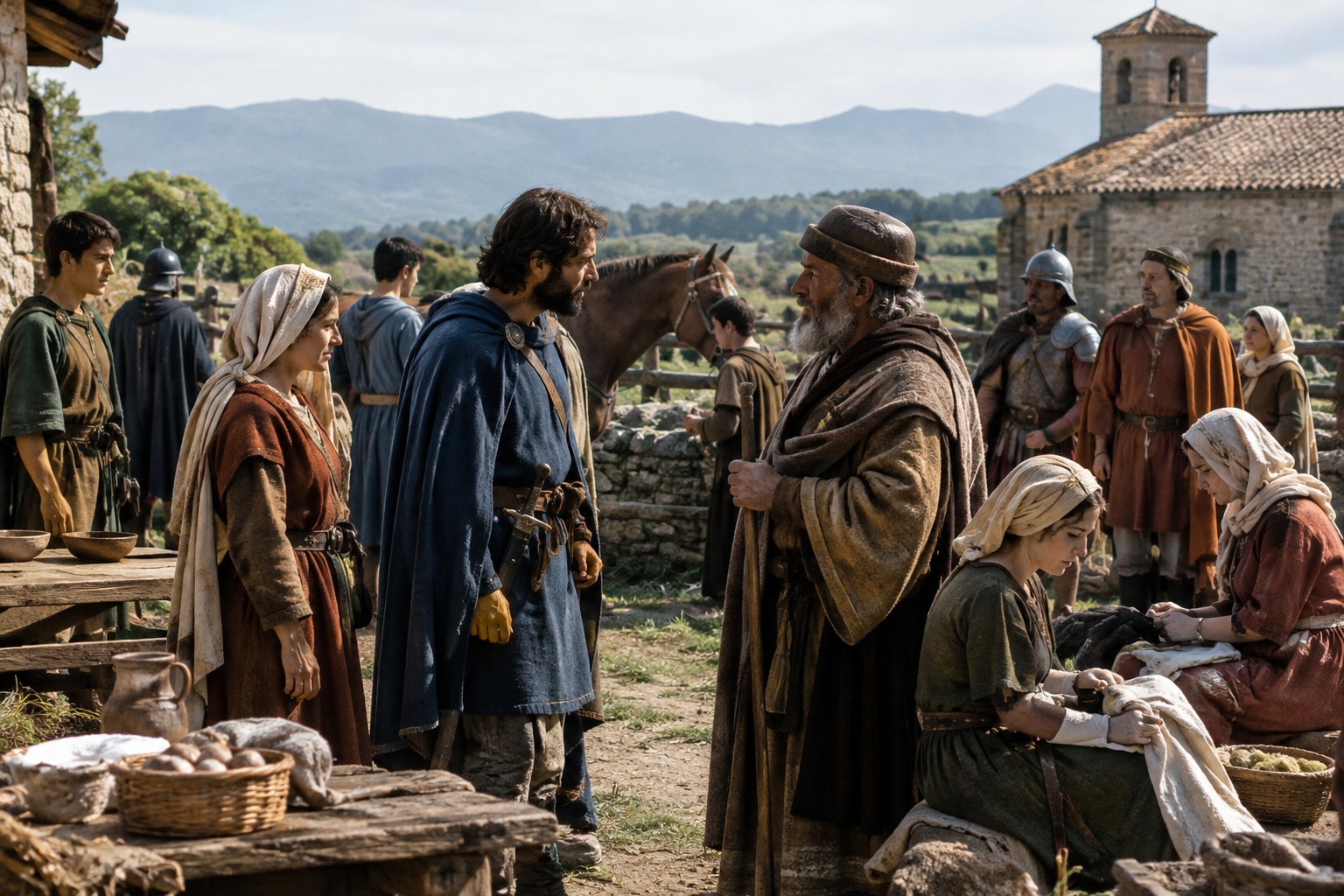
Some Y-DNA haplogroups seem to sit in one neat historical box. This one does not. R1b1a1b1a1a2b4 appears in a spread of ancient contexts that is far more interesting than any tidy label: Bronze Age central Europe, Iron Age Celtic burials, Roman and post-Roman communities, medieval Iberia, France, Italy, Britain, and beyond. That does not mean every one of those men belonged to this exact narrow branch in the modern phylogenetic sense; with highly specific subclades, one must be careful. But it does mean that the paternal line behind this designation belongs to a wider story of long-lived male ancestry moving through some of the most important historical landscapes in Europe.
Y-DNA traces a direct paternal line: father to son to son, over many generations. It is a powerful tool, but also a limited one. It does not describe a person's whole ancestry, culture, language, or identity. Still, when ancient DNA places related paternal branches in elite Celtic graves, Roman frontier communities, medieval monasteries, and noble crypts, it gives us a remarkable way to think about continuity and movement across time.
This haplogroup sits within the very large Y-chromosome family known as R1b, one of the major paternal lineages in western Europe today. For broad background, R1b is often discussed in connection with later prehistoric population changes in Europe, especially those linked to Bell Beaker and Bronze Age expansions. But that broad history should not simply be pasted onto a much narrower branch like R1b1a1b1a1a2b4 as though nothing happened in between. The narrower the branch, the more caution is needed.
What the sample list does show, however, is that closely related paternal ancestry connected with this branch had a long presence in western and central Europe. Some of the earliest clues come from the Bronze Age: MIB054 and MIB054d in Bronze Age Bohemia (2500 BC), LEU024 and LEU025 in Unetice-period Thuringia at Leubingen-Sommerda, Germany (1950 BC), and Bell Beaker-associated and related samples such as I4073, I4074, and I4073x from De Tuithoorn in North Holland (2080 BC), as well as I13028 from Ottoland-Kromme Elleboog in the Netherlands (2100 BC). These are not just dots on a map. They suggest that paternal lines ancestral or related to this haplogroup were already embedded in the societies of later prehistoric Europe.
That matters because it places the story before kingdoms, before surnames, before castles. The men in these graves belonged to worlds of burial mounds, exchange routes, metalwork, and regional elites.
By the Iron Age, the pattern becomes especially striking. This paternal line appears repeatedly in settings identified as Celtic or closely tied to La Tene and related worlds. In southwest Germany, several elite burials at Asperg-Grafenbuehl and Ludwigsburg-Roemerhuegel stand out: APG001, APG001c, APG003, LWB001, LWB001_ss, and LWB001_ss_b, all dated to about 450 BC. These are exactly the sorts of graves archaeologists love to argue over: prestige, hierarchy, warrior display, and the political theatre of burial.
Then there is Britain. The East Yorkshire Arras culture and Parisi-related samples are a small army in themselves: I37333, I36965, I36968, I36761, I31024, I31510, I31512, I30994, I30975, I37161, I30962, I21861, I21864, I21642, I21259, I21613, and the high-status Parisi burial I5502 at Nunburnholme Wold (100 BC). Add I50137, an elite Celtic chariot burial from Ferry Fryston in West Yorkshire (237 BC), and one begins to see that this was no fleeting or isolated paternal presence.
The significance is not that one haplogroup "equals the Celts." That would be far too crude. Rather, the evidence suggests that branches related to this lineage were well established among Iron Age communities in regions strongly associated with Celtic archaeology and, in some cases, high-status burial rites.
One of the pleasures of ancient DNA is that it shows how little human history respects our neat textbook categories. This lineage turns up not only in Iron Age contexts but across Roman and post-Roman Europe as well: FEN008 at Roman-era Fenstanton, Cambridgeshire (100 AD); WBK36 among the Durotriges at Duropolis, Winterborne Kingston (125 AD); and a cluster from Gallo-Roman Metz, Lunette Sablon, dated 432 AD - R2055a, R2055b, R2055c, R2055d, and R2055e - with the related later Metz sample R2055 at 490 AD.
Those Metz burials are especially revealing. Here, in northeastern Gaul, at the edge of the Roman world's transformation, we see paternal continuity or recurrence in a region where Roman, local Gallic, and incoming post-Roman identities overlapped. Similar complexity appears in Switzerland with the Alemanni grave DNA031 from Basel-Waisenhaus (376 AD), in northern Italy with the Lombard-era sample COL_098b from Collegno (580 AD), and in the Pannonian and Longobard-period cemeteries of Hungary, including SZL025, SZL072, GHD023, RKO001, and RKF253.
The lesson is not that one paternal line belonged to one people and then another. The lesson is that male lineages could persist while political worlds changed around them - Celtic, Roman, Gallo-Roman, Alemannic, Lombard, Carolingian. DNA is wonderfully indifferent to the names later historians gave those centuries.
Iberia is one of the most intriguing parts of this story. The haplogroup appears in several early medieval and medieval Spanish contexts: I20382 from early Visigothic Spain at Girona Sarria de Ter Pla de lHorta (611 AD), I30592 from Zaragoza Epila Las Lomas del Molino (600 AD), and I23276 and I23764 from late Roman and migration-period Merida (450 AD). Particularly striking is the cluster from Las Gobas in northern Spain: ldo062 (620 AD), ldo066 (1000 AD), ldo037 (1000 AD), and ldo048 (1025 AD). Here, over several centuries, we glimpse a local paternal thread surviving through the shifting world of late antiquity into the high Middle Ages.
That makes Burgundy a fitting place to bring the story into the feudal age. The House de Malain belonged to a landscape already old before its medieval lords appeared. The Chateau de Malain, in Burgundy, rose above a site with prehistoric and Gallo-Roman settlement before becoming a strong castle in the Middle Ages. Built mainly between the twelfth and fourteenth centuries, with towers, walls, and a great hall, it guarded the Ouche valley and local routes. It later suffered in the wars that scarred eastern France and gradually fell into ruin, but its surviving remains still show the outline of a serious noble stronghold.
That is the right way to think about noble-family connections to a haplogroup: not as proof that every de Malain man carried this exact lineage, and certainly not as proof of direct descent from some named Iron Age or Roman individual, but as a historical setting. Burgundy itself appears in the ancient DNA record through samples such as CGG023630 (849 AD) and CGG023658 (713 AD) from early medieval France, Burgundy, Camp du Chateau. Genetics, archaeology, and local lordship all occupy the same region, though they answer different questions.
Read about the House de Malain
R1b1a1b1a1a2b4 is historically interesting because it refuses to stay in one box. In the evidence provided here, related paternal ancestry appears in Bronze Age central Europe, elite Iron Age Celtic burials, Roman Britain and Gaul, post-Roman frontier zones, medieval Spain, Burgundy, and even later historical contexts such as Medici1296 from the Medici family crypt in San Lorenzo, Italy (1650 AD). None of that proves simple descent lines between the samples. What it does show is a durable paternal background woven through many of Europe's best-known historical transitions.
That is also a useful reminder about what ancient DNA can and cannot do. It can illuminate continuity, movement, and regional connections across centuries. It can show that the same broad paternal heritage appears in different archaeological settings. It cannot, by itself, turn a shared haplogroup into a documented family tree. Written genealogy, archaeology, and genetics each provide different kinds of evidence; when used together, they make the past larger, stranger, and more human.
If this haplogroup appears in your own Y-DNA results, MyTrueAncestry can help you explore whether your paternal line shows affinities with ancient individuals from places like Las Gobas, Iron Age Yorkshire, Gallo-Roman Metz, or early medieval Burgundy. These matches do not necessarily prove direct descent from a specific ancient person or noble house, but they can open a remarkable window onto the deeper history of your paternal ancestry.
Upload your DNA to MyTrueAncestry and see how your story may connect with the men who lived in hillforts, Roman towns, monasteries, and castles across Europe's long and complicated past.






Comments