Haplogroup R1b1a1b1a1a2b3c

– 7 min read


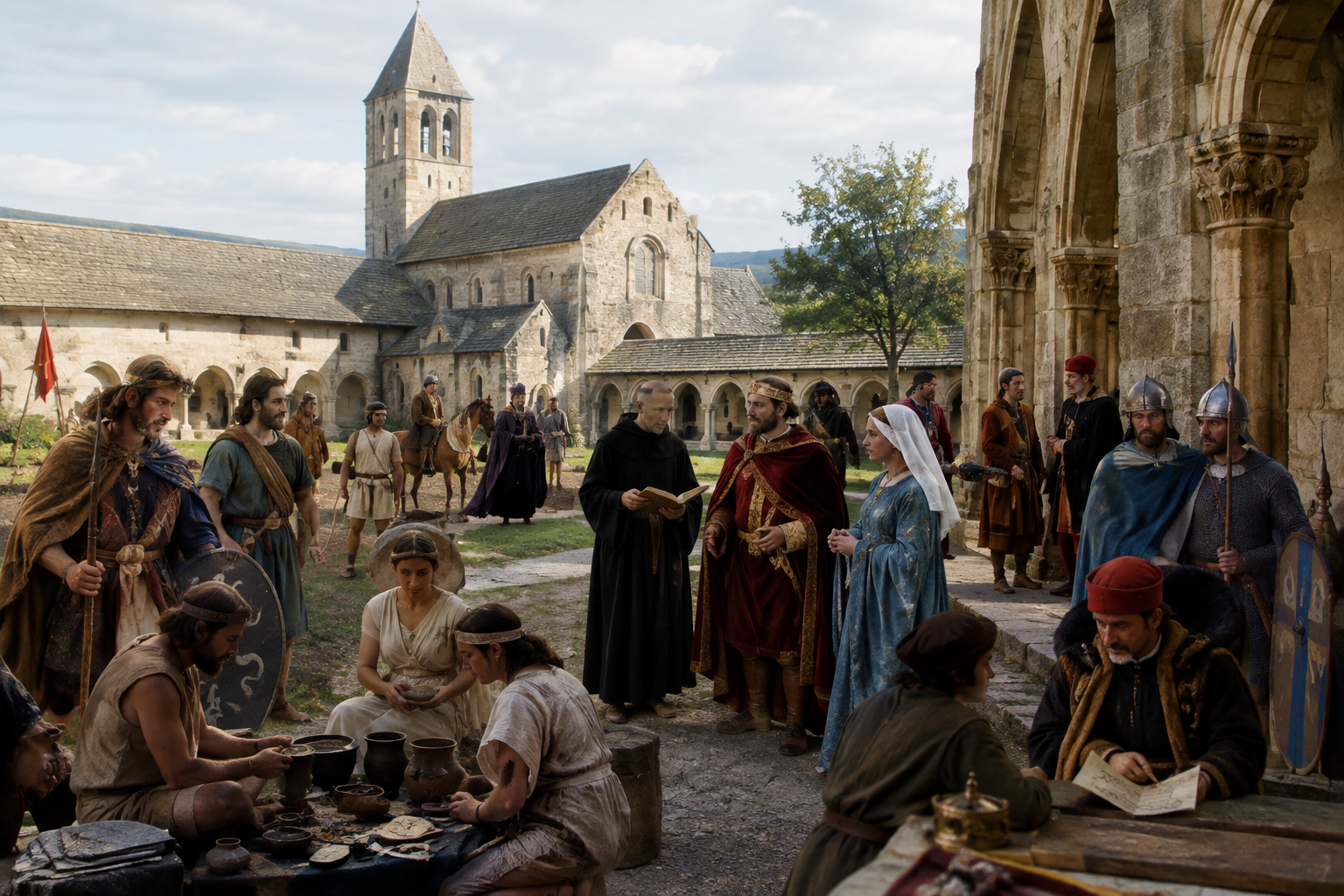
Some Y-DNA haplogroups announce themselves with a tidy story. This one does not. Haplogroup R1b1a1b1a1a2b3c sits deep within the vast R1b branch of the Y-chromosome tree, a lineage that appears again and again in the archaeology of western and central Eurasia. But a very specific subclade like this is not a magic label for one people, one kingdom, or one noble house. It is better understood as a narrow paternal thread inside a much larger historical fabric.
That is precisely what makes it interesting. Y-DNA traces a direct father-to-son line only. It does not describe a person's full ancestry, culture, language, or identity. Yet when a rare or tightly defined branch appears in ancient burials from different centuries and regions, it gives us a way to ask sharper questions. Were some paternal lines remarkably durable across the Bronze Age, Iron Age, Roman world, and medieval dynasties? Did they move with migration, conquest, marriage, military service, or local continuity? The evidence here suggests a lineage with a notably European historical footprint, visible from Bronze Age central Europe to Iron Age Britain and Italy, and into medieval and early modern elite contexts.
Because this is such a specific downstream branch, we should be careful not to load onto it the entire history of broad R1b. Still, its placement inside R1b makes it part of one of the major paternal lineages in later prehistoric and historic Europe. In general terms, many R1b branches became prominent in European populations after major prehistoric population changes involving central and western Europe. Exactly when this particular subclade formed, and where, cannot be responsibly fixed from the supplied material alone.
What the sample list does allow us to say is more concrete and in some ways more revealing: men assigned to this lineage, or very close to it, turn up in a striking belt running from Bronze Age Germany and Bohemia to Iron Age Italy and Britain, and then onward into Roman, early medieval, and dynastic settings. That pattern fits a paternal line embedded in the making of later European populations rather than a branch confined to one corner of the map.
For readers interested in the bigger archaeological debate over how paternal lineages spread in later prehistory, this broader context is worth exploring further.
Explore Celtic Origins in Ancient DNA
One of the earliest supplied anchors is LEU025, a Bronze Age Unetice individual from Leubingen, Sommerda, Thuringia, Germany, dated to 1950 BC. That matters because Unetice sits in the heart of early Bronze Age central Europe, a world of metalworking, elite burials, and expanding long-distance connections. A lineage appearing here suggests that this paternal branch, or something close to it, was already present in central Europe very early in the historical sequence visible to us.
From there, the record broadens rather than narrowing. In Iron Age and archaic Italy we find several relevant samples: I37292, I37377, I38927, and I44699 from Archaic Etruscan Felsina in the Po Valley, dated to 600 BC and 650 BC, alongside TAQ004 from Etruscan Tarquinii dated to 400 BC, and R435 from the Latin Prenestini inland area, also dated to 400 BC. Add to that the Gallic Cenomani individuals 3206n and 3217n from Verona, dated to 300 BC, and what emerges is not a neat ethnic box, but a reminder that paternal lines crossed the cultural categories historians later drew so confidently.
In Britain the same story reappears. The Iron Age Parisi sample I28744 from East Yorkshire, dated to 270 BC, and the Durotriges individuals WBK35 and WBK39 from Duropolis, Winterborne Kingston, dated to 125 AD, show that this paternal line was present in Britain before and during the Roman period. These are especially useful because they place the lineage in well-known local populations rather than only in aristocratic or courtly contexts.
The Roman and late Roman world adds further mobility. R1554 and R1556 from Imperial Rome-era Urbino Bivio, dated to 221 AD, and R11563 from the Late Roman Marxberg Necropolis at Pons Saravi, Sarrebourg, France, dated to 413 AD, suggest continuity or circulation across the Roman west. R36 from the Roman/Illyrian Celio Military Hospital, dated to 500 AD, is especially evocative: hospitals, forts, roads, and administrative centers were precisely the sorts of places where men from different regions met, served, and settled.
If you want a wider look at how Italy's ancient populations changed from Roman into early medieval times, there is an excellent companion piece in the community archive.
Read Roman to Medieval Italy DNA
After Rome, the line does not vanish. It turns up in the kind of mixed and shifting societies that followed imperial collapse. In Italy, the Bardonecchia Dark Ages individuals Bard_T2, Bard_T8, and Bard_T7A, all dated to 650 AD, show this lineage in an Alpine corridor that linked Italy with transalpine Europe. In Hungary, A181023 from Gepidic Hajdunanas-Furj-halom-dulo, dated to 400 AD, and AHS58 from medieval Zalavar Varsziget in the Carolingian sphere, dated to 850 AD, place it in the Carpathian Basin during centuries of political upheaval and reorganization.
There is also SHper41_GE, a Hungarian Late Conqueror individual from Sarretudvari-Hizofold, dated to 950 AD, and ST1358, identified as a medieval Belgium outsider from Sint-Truiden Onze-Lieve-Vrouwekerk, dated to 900 AD. These are the sort of samples that remind us that paternal lineages can persist through migration, assimilation, and elite turnover without mapping neatly onto one named people.
The dynastic evidence is especially tantalizing. The Hungarian Royal House of Aba appears in HUASper81 from a Gothic Vault at the Royal House of Aba Benedictine Monastary, dated to 1405 AD, and HUASper55B from the same monastic setting, dated to 1500 AD. In Poland, the Piast world appears with PCA0618, a Piast Masovian Dynasty prince dated to 1288 AD, and PCA0252, Janusz III Piast Duke of Masovia, dated to 1526 AD. There is also Medici1296 from the Medici Family Crypt at San Lorenzo, Italy, dated to 1650 AD, and R1287 from the Late Medieval Cancelleria Basilica, dated to 1429 AD.
None of this proves direct descent from one dynasty to another, still less from a Bronze Age burial to a Renaissance prince. What it does show is that this paternal lineage appears in both ordinary archaeological populations and later elite burials. That combination is historically valuable. It suggests not a line belonging only to kings, nor only to villagers, but one that was woven into European populations broadly enough to surface in both.
For more on how one of those medieval ruling houses has been studied genetically, the Piast material is especially relevant.
Discover the Piast Dynasty DNA
This is where readers often want a simple answer: does the haplogroup "belong" to a noble family? History is rarely so obliging. The supplied noble associations are better treated as historical contexts in which this paternal branch has been discussed, not as proof that every bearer of a family name shared the same Y-DNA.
Still, the settings are wonderfully revealing. House La Zouche is linked to Ashby de la Zouch Castle, a site that began as a Norman manor after the Conquest and grew into a grand stone residence in the late 12th century under William de Ferrers. Later expanded by the Hastings family, it became one of the great noble houses of the Midlands, and by the 15th and 16th centuries had shifted from fortress toward palace. Its siege in 1646 during the English Civil War, and its subsequent slighting, make it a memorable monument to the way aristocratic display and military power could occupy the same building.
House Noel brings us to Knole in Sevenoaks, Kent, which began as an archbishop's house in the 15th century, was rebuilt grandly by Thomas Bourchier, passed through Crown and ecclesiastical hands, and in 1603 was granted by James I to Thomas Sackville. Knole preserves that long entanglement of church, monarchy, and aristocratic estate culture unusually well.
In Norfolk, House of Wyndham is associated with Felbrigg Hall, a later country house rather than a medieval fortress, but no less important for understanding elite continuity. Its 17th- and 18th-century form, shaped by the Windham family, speaks to another chapter in the story of paternal lines: not only conquest and war, but inheritance, landholding, books, art, and memory.
And then there is Clan FitzRandolph at Middleham Castle in North Yorkshire, begun around 1190 by Robert Fitzrandolph and later transformed by the Nevilles into a great noble residence. It is especially famous as the childhood home of Richard, Duke of Gloucester, later Richard III. If Ashby shows the Midlands and Knole the orbit of London, Middleham shows the north: hard politics, noble ambition, and the making of late medieval power.
Readers interested in one of these houses can follow the story further in the dedicated family article.
Put the evidence together and haplogroup R1b1a1b1a1a2b3c looks less like the badge of a single tribe and more like a durable paternal branch within the history of Europe. It appears in Bronze Age central Europe, Iron Age Britain and Italy, Roman contexts, post-Roman frontier zones, and later dynastic burials. That spread is historically plausible in a continent shaped by migration, military movement, local continuity, and repeated elite turnover.
But caution is the whole point of good archaeogenetics. Sharing a haplogroup does not prove close kinship. It does not make an Etruscan, a Durotrigan, a Piast duke, and a later English nobleman members of one documented family tree. What it does provide is a paternal line of evidence that written records alone cannot supply. Castles, monasteries, crypts, and graves tell us where people lived and how they wished to be remembered. Ancient DNA shows that some paternal lines passed through those worlds for centuries.
If this mixture of archaeology, noble history, and genetics appeals, the community also has excellent material on the Norman and post-Conquest genetic background of medieval England.
That is really the fascination of a lineage like R1b1a1b1a1a2b3c. It links no single legend, but many real places: Bronze Age graves in Germany, Iron Age cemeteries in Britain and Italy, Roman roads, Hungarian monasteries, Polish dynastic burials, and the later landscapes of castles and country houses. MyTrueAncestry lets you explore whether your DNA shows similarities to ancient individuals and historical populations like these. Those matches do not by themselves prove direct descent from a specific ancient person or noble family, but they can open a remarkably vivid window onto the deeper history behind your ancestry.






Comments