Haplogroup R1b1a1b1a1a2b1c1b3

– 6 min read


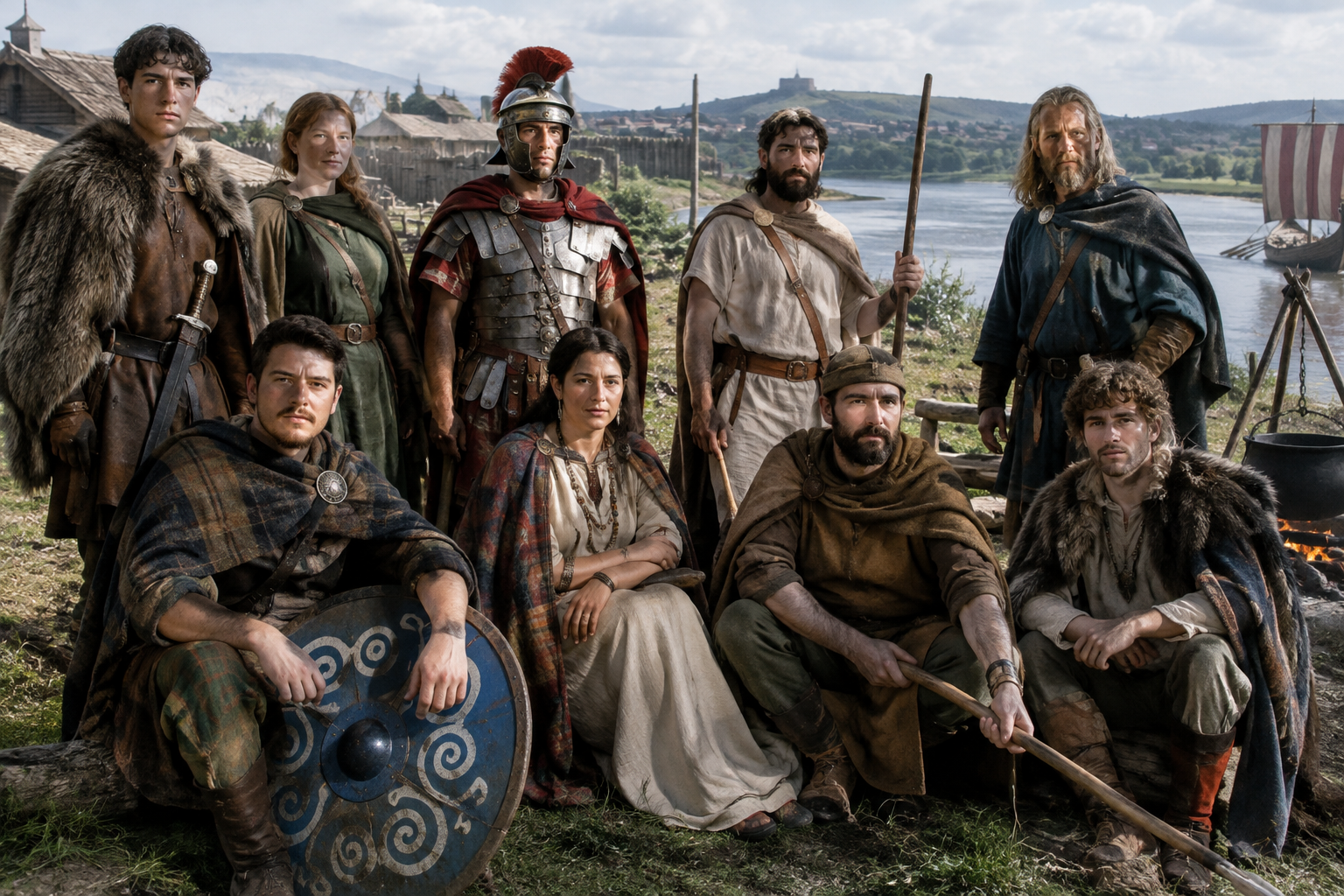
Some Y-chromosome lineages announce themselves with a grand historical label. Others, like R1b1a1b1a1a2b1c1b3, look at first glance like a string only a laboratory could love. But this is exactly where ancient DNA becomes interesting. Behind that formidable code lies one narrow branch of the wider R1b tree, part of a paternal lineage that appears again and again in the archaeology of later prehistoric and historic Europe.
What makes this particular branch intriguing is not that it can be tied neatly to one people, one kingdom, or one noble house. Quite the opposite. The evidence supplied here places related paternal lines in Iron Age Britain, the Roman provinces of Austria and Croatia, the world beyond the Roman frontier in Slovakia, Migration Period Hungary, and even Viking Age Sweden. That spread is a useful reminder of what Y-DNA can and cannot do. It traces one direct paternal line only. It does not represent a person's whole ancestry, and it certainly does not turn a haplogroup into an ethnicity. But it can reveal patterns of movement, persistence, and historical overlap that written sources alone would never show.
R1b is one of the major Y-chromosome haplogroups of western Eurasia, with many branches that expanded at different times and in different places. The subclade discussed here, R1b1a1b1a1a2b1c1b3, is a very narrow twig on that much larger tree. That matters. We should not simply pour the whole history of broad R1b into this one downstream branch as if nothing changed along the way.
Still, the ancient samples associated with this lineage suggest a branch embedded in the long history of later European populations: Iron Age communities, Roman provincial society, frontier groups, and medieval northern Europe. The pattern is not one of a single dramatic migration that can be pointed to with a theatrical flourish. It is more Roman road than cavalry charge: repeated appearances across connected regions, especially in the broad zone running from Britain through central Europe to the Balkans and onward into Scandinavia.
For readers interested in the bigger genetic background to this sort of paternal history, MyTrueAncestry has a useful overview in Ancient DNA and the Rise of Archaeogenetics.
The earliest supplied appearances come from Iron Age Britain and central Europe, and they are wonderfully awkward for anyone who wants a simple slogan. In East Yorkshire, the Celtic Parisi sample I36822 from Wetwang Slack, dated to 225 BC, places this paternal line in one of the best-known Iron Age landscapes of Britain. Wetwang Slack is famous for its burials and for showing that Iron Age Britain was not some dim, isolated backwater but a world of local identities, long contacts, and social display.
There is more British evidence. I16440, from Harlyn Bay, Cornwall, dated to 200 BC, and I19873 from Late Iron Age East Kent, England, dated to 300 BC, show related paternal ancestry on opposite sides of southern Britain. Cornwall and Kent are not interchangeable places. One faces the Atlantic approaches; the other looks toward the Continent. The appearance of related Y-lines in both regions hints that this branch, or closely related ones, was already woven into multiple British communities before Rome arrived.
Meanwhile, on the European mainland, I11712 from the Quadi Tribe, Bratislava, Slovakia, dated to 95 BC, places the lineage in a frontier zone north of the Danube. The Quadi belong to that difficult category that Roman authors loved to simplify as "barbarians", though of course the archaeology tells a more complicated story of settlements, exchange, alliance, and conflict. A paternal line appearing both in Iron Age Britain and in the middle Danube world does not prove one common recent origin. It does show that related branches circulated across regions tied together by mobility long before medieval national histories began drawing their tidy maps.
Readers who want more on this wider background may enjoy Ancient DNA Reveals Central European Origins and Spread of Celtic Languages, which explores exactly the kind of prehistoric and Iron Age networks that help make sense of such distributions.
If the Iron Age evidence gives us a scattered map, the Roman period gives us movement with infrastructure. Three supplied samples are especially telling: R10668 from Roman Era Wels, Austria, dated to 245 AD; R3747 from Imperial Roman Era Zadar Ulica, Croatia, dated to 175 AD; and R2041 from Late Roman Era Sisak Pogorelec, Croatia, dated to 300 AD.
These are not all from one little pocket. Wels in Austria belonged to the Danubian world of the Roman provinces. Zadar and Sisak in Croatia connect us to the Adriatic and inland Balkan routes. In other words, this paternal branch appears in the sort of places where soldiers, traders, administrators, craftspeople, and families moved under Roman rule. One of the great lessons of archaeogenetics is that the Roman Empire did not create identical people everywhere, but it did create conditions for remarkable local diversity and long-distance contact.
That is why it would be wrong to label this lineage simply "Celtic", or "Germanic", or "Roman". The men carrying related Y-lines could have belonged to communities speaking different languages and living under very different political systems. Roman rule did not erase paternal variation; it brought many such lineages into closer contact and into the archaeological record.
For a deeper look at this provincial world, see Ancient DNA Reveals Long-Term Maternal Continuity and Shifting Paternal Lineages in Croatia, a particularly relevant comparison for the Croatian samples here.
The story does not stop with Rome. RKF247 from Migration Period Hungary Rakoczifalva, dated to 650 AD, shows this paternal branch still present in the turbulent centuries after Roman authority had vanished from much of Europe. Hungary in this period was not a blank slate awaiting later kingdoms. It was a zone of shifting power, new arrivals, older local groups, and constant reworking of identity. A lineage found there belongs to that unsettled post-Roman world, when communities were forming and reforming across central Europe.
Then there is VK40 from Viking Age Skara Varnhem, Sweden, dated to 1050 AD. That one should make us pause. By the eleventh century, the same broad paternal branch turns up in a Christianizing Scandinavian landscape famous for its early medieval burials. It would be absurd to claim a straight, documented line from an Iron Age Briton or a Roman provincial man to this Swedish individual. But it is entirely reasonable to say that the long survival of related Y-lines across these centuries shows how paternal branches can persist while the historical labels around them change completely.
If you want to keep following that Scandinavian thread, MyTrueAncestry readers may like Exploring Viking Age Genetics: Insights from Population Genomics and Ancient DNA.
The supplied noble connection is deliberately unusual: House Strickland alongside Sizergha Castle in what is now northern Iran. Sizergha was a medieval fortress linked to the Nizari Ismailis, the group often called the Assassins in later legend. It stood in the Alborz region, where mountain strongholds controlled routes, supplies, and political leverage. Between the eleventh and thirteenth centuries, this was part of a wider network associated with Hasan-i Sabbah and his successors, until Mongol campaigns smashed much of that system in the 1200s.
This is exactly the sort of detail one should handle carefully. A historical association between a house and a haplogroup does not prove that every bearer of the surname, still less every member of a broader family tradition, shared the same Y-line. Nor does a castle in Iran somehow turn a largely European ancient DNA pattern into proof of direct descent. What it does offer is historical context of another kind: the reminder that lineages, names, and family memories can end up attached to regions far beyond where ancient samples have so far been recovered.
And Sizergha itself is worth lingering over. Not because ruins are romantic, though people always try to make them so, but because this fortress belonged to a brutally practical world. Remote castles in the Alborz were not ornaments. They were machines for holding terrain, guarding movement, and surviving siege. Today Sizergha survives mainly as a ruin, but it preserves the memory of a medieval political landscape where geography could be as decisive as bloodline.
Readers interested in the family side of that association can continue with The House of Strickland, while those curious about the Iranian setting may find broader context in other MyTrueAncestry work on northern Iran and regional genetic history.
So what does R1b1a1b1a1a2b1c1b3 reveal? First, that narrow paternal branches can appear across very different historical settings without belonging to just one "people." Second, that ancient DNA often shows continuity not of kingdoms or ethnic labels, but of lineages moving through changing worlds: Iron Age Britain, Danubian frontiers, Roman provincial towns, post-Roman Hungary, Viking Age Scandinavia. Third, that castles and noble houses add texture and memory to the story, but not automatic genetic proof.
That is the great pleasure of this sort of evidence. Written genealogy usually begins late and focuses on the memorable few. Ancient DNA does the opposite. It brings back ordinary and extraordinary men alike: the burial at Wetwang Slack, the man from Harlyn Bay, the individual from Zadar, the frontier presence in Bratislava, the later burial at Varnhem. They are not captions for modern identity. They are evidence for how complicated the past really was.
If your own Y-DNA belongs somewhere within the R1b world, MyTrueAncestry can help place that paternal line in a far larger archaeological setting. You may discover genetic similarities to ancient individuals and historical populations discussed here, while remembering that such matches do not by themselves prove direct descent or noble ancestry.






Comments