Haplogroup R1b1a1b1a1a2b1c1b1a

– 6 min read


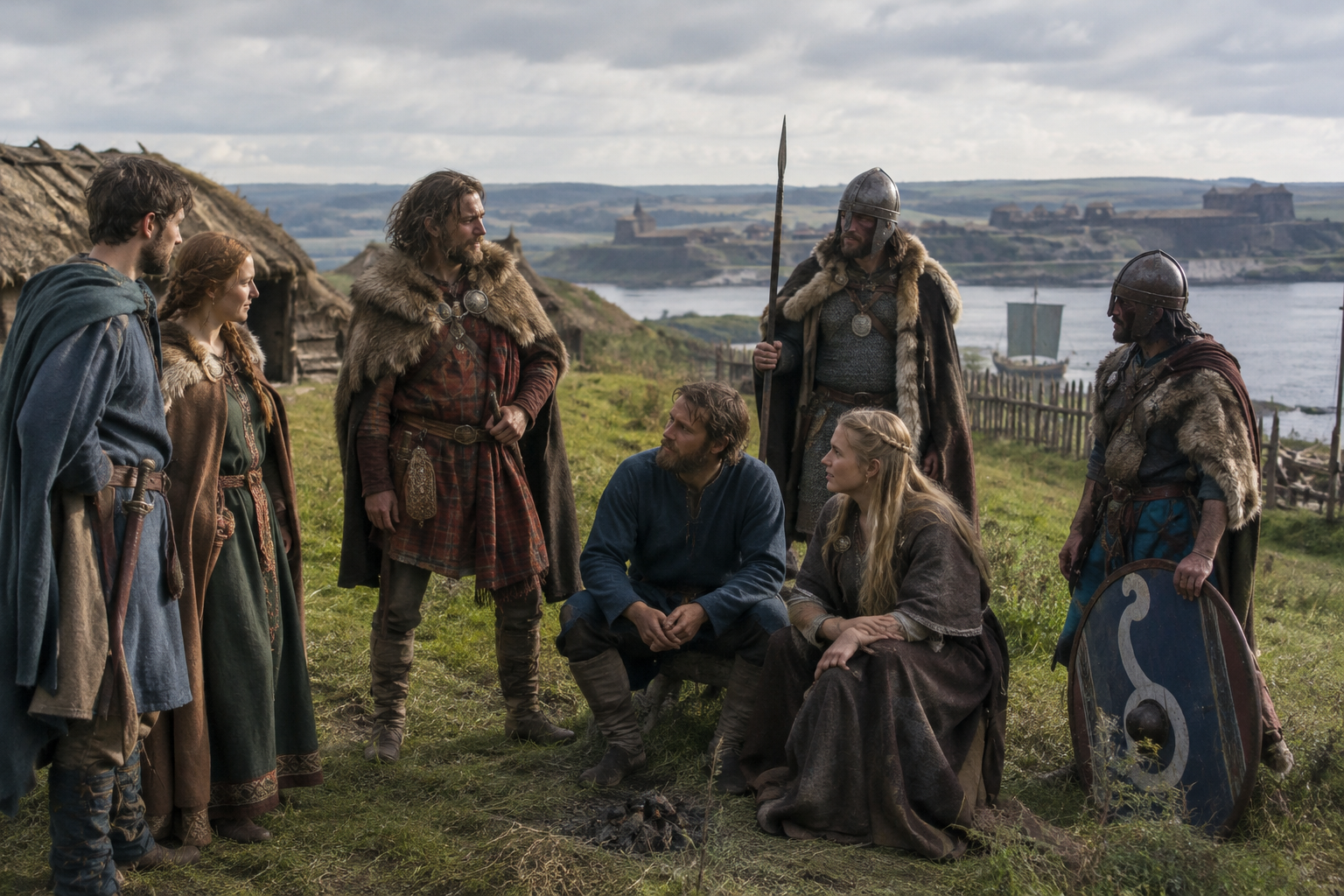
Some Y-DNA lineages are easy to tell broad stories about. This one, R1b1a1b1a1a2b1c1b1a, is not. It sits deep inside the sprawling R1b family tree, one of the major paternal lineages of western Eurasia, and that is precisely what makes it interesting. Instead of giving us a simple label like "Celtic" or "Germanic" - labels genetics often refuses to obey anyway - it forces us to look carefully at the evidence: who appears where, in what period, and in what archaeological setting.
That is worth dwelling on for a moment. Y-DNA haplogroups trace one very particular line of ancestry: the direct paternal line, passed from father to son. They do not describe a person's whole ancestry, culture, language, or identity. But when ancient DNA places related paternal branches in Iron Age Britain, among a Quadi individual near Bratislava, in Migration Period Hungary, and in Viking Age Sweden, we begin to see something rather more interesting than a slogan. We see a lineage turning up in the human traffic of later prehistoric and early medieval Europe.
The wider haplogroup R1b has a long and complicated history across Eurasia and is especially prominent in later European prehistory and history. But one must be careful here: the deep history of broad R1b cannot simply be pasted wholesale onto a much narrower branch like R1b1a1b1a1a2b1c1b1a. What we can say more safely is that this subclade belongs within a paternal framework that became widespread in many parts of Europe over the Bronze and Iron Ages, and that its known ancient appearances suggest a western and central European historical footprint rather than a narrowly local one.
The supplied ancient samples are especially revealing because they cluster not in one single kingdom or tribe, but across several connected worlds: Iron Age Britain, central Europe near the Danube, post-Roman England, the Carpathian Basin, and medieval Scandinavia. That distribution hints at a lineage moving through the same continental corridors used by traders, warriors, migrants, and farming communities over many centuries.
Readers interested in the bigger archaeological argument about how paternal lineages became tied to the spread of Celtic-speaking worlds may also enjoy this related article.
Explore Celtic language origins
The British samples are some of the most evocative in this set because they place this paternal branch, or a close related lineage, in multiple Iron Age settings. At Wetwang Slack in East Yorkshire, sample I36822, dated to 225 BC, comes from the world of the Celtic Parisi. Wetwang Slack has become one of those sites that reminds us Iron Age Britain was not some dim prelude to history but a landscape of communities with distinct burial customs, social structures, and regional identities.
Then there is I19873 from Late Iron Age East Kent England, dated to 300 BC, and I16440 from Celtic Iron Age Harlyn Bay Cornwall, dated to 200 BC. Together these samples stretch from the southeast of England to Cornwall in the far southwest. That does not prove a single tightly bounded "people" in genetic terms. What it does show is that related paternal lines could be found across several parts of Iron Age Britain, in places tied to very different regional histories and maritime connections.
And that matters. East Kent faced the Continent across a narrow sea. Cornwall looked to Atlantic routes. Yorkshire sat in a different social and political world again. A lineage present in all three settings fits rather well with what archaeology has been telling us for years: Iron Age Britain was regionally diverse, but not isolated.
If you want to read more about how genetics is changing our understanding of these communities, this article is an excellent companion.
One of the most intriguing continental samples is I11712, identified as Quadi Tribe Bratislava Slovakia, dated to 95 BC. The Quadi belong to the complicated world of central Europe beyond Rome's formal frontiers, though of course such frontiers were never neat barriers. Peoples moved, allied, traded, raided, married, and resettled. A paternal branch appearing both in Iron Age Britain and in a Quadi-associated individual near Bratislava does not mean those communities were the same. It does, however, place this lineage in a broad zone of interaction stretching from the Atlantic facade to the middle Danube.
That same sense of movement appears again in C10462 from Post Roman Iron Age England East Yorkshire Wetwang Slack 267, dated to 450 AD. By this date Roman administration in Britain had collapsed, but people had not vanished. Some lineages continued locally; others arrived through new migrations from across the North Sea; many communities likely represented mixtures of both. A paternal line turning up in East Yorkshire before and after Rome is a useful reminder that the end of empire did not erase earlier ancestry. It rearranged it.
The continental side of this story deepens with RKF247 from Migration Period Hungary Rakoczifalva, dated to 650 AD. The Carpathian Basin in this period was a place of remarkable mobility, where the debris of the Roman world, steppe-linked groups, Germanic populations, and local survivors all met. To find a related paternal lineage here is not surprising, but it is illuminating. It shows the branch participating in precisely the sort of mixed and shifting population landscape that ancient DNA has been revealing again and again.
For readers drawn to that turbulent central European setting, this related article offers a wider view.
The latest sample in the set is VK40 from Viking Age Skara Varnhem Sweden, dated to 1050 AD. By this stage, the lineage appears in a thoroughly medieval Scandinavian context. Again, one must resist the temptation to overdramatize. This does not make the haplogroup "Viking" in any exclusive sense. But it does show that the branch, or a close relation within the same paternal network, had reached or persisted in Scandinavia by the end of the Viking Age.
Seen alongside the British and central European evidence, VK40 suggests a paternal history linked not to one tribe or one national story, but to the connected northern half of Europe: the North Sea, the Baltic, the Channel, and the Danube corridor. That is where this haplogroup becomes historically interesting. It keeps turning up in the zones where people met and moved.
Those Scandinavian links are worth following further, especially if Viking Age mobility is what caught your eye.
The later historical association supplied here brings us to House de Soucy and Chateau de Souzy la Briche in Essonne. This is a very different world from Iron Age cemeteries and Migration Period burials, but that contrast is part of the fascination. Medieval and early modern noble houses occupied landscapes already ancient with settlement, movement, and inheritance.
The site at Souzy la Briche began as a seigneurial estate in the medieval period. Over time it became a country residence tied not only to aristocratic life but later to the French state itself. The present chateau was largely rebuilt in the nineteenth century, yet the importance of the place lies in its long continuity of use. It moved from feudal lordship to elite residence, and later into the discreet political world of the French presidency under the Fifth Republic.
That long career makes the chateau historically suggestive. It stands for a pattern seen across Europe: aristocratic houses and estates often occupy regions whose human history runs far deeper than the documents preserving their names. Genetics cannot leap from an Iron Age burial to a medieval French noble family without specific evidence, and we must not pretend otherwise. Still, a house like de Soucy belongs to the same broader European story in which paternal lines survive, branch, disappear, reappear, and become embedded in new political orders.
In that sense, the castle is not proof of lineage but a monument to historical layering. Beneath the medieval estate lay older populations; after the seigneurial age came the modern state. The stones changed their function, as families and institutions changed theirs, but the landscape remained a stage on which many generations played out their claims to belonging.
Readers interested in the specific family history can continue with the dedicated community article here.
What, then, does R1b1a1b1a1a2b1c1b1a reveal? Not a tidy ethnic badge, and not a shortcut to a noble pedigree. What it offers instead is a map of appearances: Iron Age Britain, a Quadi-associated individual near Bratislava, post-Roman Yorkshire, Migration Period Hungary, and Viking Age Sweden. That is a serious historical spread. It points to paternal continuity and mobility across several major European zones over more than a thousand years.
Ancient DNA is especially powerful here because written genealogy cannot reach this far back. It lets us see real men, buried in real cemeteries, carrying related paternal signatures in very different cultural settings. Some may reflect long local continuity. Others may mark migration or assimilation. Usually, the truth is some combination of both.
And that, frankly, is more interesting than the old habit of trying to pin a haplogroup to one people forever. Human history was messier. Fortunately, ancient DNA is good at mess.
If your own Y-DNA belongs somewhere within the vast R1b world, MyTrueAncestry can help place it alongside ancient individuals and historical populations like those discussed here. Those matches do not by themselves prove direct descent from a particular ancient person or noble house, but they can open a striking window onto the deeper past of your paternal line.






Comments