Haplogroup R1b1a1b1a1a2b1c1b1

– 6 min read


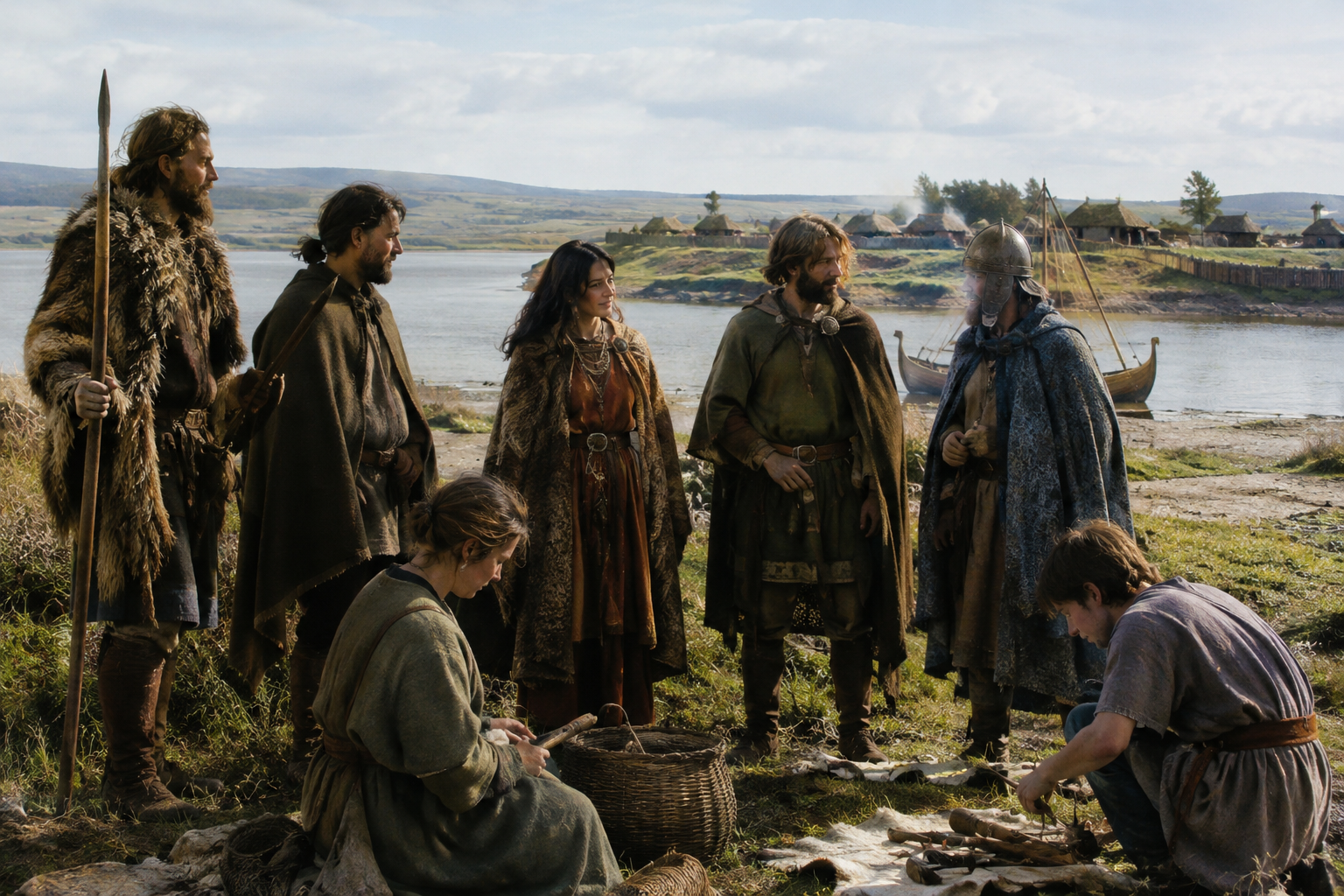
Some Y-DNA haplogroups announce themselves with royal fanfare. Others do something more interesting: they turn up quietly, in graves scattered across centuries and coastlines, and force us to think about how paternal lineages moved through the ordinary and extraordinary worlds of ancient Europe. Haplogroup R1b1a1b1a1a2b1c1b1 belongs to that second category.
At first glance, it is an extremely specific branch name, the sort of genetic label only a population geneticist could love. But that is precisely the point. Y-DNA haplogroups trace one direct paternal line, father to son to son again, and narrow subclades like this can help illuminate very particular historical pathways. They do not describe a person's whole ancestry, culture, or identity. What they can do, when ancient DNA is available, is show us that one paternal thread appearing in Iron Age Britain, on the middle Danube frontier, in post-Roman England, and in Viking Age Sweden.
This haplogroup is a downstream branch within the wider R1b family, one of the major Y-chromosome lineages long associated with many parts of western Eurasia and especially well represented in later prehistoric and historic Europe. That broad statement is secure. What needs more caution is the jump from the broad R1b story to this very narrow branch. We should not lazily pour the entire prehistory of R1b into one late twig of its family tree as if nothing changed along the way.
What the evidence supplied here does suggest is that this branch, or closely related paternal lines, was present in parts of Europe by the Iron Age and remained visible into the early medieval world. The geographic spread of the ancient samples is striking: eastern and southern Britain, the Danube region, the Carpathian Basin, and Scandinavia. That pattern fits a Europe connected by movement, trade, warfare, marriage, and local continuity rather than by neat ethnic boxes.
For readers wanting a wider view of how genetics is reshaping our picture of language and movement in later prehistoric Europe, one useful companion piece is below.
Explore Celtic Origins Through Ancient DNA
The oldest supplied individuals carrying this haplogroup sit firmly in the Iron Age, and they immediately complicate any tidy regional story. At Wetwang Slack in East Yorkshire, the sample I36822, described as Celtic Parisi Iron Age England East Yorkshire Wetwang Slack Year:225 BC ID:I36822, places this paternal line in one of the best-known Iron Age landscapes of Britain. Wetwang Slack is famous for burials linked to the Arras culture, a world of chariots, elite display, and local identities that were never as isolated as older textbooks liked to imagine.
Further south and west, the same haplogroup appears in I19873, listed as Late Iron Age East Kent England Year:300 BC ID:I19873, and in I16440, Celtic Iron Age Harlyn Bay Cornwall Year:200 BC ID:I16440. East Kent and Cornwall are not minor footnotes here. They are opposite ends of southern Britain, each with its own maritime horizons. Kent faced the Continent directly. Cornwall looked out into Atlantic exchange networks. The presence of the same paternal branch in both regions hints that this was not an isolated local lineage trapped in one valley.
Then there is I11712, Quadi Tribe Bratislava Slovakia Year:95 BC ID:I11712. The Quadi are usually placed in the complicated world north of the Roman Danube frontier, among societies later described by Roman authors as Germanic. Yet here again we must resist simplistic equations between haplogroup and ethnicity. What matters is that a related paternal line appears in the Danubian zone as well as Iron Age Britain. That may reflect older shared ancestry, later mobility, or both.
If you want to dig further into paternal and family patterns in this period, this related study offers a broader archaeological genetics perspective.
Discover Iron Age Kinship and DNA
The Roman Empire did not create mobility in Europe, but it certainly intensified it. In the centuries around its decline, our haplogroup turns up in places that historians have long treated as frontiers of change. Sample C10462, Post Roman Iron Age England East Yorkshire Wetwang Slack 267 Year:450 AD ID:C10462, is especially telling. East Yorkshire had already yielded the earlier Iron Age individual I36822. Now, centuries later, the same paternal branch is still present in the same broader landscape.
That does not prove direct descent from one excavated man to another; archaeology is not a family tree service. But it does suggest that some paternal lines could endure locally through dramatic political shifts, even as post-Roman Britain absorbed newcomers and new identities.
The same wider period is represented by RKF247, Migration Period Hungary Rakoczifalva Year:650 AD ID:RKF247. This is the age when the Carpathian Basin was a place of layered populations, post-Roman transformations, and shifting political powers. A lineage found there and also in Britain and the Danube zone reminds us that the so-called Migration Period was not one simple folk movement but a dense web of ancestry, alliance, and resettlement.
For a closer look at exactly that post-Roman Hungarian setting, this community article is an excellent companion.
Read About Post-Roman Hungary DNA
By the early second millennium, the branch appears again in Scandinavia: VK40, Viking Age Skara Varnhem Sweden Year:1050 AD ID:VK40. Varnhem belongs to a fascinating moment when Viking Age society and Christian burial customs overlapped. It is tempting to make the haplogroup itself somehow "Viking," but that would be sloppy. Better to say that this paternal line was part of the male population living in Scandinavia at that time, just as related lines had earlier appeared in Iron Age Britain and central Europe.
Readers interested in that Scandinavian context may enjoy the following piece.
What, then, of the supplied noble connection: Clan Charron, associated with Cairon in Normandy near Caen? Here the historical interest lies less in proving a specific genetic pedigree and more in setting a later family landscape against the longer backdrop revealed by ancient DNA.
Cairon is described as a small village whose story runs from deep prehistory to modern rural France, with traces of very early settlement, a Gallo-Roman presence under the empire, and a medieval community shaped by local lords, the church, and the fertile farmland of the Caen plain. That is almost a textbook example of how European places accumulate history in layers rather than chapters. One generation ploughs over another.
In 1346, during the Hundred Years War, English forces under Edward III passed through and burned the village on the road to Caen. In 1944 the area was again caught in war during the Battle of Normandy after the D-Day landings. Yet Cairon endured as an agricultural settlement. Its old church, manor houses, roads, and stone-built homes still preserve the outline of that long continuity.
Scientifically, we must be disciplined. The existence of Clan Charron in Normandy does not prove that all men of that name carried haplogroup R1b1a1b1a1a2b1c1b1, nor does the haplogroup prove descent from a medieval family at Cairon. But Normandy is exactly the kind of region where such paternal histories become historically interesting: a place shaped by prehistoric settlement, Roman rule, medieval lordship, Anglo-Norman warfare, and later upheaval. Ancient DNA gives us the deep population background against which such local family histories unfolded.
For readers curious about the family side of that Norman story, the MyTrueAncestry community already has a relevant article.
The value of haplogroup R1b1a1b1a1a2b1c1b1 is not that it hands us a fairy-tale origin story. Its value is subtler and, in truth, more impressive. It shows one paternal lineage present in Iron Age Britain, on the central European frontier, in post-Roman Hungary, and in Viking Age Sweden. That is a real historical pattern, even if its exact branching route remains a matter for further sampling and research.
It also shows why Y-DNA matters. Written genealogy usually begins late and privileges elites. Ancient DNA reaches much further back, into communities that left graves rather than chronicles. When we place those graves beside later medieval places such as Cairon, we do not get proof of direct descent. We get something better: a grounded sense of how paternal lines can persist, spread, and reappear across very different historical worlds.
If your own Y-DNA falls on a branch like this, MyTrueAncestry can help place it in that broader human story. By comparing your DNA to ancient individuals and historical populations, you may find links that open new questions about where your direct paternal line fits into Europe's long and complicated past. Those matches do not by themselves prove descent from a particular ancient person or noble house, but they can offer an illuminating historical perspective.






Comments