Haplogroup R1b1a1b1a1a2a7

– 6 min read


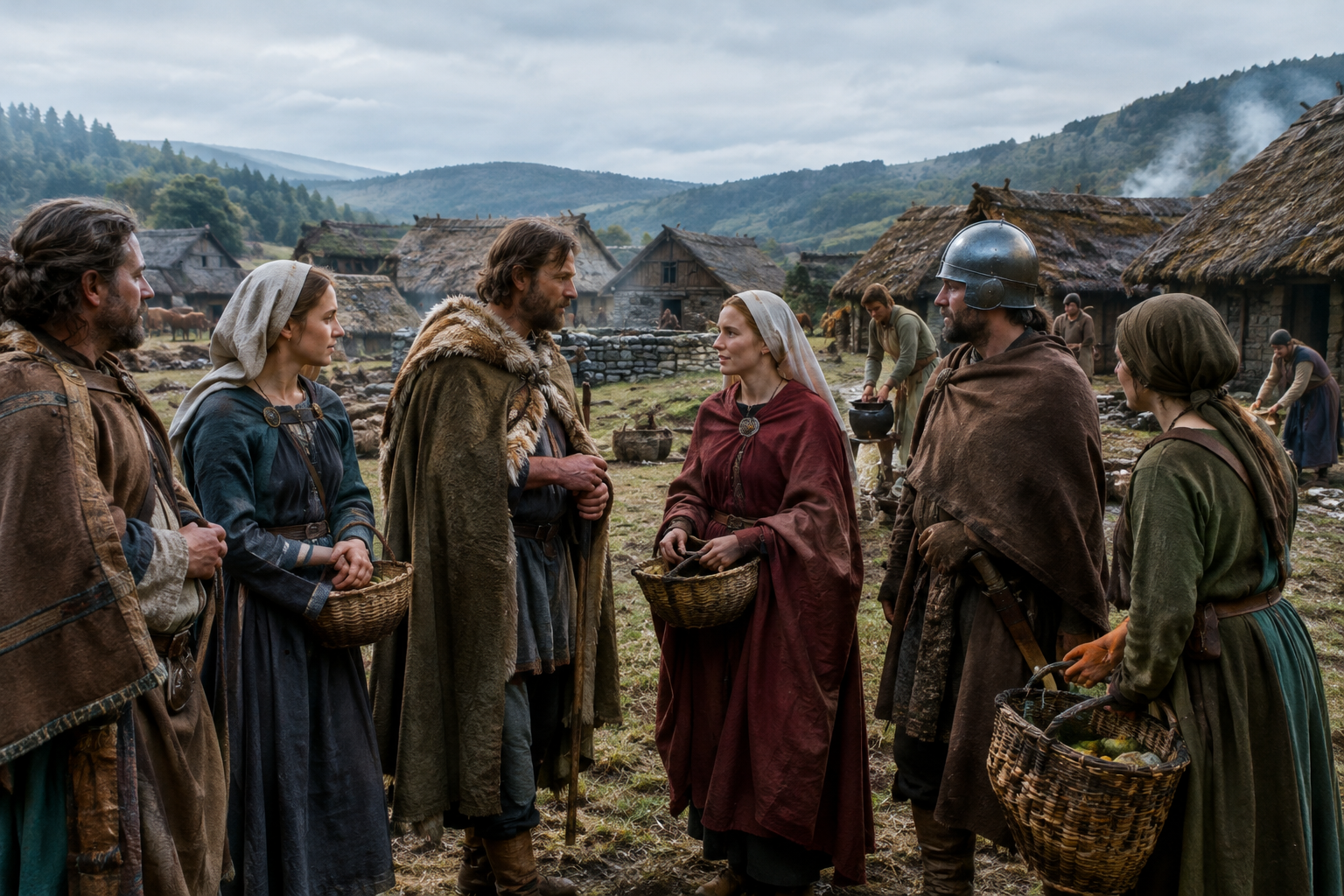
Some Y-chromosome lineages are easy to place in a single chapter of history. This one is not. Haplogroup R1b1a1b1a1a2a7 appears in an ancient-DNA landscape that stretches across Bronze Age central Europe, Iron Age Britain and Gaul, Roman and post-Roman mobility, medieval Iberia, and later historic Europe. That does not make it a badge of one people, one kingdom, or one surname. It makes it interesting.
Like all Y-DNA haplogroups, this lineage traces only a direct paternal line: father to father to father. It does not describe a person's whole ancestry, culture, language, or identity. Still, paternal lineages can be remarkably useful historical tools. They let us watch some male lines persist, spread, fragment, and reappear in very different archaeological settings. In the case of R1b1a1b1a1a2a7, the evidence points toward a branch within the wider R1b family that is deeply entangled with western and central European history, while reminding us to be careful not to collapse the history of broad R1b into the story of one narrow subclade.
The larger R1b family is one of the best-known paternal lineages in Europe, especially in western Europe, but a specific branch such as R1b1a1b1a1a2a7 must be treated much more narrowly. What the sample set suggests is not a simple point of origin, but a pattern: this lineage or closely related branches are visible across central Europe in the Bronze Age and then in many Iron Age and historical contexts from Britain to Iberia and the Low Countries.
That fits a wider archaeological picture in which male lineages connected to R1b became prominent in parts of Europe after late prehistoric population changes associated with Bell Beaker and Bronze Age societies. Yet one must be cautious: the presence of related R1b branches in Beaker or Bronze Age contexts does not mean every later branch was already distributed in exactly the same way. Instead, what we are probably seeing is the long afterlife of an older paternal structure that later diversified regionally.
Explore Celtic origins in ancient DNA
One of the most striking early anchors is LEU024, from Bronze Age Unetice Thuringia Leubingen Sommerda Germany, dated to 1950 BC. Unetice stands near the beginning of the Bronze Age world of central Europe: metalworking, elite burial, and emerging regional hierarchies. A sample like LEU024 matters because it places this paternal signal in a central European setting long before the classical world or medieval kingdoms.
Central Europe keeps returning. There is MIB054 from Bronze Age Bohemia, dated 2500 BC, and a cluster of later Bronze Age and Bell Beaker-associated cases from the Czech lands and neighboring regions, such as HOP001, HOP003, KOP002, and KOP003. Taken together, these do not prove a single uninterrupted family line, but they do suggest that related paternal branches were established across the middle Danube and Bohemian zone very early.
Then the Iron Age sharpens the picture. In southwestern Germany, elite Hallstatt-associated burials such as APG001, APG003, and LWB001 from Elite Celtic Burial Germany Asperg-Grafenbuehl and Ludwigsburg Roemerhuegel, dated to 450 BC, place this lineage in high-status Celtic settings. That is important, not because it lets us lazily call the haplogroup "Celtic," but because it shows the branch in communities archaeologists already identify as part of the early Celtic world.
Britain provides another dense cluster. The long run of Parisi and related Iron Age burials in East Yorkshire, including I36879, I36965, I21699, I21861, and I5502, dated roughly between 295 BC and 100 BC, suggests that closely related paternal lines were common in at least some eastern British groups. Add I50137, the Elite Celtic Chariot Burial Iron Age England West Yorkshire Ferry Fryston dated to 237 BC, and the pattern becomes hard to miss: this was a lineage at home in Iron Age Britain, from ordinary cemeteries to conspicuously high-status graves.
Roman and post-Roman contexts show that the story does not stop with the Iron Age. FEN008 from Roman Era Fenstanton Cambridgeshire dated to 100 AD, and WBK36 from Celtic Durotriges England Duropolis Winterborne Kingston dated to 125 AD, remind us that local paternal lines persisted under Roman rule. In Gaul, the R2055 group from Gallo Roman France Metz Lunette Sablon dated to 432 AD shows the same broad branch surviving into Late Antiquity in a frontier world where Roman, local, and incoming identities overlapped.
Discover Roman and early medieval Britain
If central Europe and Britain show early depth, Iberia shows endurance. The sample list includes prehistoric Iberian examples such as EHU002 from Bronze Age El Hundido Monasterio de Rodilla Spain dated to 2417 BC, MDP003 from Bronze Age Spain Molinos del Papel Murcia Caravaca dated to 2090 BC, and the La Bastida group including BAS002 and BAS026 dated to 2200 BC. Whatever the exact downstream branching, this is a reminder that related paternal ancestry had a deep foothold in Iberia too.
By the historical period, northern Spain becomes especially vivid. At Las Gobas in northern Spain we find ldo062 dated to 620 AD, then ldo066 and ldo037 at 1000 AD, and ldo048 at 1025 AD. A sequence like that is gold for historians. It suggests not a single dramatic migration event, but local continuity through the end of Roman rule, the Visigothic and early medieval centuries, and into the Christian kingdoms of the north. Nearby or related Iberian-period contexts such as I20382 from Early Visigothic Spain Girona Sarria de Ter Pla de lHorta dated to 611 AD and I30592 from Early Medieval Spain Zaragoza Epila Las Lomas del Molino dated to 600 AD reinforce that impression of persistence in an Iberia shaped by Roman collapse and new political formations.
This is exactly the sort of evidence that helps correct older historical habits. Medieval northern Spain was not populated by abstract labels like "Visigoth" or "Hispano-Roman." It was full of people whose paternal ancestry could be local, long-rooted, and yet part of a broader European pattern.
Read about Roman Hispania's genetic legacy
How does a paternal lineage like this meet the later medieval world? Not through a simple claim of descent from an Iron Age warrior to a named clan chief. Genetics does not work like a romantic saga, and responsible history should not pretend otherwise. But ancient DNA does help us understand the deep background of the regions in which later families emerged.
That brings us to Clan Henderson and Fordell Castle in Fife. The castle began as the seat of the Norman family of de Camera, later called Chamberlain, and by the 16th century had grown into a fortified laird's house with tower and hall. Mary Queen of Scots is said to have visited. The building then passed through the dangerous world of Scottish noble politics before later decline, alteration, and 18th- and 19th-century rebuilding in baronial style. Its medieval core survived within those later changes, and modern restoration has preserved it as a layered family seat rather than a mere fortress.
That is worth pausing over. Castles like Fordell are often imagined as static symbols of bloodline purity. In reality they are records of adaptation: Norman foundations, Scottish lordship, royal visits, rebuilding, neglect, reinvention. In that sense, they resemble Y-DNA evidence rather closely. A lineage may persist, but the cultural world around it changes repeatedly. The men who carried related paternal lines in Bronze Age Bohemia, Iron Age Yorkshire, Gallo-Roman Metz, and medieval Spain lived in utterly different societies. So did the later families who occupied Scottish strongholds.
It would be wrong to claim that Clan Henderson, the de Camera or Chamberlain family, or the occupants of Fordell Castle are genetically proven carriers of R1b1a1b1a1a2a7 on the evidence supplied here alone. What we can say is that the haplogroup's ancient footprint across Britain and western Europe provides historical context for the sort of paternal diversity long present in the regions from which later Scottish noble families emerged.
Explore the story of Clan Henderson
The fascination of R1b1a1b1a1a2a7 lies in its breadth across time. Samples such as LEU024 in Bronze Age Germany, APG001 in an elite Celtic burial, the long Yorkshire Iron Age series including I21699 and I5502, and the Las Gobas sequence of ldo062, ldo066, ldo037, and ldo048 show a paternal history that is not tied to one short-lived episode. It appears instead as part of a durable western and central European story, visible in prehistoric chiefdoms, Iron Age communities, Roman provinces, and medieval settlements.
Ancient DNA is especially good at revealing what written genealogy cannot. Medieval charters can tell us who held a castle; archaeology can tell us how a grave was furnished; genetics can show that some paternal branches crossed those centuries in the same landscapes, though not as a neat chain of named individuals. That combination is far more interesting than a fantasy pedigree, because it shows how population history and family history intersect without being identical.
If this haplogroup appears in your own results, it does not make you a Celt, a Roman Briton, a Visigoth, or a Scottish laird. But it may place your direct paternal line within a remarkably old European pattern, one that ancient burials have begun to illuminate in extraordinary detail.
If you want to explore the ancient people, archaeological cultures, and historical regions connected to your DNA, MyTrueAncestry can help you compare your results with ancient samples and discover where your deeper ancestry may fit into the human past. Those matches do not prove direct descent from a specific ancient individual or noble family, but they can open a wonderfully concrete window onto the world your ancestors inhabited.






Comments