Haplogroup R1b1a1b1a1a2a3

– 6 min read


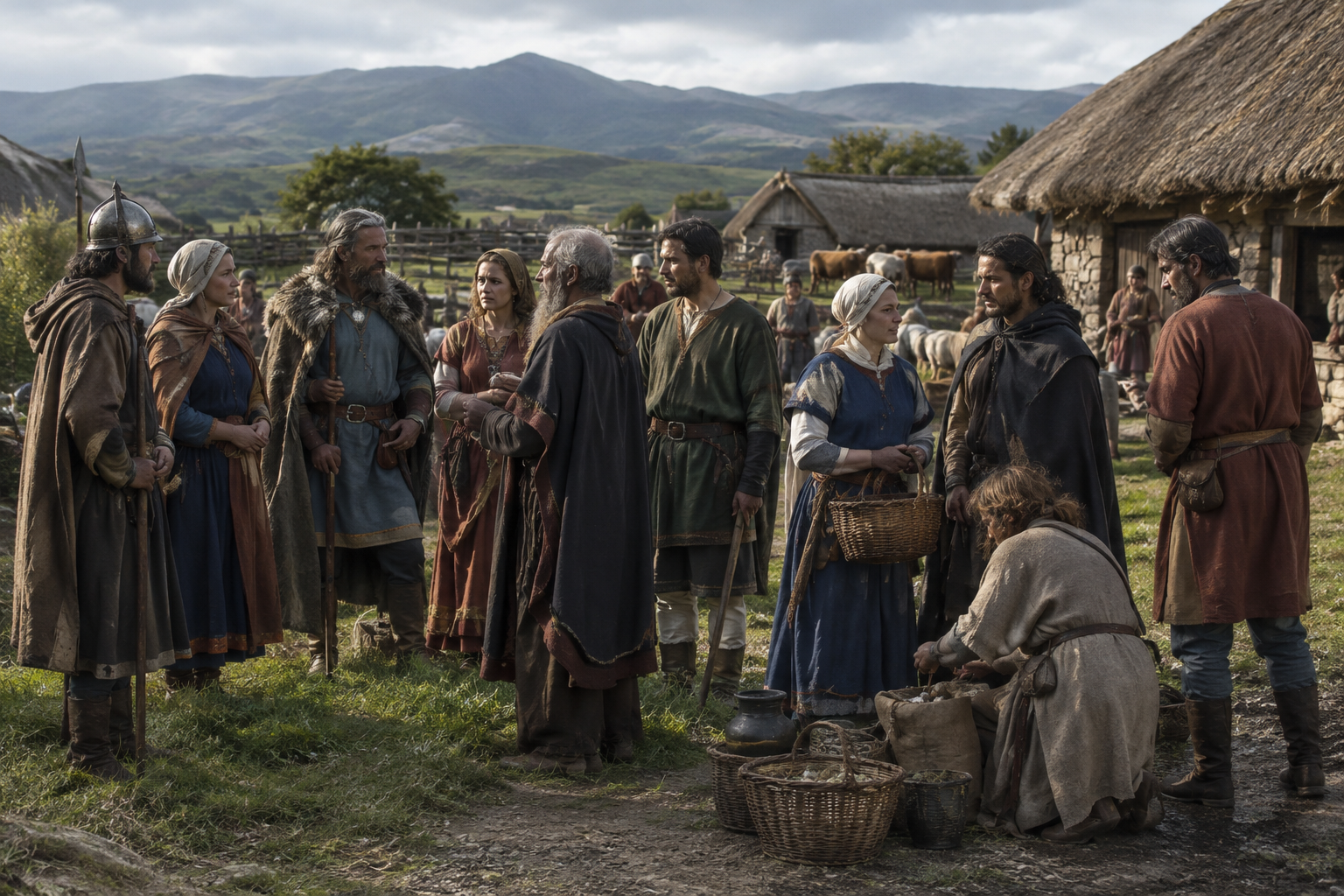
Some Y-DNA haplogroups announce themselves with obvious historical drama. Others, like R1b1a1b1a1a2a3, are more interesting for a different reason: they keep turning up in just enough places, and across just enough centuries, to remind us that paternal history is rarely a neat national story. It is a record of men moving, settling, marrying locally, serving armies, joining monasteries, raising families, and vanishing into the ordinary fabric of Europe.
This is a direct paternal lineage, traced through the Y chromosome from father to son. That makes it useful for reconstructing one narrow line of ancestry, but only one line. It does not describe a person's whole ancestry, culture, language, or identity. Still, when a branch like this appears in ancient DNA from Bronze Age Central Europe, Iron Age Celtic burials, Roman and post-Roman sites, medieval Iberia, Britain, and the Low Countries, it gives us a remarkable set of clues about continuity and movement across the European past.
The long label R1b1a1b1a1a2a3 tells us immediately that this lineage sits deep within the wider family of haplogroup R1b, one of the major Y-chromosome lineages in western Europe today. But one must be careful here. The history of broad R1b is not automatically the history of every tiny downstream branch. What we can safely say is that this subclade belongs within a paternal family that became widespread across large parts of Europe, especially after later prehistoric population changes.
The supplied ancient DNA strongly suggests that lineages close to this branch were already present in parts of central and western Europe by the Bronze Age. Samples such as LEU024 from Bronze Age Unetice Thuringia at Leubingen Sommerda, Germany, dated to 1950 BC, and MIB054 and MIB054d from Bronze Age Bohemia Year:2500 BC, place related paternal lines in the heart of prehistoric central Europe very early indeed. That does not prove this exact subclade began there, but it does show the kind of landscape in which its ancestors were already established.
From there, the story becomes less a single migration arrow on a map and more a pattern of repeated appearances: the Low Countries, Britain, Gaul, Iberia, northern Italy, Pannonia, and later medieval communities farther west.
If one were looking for a grand stage on which these paternal lines became visible, Iron Age Europe would do nicely. The sample list is crowded with evidence from Celtic and related contexts. In southern Germany, the Elite Celtic Burial Germany Asperg-Grafenbuehl Year:450 BC samples APG001, APG001c, and APG003, together with LWB001, LWB001_ss, and LWB001_ss_b from Ludwigsburg Roemerhuegel Year:450 BC, show this paternal signature in high-status Hallstatt or early La Tene settings. These were not nameless dots on a chart. They belonged to communities displaying rank, wealth, and social differentiation.
Then there is Britain, where the lineage appears with striking frequency in Iron Age eastern Yorkshire. Wetwang Slack, Pocklington, Melton, Nunburnholme Wold, and Ferry Fryston all make appearances: I36879, I37333, I36965, I21699, I21861, I5502, and I50137, among many others. This clustering matters. It suggests that paternal lines of this kind were not passing oddities in Iron Age Britain, but part of the local male landscape among the Parisi and neighboring Brittonic groups.
That is useful historically because it warns against a simplistic notion that every later British or Scottish example must derive from a single medieval arrival. Some of these paternal lines were already in Britain centuries before Rome, long before anyone had heard of Norman barons or Scottish clans.
Elsewhere, we find related appearances in CGG022421 and CGG022464 from Belgic Suessiones contexts in France, UN85 from the Gallic Venelli of Normandy, and 3298 from the Gallic Cenomani Tribe Italy Verona Seminario Vescovile Year:300 BC. The map is not random. It points to a strong western and central European distribution in later prehistory, especially in regions linked with Celtic-speaking or Celtic-associated archaeology.
Then Rome arrives, and with Rome comes mobility. Not a clean replacement of one people by another, but an untidy reshuffling of soldiers, settlers, traders, locals, and migrants. That is where this lineage becomes especially interesting. Samples like FEN008 from Roman Era Fenstanton Cambridgeshire Year:100 AD and WBK36 from Celtic Durotriges England Duropolis Winterborne Kingston Year:125 AD show paternal continuity and adaptation within Roman Britain. In Gaul, R2055a, R2055b, R2055c, R2055d, and R2055e from Gallo Roman France Metz Lunette Sablon Year:432 AD sit at the hinge between Roman order and the post-Roman world.
In Iberia, the same broad story unfolds. I23276 from late Roman and early migration period Merida, I23764 from the Merida Necropolis Blanes, I20382 from Early Visigothic Spain Girona Sarria de Ter Pla de lHorta Year:611 AD, and I30592 from early medieval Zaragoza show that this paternal branch was present across changing political regimes. Roman, Visigothic, and local Iberian worlds were not genetically sealed compartments.
Perhaps most evocative are the multiple entries from Las Gobas in northern Spain: ldo062 dated 620 AD, then ldo066 and ldo037 at 1000 AD, and ldo048 at 1025 AD. A single site represented across centuries is exactly the sort of evidence that makes archaeogenetics so valuable. It lets us glimpse not just migration, but persistence: paternal lines remaining in a place through changing kingdoms, religions, and local social worlds.
Read Roman Hispania's DNA Story
The lineage also appears in exactly the sort of places where late antique and early medieval Europe became gloriously complicated. COL_098b from Lombard Era Collegno Northern Italy Year:580 AD, DNA031 from an Alemanni Grave Switzerland Basel-Waisenhaus Year:376 AD, and a whole cluster from Pannonia and the Hungarian plain - SZL025, SZL032, SZL052, SZL054, GHD023, RKO001, and RKF253 - show how these paternal lines sat within frontier societies shaped by Rome's collapse and new political formations.
One should not leap from haplogroup to ethnic label. A man buried in a Lombard cemetery was not "genetically Lombard" in some pure sense, nor does a burial in Pannonia settle language or identity by itself. But such finds do reveal that lineages connected to western and central Europe were present among the men moving through these post-Roman zones.
Later still, the branch turns up in medieval and early modern settings from Sint-Truiden and St. Rombouts in Belgium to ATP_PSN_1217 in late medieval Cambridgeshire, CGG101854 in medieval Denmark, and even PCA0657, Piast Dynasty Prince Boleslaw II of Masovia Year:1310 AD. The effect is cumulative: not one spectacular royal lineage, but a long, persistent paternal presence in the western half of Europe.
The later historical connection supplied here leads us to Clan Colville and to Culross Abbey in Fife, Scotland. This is where one must keep one's feet firmly on the ground. A historical association with this haplogroup does not prove that every Colville male carried R1b1a1b1a1a2a3, nor that any ancient sample discussed above was an ancestor of the clan. What it does offer is a meaningful regional and historical setting in which to think about paternal continuity in Britain.
Culross Abbey began as a Cistercian monastery in 1217, founded by Malcolm, Earl of Fife, on a site already linked to the early medieval saint Serf. Over time it became a religious center with land, income, and local influence. After the Scottish Reformation in 1560, monastic life ended, much of the complex fell into ruin, and the nave survived as the parish kirk. The surviving structure, with its medieval fabric, later repair, and romantic ruin, is a reminder that family history in Scotland was never only about castles in the martial sense. Abbeys too were seats of power, memory, patronage, and local standing.
In that respect, the Colville connection is fitting. The ancient DNA record for this haplogroup includes prehistoric and Iron Age Britain, Roman-era eastern England, and later samples from Scotland's wider cultural zone such as I16503 and I16416 from Iron Age Hillfort Broxmouth East Lothian. None of that proves a Colville pedigree. But it does show that paternal lines from this broader family had deep roots in Britain long before medieval surnames emerged.
So what does R1b1a1b1a1a2a3 reveal? Above all, it shows how ancient DNA complicates tidy historical storytelling. This is a lineage that appears in Bronze Age central Europe, among elite Celtic burials, in Iron Age Britain, in Roman and post-Roman frontier societies, in medieval Iberia, and in later western European communities. It seems to belong to that large body of paternal ancestry that became widely established across western and central Europe and then persisted, diversified, and moved within later historical worlds.
That matters because written genealogy usually begins late and favors the powerful. Ancient DNA gives us something different: a way to see lineages before surnames, before heraldry, before chronicles. It can place a medieval clan or noble house into a much older regional context, while also reminding us that shared haplogroups are not proof of recent kinship. A man from Wetwang Slack and a man associated with a Scottish clan may share a distant paternal branch while being separated by many centuries and countless unrecorded generations.
If you want a broader view of how these British and continental patterns play out in later history, the story sits very comfortably beside work on medieval and post-Roman population change in Britain and northwestern Europe.
Explore Roman and Medieval Britain
That, really, is the pleasure of this haplogroup. It is not a single conquering tribe bottled in a test tube. It is a paternal thread seen in farmers, warriors, local elites, frontier settlers, medieval townsmen, and later historical families. The science does not flatten history; it makes it more human.
Upload your DNA to MyTrueAncestry to explore whether your own results show connections to ancient individuals, archaeological cultures, and historical populations linked to lineages like R1b1a1b1a1a2a3. These matches do not prove direct descent from a noble family or any one ancient person, but they can open an extraordinary window onto your deeper past.






Comments