Haplogroup R1b1a1b1a1a2a2a

– 7 min read


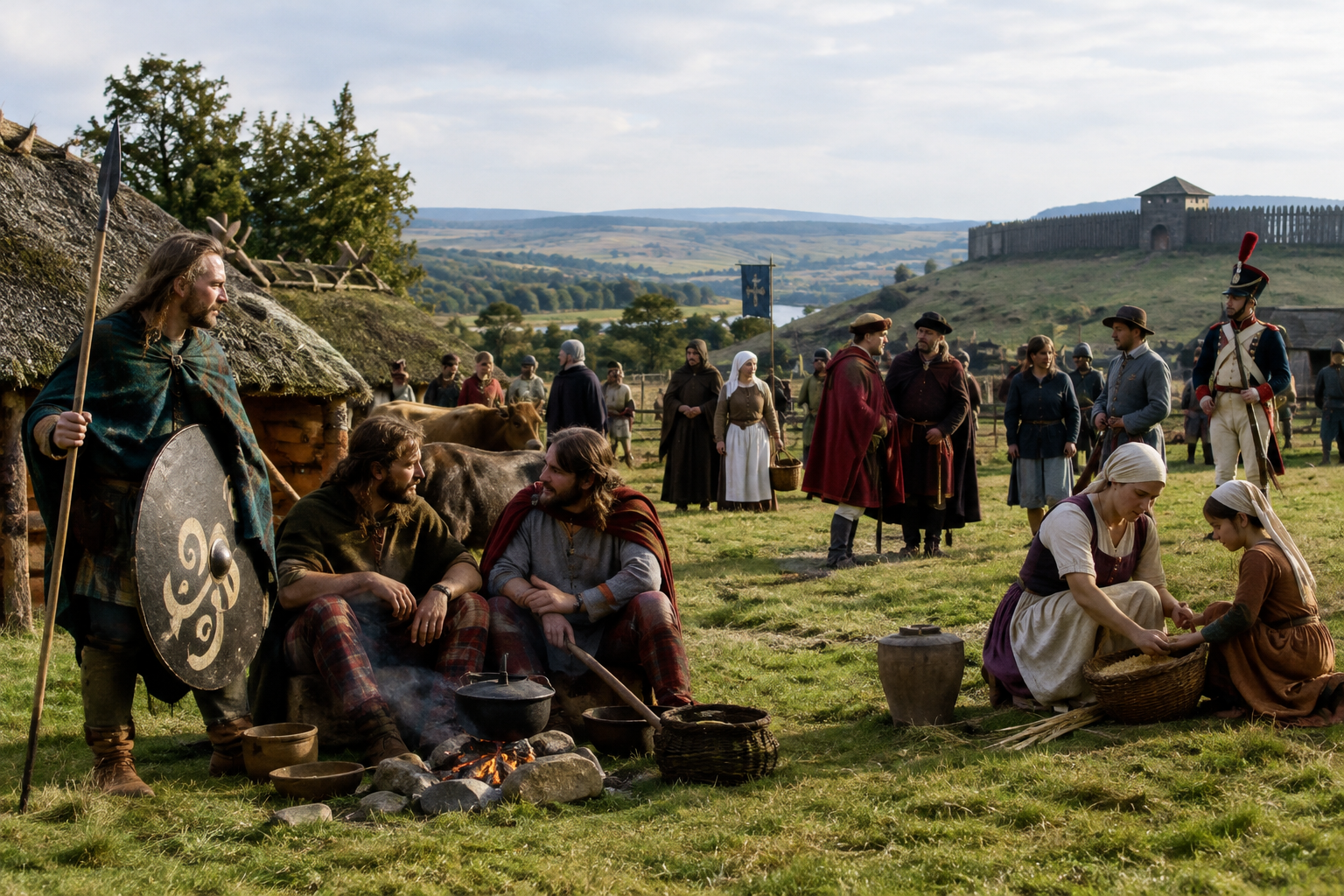
Some Y-DNA haplogroups announce themselves in history with a trumpet blast. Others are more interesting precisely because they do not. R1b1a1b1a1a2a2a belongs to a very large and important western Eurasian Y-chromosome family, but this narrow branch is best understood not as a label for one people, one kingdom, or one dynasty, but as part of a long chain of paternal descent that appears across a surprisingly wide historical map.
That is what makes it useful. Y-DNA traces one direct paternal line only: father to father to father. It does not describe all of a person's ancestry, identity, language, or social world. But when ancient DNA turns up related paternal branches in Iron Age Britain, Roman Spain, post-Roman Portugal, late antique Croatia, medieval France, and even later colonial and military settings, it gives us a rare way to watch one strand of male-line history move through real landscapes and real communities.
The first thing to say, soberly, is that this very specific subclade should not simply be given the entire biography of broad R1b. R1b is a major Y-chromosome lineage with deep importance in western Europe, and many of its branches expanded in different times and places. A downstream branch such as R1b1a1b1a1a2a2a represents a much narrower twig on that tree. Its story must therefore be pieced together from where related ancient samples appear, and from the historical settings in which those men lived.
The supplied ancient evidence points strongly toward a western and central European pattern, with especially striking appearances in Britain, Gaul, Iberia, and parts of the wider Roman and post-Roman world. That does not prove a single simple migration route. It does suggest that lineages within this paternal family were present in communities shaped by Bronze Age population change, Iron Age regional societies, Roman mobility, and medieval continuity.
Readers interested in the bigger prehistoric backdrop to Celtic-speaking expansions and their genetic context may enjoy this related MyTrueAncestry piece.
Explore Celtic origins in ancient DNA
If one region stands out in this sample set, it is Britain. The chronology is impressive. There is a Bronze Age presence in southern England with dfb003 from Cranborne Chase Down Farm Pond Barrow in Dorset, dated to 1900 BC, and I19857 from Rowbarrow, Wiltshire, dated to 1475 BC. Further west, I16454 from Constantine Island, Cornwall, dated to 1210 BC, and farther north I7629 from Melton Quarry, East Riding of Yorkshire, dated to 933 BC, suggest that related paternal lines were already spread across very different British regions long before written history.
By the Iron Age the picture becomes denser and more socially textured. East Yorkshire is particularly revealing. At Wetwang Slack, a famous Arras Culture cemetery landscape, multiple individuals carry related paternal signatures: I36879, I36979, I36862, I36973, I36818, I36789, I36796, I36808, I31511, I36748, and I30991, all dated to 225 BC. Add I21699 and I21645 from Pocklington, dated to 225 BC, I28773 from Melton, dated to 270 BC, and I12413 from Pocklington, also dated to 225 BC, and you begin to see not an isolated burial or two, but a regional pattern.
That matters. It suggests that paternal branches in this part of the R1b family were embedded in Iron Age communities of eastern Britain, not merely passing through them. These were people buried in places associated with local elites, wagons, weaponry, and the distinctive funerary customs of the Arras Culture. Yet genetics cannot tell us that all these men were close kin, nor that they spoke the same language, nor that they belonged to one tribe in the way Roman writers loved to imagine tribes. It tells us something narrower and in its way more powerful: related male-line ancestry was established here across generations.
Other British samples broaden the map. I12771 from Brassington in Derbyshire, dated to 360 BC, I20630 from Fin Cop in Derbyshire, dated to 200 BC, I11143 from Worlebury Camp in Somerset, dated to 200 BC, I14327 from Thornholme in Yorkshire, dated to 190 BC, and I16450 from Trethellan Farm in Cornwall, dated to 100 BC, show that this paternal world was not confined to one county.
Roman Britain does not break the pattern. At Duropolis, Winterborne Kingston, among the Durotriges in England, we find WBK103, WBK105, and WBK23, all dated to 125 AD. Here the significance is not that some pure and timeless "Celtic" population survived untouched under Rome - that would be far too simple - but that paternal continuity and local persistence could coexist with imperial rule, trade, military movement, and cultural change.
For more on how archaeology and genetics together are reshaping our picture of Britain from Rome into the early medieval period, this article is well worth reading.
Read Roman and early medieval Britain
The continental evidence is just as intriguing. In Iron Age Gaul, ISL6950 from the Remi territory at Isles sur Suippe Les Sohettes in the Marne region, dated to 195 BC, and CGG022434 from the Suessiones site of Bucy-le-Long, dated to 360 BC, place this paternal line in northern France among Belgic populations. CLR31 from Le Cailar in southern France, dated to 350 BC, and I19360 from Chemin de Coupetz in Marne, dated to 250 BC, show a wider Gallic spread.
Iberia offers both depth and range. There is an early appearance in northern Spain with I6470 from Virgazal in Burgos, dated to 2600 BC, and later Bronze Age samples such as esp005 from Cueva de los Lagos in La Rioja, dated to 1450 BC, and I12209 from Bronze Age Cogotas, dated to 1290 BC. By the Iron Age and Roman periods, the lineage turns up in different corners of the peninsula and nearby islands: I27620 from Ibiza, dated to 400 BC; I19991 from Cantabrian Spain, dated to 100 BC; and I19799 from Imperial Roman Tarragona Reus La Canonja Antigons, dated to 375 AD.
Then there is R10503 from Miroico, Portugal, dated to 520 AD, a reminder that the end of Roman administration did not mean the end of local populations. Male-line continuity could persist even as political authority changed hands from Roman to post-Roman rulers.
Anyone drawn to this Iberian side of the story should follow up with the broader discussion of Roman-period and later genetic impact in Hispania.
Explore Roman Hispania's legacy
One of the pleasures of this dataset is that it refuses to stop at the Iron Age. I26763 from Pogorelec, Sisak in Croatia, dated to 375 AD, places the lineage in the late Roman Balkans. CSK014 from Csokorgasse in the Vienna Basin, dated to 650 AD, and MS-45 from Melykut-Sancdulo in Hungary, dated to 645 AD, show related branches in the post-Roman middle Danube world. VK365 from Bogovej, Langeland in Denmark, dated to 900 AD, and VK261 from Ridgeway Hill in England, dated to 998 AD, point toward Viking Age settings, though not necessarily to any single ethnic narrative.
Later still, the line appears in I15027 from Saint-Pierre Quiberon in Morbihan, dated to 1256 AD, and in the Crusader-era SI-41, a Tuscan / Lebanon burial dated to 1250 AD. That is a fine reminder that medieval paternal lines travelled with merchants, warriors, settlers, and pilgrims. They did not respect the tidy boundaries of modern national histories.
The early modern and modern-era samples continue the story rather than conclude it: STR067, STR067d, STR067a, and STR067c from St. Rombouts in Belgium, dated to 1652 AD; STR091, STR091c, and STR091d from the same site, dated to 1558 AD; I35260 from St. Mary City Chapel Field Cemetery in Maryland, dated to 1634 AD; and YYY095A, a soldier of Napoleon's Grande Armee from Vilnius, dated to 1812 AD. In other words, this paternal line sits not in a sealed prehistoric box but inside the making of the Atlantic world, early colonial America, and the armies of modern Europe.
That brings us, carefully, to medieval and later family history. The supplied noble association here is the House Ogle, tied to Ogle Castle in Northumberland. We should be precise: a historical association in this context does not prove that every man of the house carried this exact Y-DNA branch, nor does it demonstrate a direct paternal connection to any ancient individual listed above. What it does provide is a geographical and historical setting in which a western European paternal lineage of this sort would not be out of place.
Ogle Castle emerged as the fortified seat of the Ogle family in the 14th century, probably after a licence to crenellate in 1341. That date matters because Northumberland was no quiet backwater. It was a frontier county, shaped by Anglo-Scottish war, raiding, feuds, shifting loyalties, and the daily demands of defense. The surviving ruined tower keep, with traces of its enclosure, still suggests a compact stronghold built as much for local status and seigneurial authority as for sheer survival.
There is something rather revealing in that combination. Castles on the border were not merely theatrical backdrops for noble surnames. They were practical machines of lordship. By the post-medieval period Ogle Castle lost its military importance and much of it declined, but the ruins still speak to the ambitions of a rising gentry family whose power rested on land, defense, and social standing in a contested region.
If you want to continue from DNA context into the documented history of that family itself, this companion article is the natural next stop.
R1b1a1b1a1a2a2a is interesting not because it can be turned into a slogan, but because it resists one. The ancient samples associated with this paternal branch and its close context show a line distributed across Bronze Age Britain, Iron Age Yorkshire cemeteries, Belgic Gaul, Iberian communities, Roman provincial settings, post-Roman Europe, medieval burials, and early modern populations. That pattern is exactly what historians should expect from a long-lived western European male lineage: persistence, movement, local continuity, and repeated reshaping by politics and culture.
Ancient DNA helps here because written genealogy usually begins late and follows the literate and the privileged. Genetics reaches far deeper, into men buried in barrows, hillforts, cemeteries, churches, frontier towns, and battlefields. It cannot by itself tell us who claimed noble blood, who spoke Brittonic or Latin or French, or who inherited a Northumbrian tower house. But it can show that paternal history runs underneath those later identities, sometimes steadily, sometimes unpredictably, always more complicated than family legend allows.
If your own Y-DNA or autosomal results connect you to this corner of the human story, MyTrueAncestry can help place that result beside real archaeological individuals and the worlds they inhabited. That does not prove direct descent from WBK103, I21699, or the lords of Ogle Castle. It does offer something better: a historically grounded glimpse of where your deeper ancestry may fit into the long record of Europe and beyond.
Upload your DNA to MyTrueAncestry and see whether your results reveal links to ancient Britons, Iron Age Gauls, Roman-era Iberians, medieval Europeans, or other archaeological populations connected to this enduring paternal line.






Comments