Haplogroup R1b1a1b1a1a2a1a1

– 7 min read


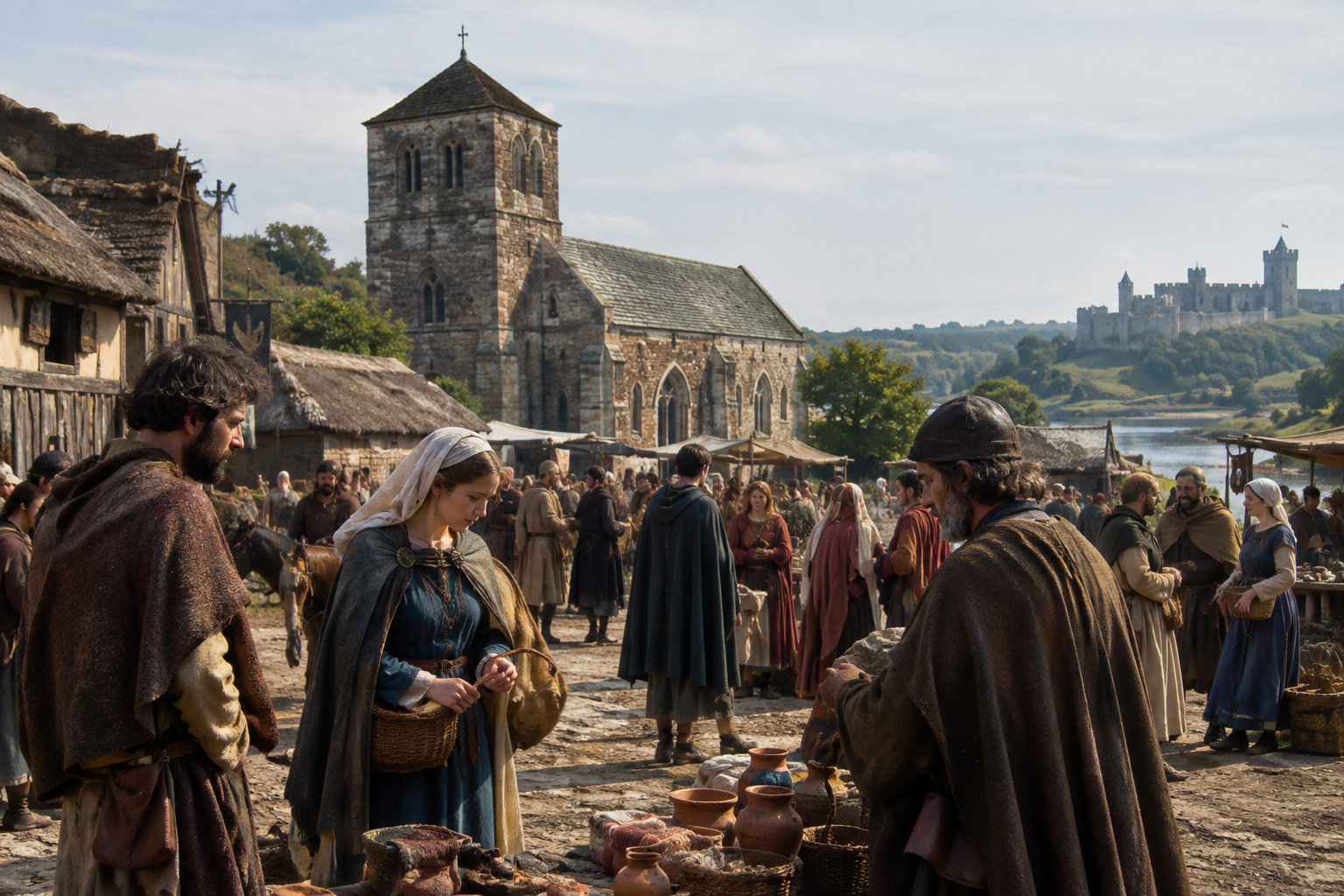
Some Y-DNA lineages seem to appear in history not as a single grand imperial banner, but as a repeated presence in different corners of Europe over a very long period. Haplogroup R1b1a1b1a1a2a1a1 is one of those cases. It belongs within the wider R1b family, a major branch of western Eurasian paternal ancestry that appears often in later prehistoric and historic Europe. What makes this more specific branch interesting is not that it can be made to explain everything - it cannot - but that the supplied ancient DNA places related paternal lines in a remarkable chain of settings: Bronze Age southeastern Spain, Iron Age France and Bohemia, Visigothic and medieval Iberia, Anglo-Saxon and medieval England, Frankish Germany, Viking Age and post-Viking Scandinavia, and even Sicily and Sardinia.
That is exactly why Y-DNA is so useful, and why it must be handled carefully. A Y-chromosome haplogroup traces one direct paternal line only: father to son, and so on back through time. It does not describe a person's whole ancestry, culture, language, or social identity. Nor does the appearance of a haplogroup in an ancient burial prove direct descent from that individual. But when many finds are placed side by side, they let us glimpse how paternal lineages moved, survived, and settled across the landscapes that later produced kingdoms, noble houses, and castles.
This haplogroup is a downstream branch within the wider R1b tree. For broad context, R1b lineages are deeply important in the paternal history of much of western Europe, especially from later prehistory onward. But one must not lazily pour the whole history of R1b into one narrow subclade. The specific branch here should be approached through the evidence actually supplied: its ancient appearances cluster strongly in Iberia, while later examples show it also present across western, central, and northern Europe.
The densest early concentration in the data comes from Bronze Age Spain. That matters. It suggests that lineages on this branch, or very near it, were established in Iberia long before the Roman Empire, the Visigoths, or the medieval Christian kingdoms. At the same time, samples from Austria, France, Bohemia, and later the North Sea world remind us that paternal lines do not respect the tidy borders of modern nations. They move through marriage, warfare, trade, resettlement, and ordinary family continuity.
Readers interested in the deeper archaeological framework behind such paternal histories may enjoy this broader look at how ancient DNA transformed the field itself.
If one wanted a dramatic opening chapter, one could hardly do better than the cluster from Murcia Almoloya Pliego in Bronze Age Spain. The list includes ALM036, ALM039, ALM050, and ALM052, all dated to 1875 BC, followed by ALM058, ALM063, ALM064, ALM070, and ALM081 at 1650 BC. Add to these PUC002 from Puntal de los Carniceros Alicante Villena dated 1653 BC, I3997 from Lloma de Betxi dated 1841 BC, and ZAP002 from Lorca-Zapeteria Falls Iberia dated 1500 BC. This is not a stray appearance. It looks like a substantial paternal presence in Bronze Age southeastern Iberia.
That does not mean every man in Bronze Age Iberia belonged to this lineage, nor that the branch originated exactly there. But it does show something solid: by the second millennium BC, this paternal line was already part of the human landscape of Mediterranean Spain. Archaeologically, these were complex societies of the Bronze Age, long before later labels such as Celtiberian, Roman, or Visigothic would be applied to Iberian populations.
There are also earlier and wider hints. GBVPK from Grotte Basse de la Vigne Perdue France, dated 2380 BC, and UZH028 from Unterhautzenthal Austria, dated 1900 BC, show related paternal presence beyond Iberia in later prehistory. They do not prove a single simple migration route. But together they suggest a western and central European distribution already in place before the historical period.
For readers drawn to the Iberian side of this picture, this article on Roman-era continuity and change in Spain adds valuable context for how old regional ancestries could persist through later empires.
By the Iron Age, the branch is visible in strikingly different cultural settings. CGG023685, from Parancot and identified with the Sequani Tribe in Gaul, is dated 579 BC. In Central Europe, I20522 from Prague Jinonice Central Bohemia is dated 300 BC. And in northeastern Iberia, I3324 from Ullastret Ligurian Head Girona is dated 280 BC. These are not one people in the old-fashioned sense. They belong to different archaeological and historical worlds. Yet the paternal signal appears across them.
That is one of the salutary lessons of Y-DNA. A lineage can pass through communities that spoke different languages, served different rulers, and buried their dead according to different customs. Haplogroups are not ethnic uniforms.
The Mediterranean examples from Sicily are especially evocative. I21859, a Carthaginian Italy Sicily Outsider Lilybaeum Marsala Necropoli Monumentale burial dated 144 BC, and I21858 from Carthaginian Era Mozia Western Sicily Lilybaeum dated 120 BC, place the lineage in a Punic-connected island crossroads. Nearby in deeper time stands I8561 from Early Bronze Age Abisso del Vento Sicily, dated 2073 BC. Sicily, as ever, was not a margin but a meeting point.
Then the early medieval world appears. CGG022051 from Estevillas Virgen de la Torre in Visigothic Migration Period Spain, dated 552 AD, and EV8 from Merovingian Period Frankish Eltville Germany, dated 660 AD, show the branch present in two of the successor worlds that emerged after Rome. Again, these samples do not prove that "Visigoths" or "Franks" as wholes were defined by this lineage. They show that men carrying it lived inside those historical societies.
If you want a broader look at exactly this kind of mixed post-Roman world, the lower Rhine frontier offers a very useful comparison.
Explore Roman-Frankish Frontiers
The English evidence is unusually vivid. In Norfolk, three men from Anglo-Saxon Sedgeford - SED018, SED020, and SED021 - are all dated 760 AD. One is even noted as a Battle Victim. These are the sort of finds that make the past suddenly less abstract: not a map of arrows and cultures, but men living, fighting, and dying in one East Anglian community.
That matters for the later noble geography in the supplied material, because Norfolk is also where Wormegay Castle, associated with the House of Bardolf, later stood. The castle began as a Norman motte and bailey after the Conquest, likely by the de Vaux family, planted into the fenland to control routes and manor alike. There is no basis for claiming that the Bardolfs or de Vaux men were direct paternal descendants of the Sedgeford burials. But the regional continuity is historically suggestive: long before Norman earthworks rose over Norfolk, related paternal lines were already present in that landscape.
The same is true further west and inland. ATP_PSN_950 from Cherry Hinton, dated 1055 AD, and ATP_PSN_905 from Cambridge St Johns Hospital, dated 1250 AD, keep the lineage in medieval England across the Norman divide. That is a useful reminder that conquest does not erase populations overnight.
The line also appears in Scandinavia and the North Sea trading zone: VK329 from Viking Age Ribe Jutland dated 786 AD, and SWG006 from Post Viking Age Hedeby Schleswig Rathausmarkt Southern Jutland dated 1070 AD. Add ST2107 from Sint-Truiden Groenmarkt in Belgium dated 1050 AD, SZA-7 from Szegvar-Szolokalja in the Hungarian Conqueror period dated 950 AD, and SNN002 from Duomo San Nicola Sardinia dated 1500 AD, and one sees not a single tribal story but a long medieval circulation across Europe.
For more on how such lineages fit into England before and after 1066, this related piece is well worth reading.
The noble families supplied here belong to a later world of charters, feudal rights, and stone fortification, but they sit in regions where these older paternal histories had long been unfolding. In France, the House Turenne held Chateau de Turenne high on its rocky hill in the Correze, ruling an unusually independent viscounty from the early Middle Ages until 1738. The surviving Cesar tower and Treasure tower still speak of a time when local lordship could rival kings. In a broad geographical sense, the French samples - from GBVPK in prehistoric France to the Gallic CGG023685 and Merovingian EV8 - remind us that such noble territories were laid over landscapes with very deep demographic histories.
The House de Dreux offers another version of noble memory. Chateau de Dreux in Eure-et-Loir began as a medieval stronghold, then became in the 19th century a place of dynastic memorialization tied to the House of Orleans and the Chapelle royale de Dreux. Less fortress now than dynastic archive in stone, it shows how aristocratic places can outlive their military purpose and become repositories of lineage in a social rather than genetic sense.
In England, the pattern is rather different. Halton Castle, linked here with the House Gernet, rose above the Mersey first as a Norman motte and bailey built by Nigel of Cotentin, then as a major stone stronghold under John de Lacy. Deddington Castle, associated with the House de Saddington, survives mainly in earthworks: Norman power now visible as a shape in the ground. Brocklesby Hall, of the House of Yarborough, represents the later aristocratic estate rather than the medieval fortress, its history tied to inheritance, landscape design, and political status in North Lincolnshire.
None of these castles proves a haplogroup. Castles are not chromosomes. But they do preserve something genetics also preserves in its own way: continuity through change. Families rise, estates are rebuilt, fortresses are ruined, titles shift, and yet regional histories endure. A paternal lineage found in ancient burials and a castle held by a medieval noble house are different kinds of evidence, but both are records of men embedded in place.
What, then, does R1b1a1b1a1a2a1a1 reveal? Not a neat ethnic label, and certainly not a shortcut to noble descent. What it does reveal is a paternal line with clear depth in Iberia, especially Bronze Age southeastern Spain, and a later presence across the western and central European worlds of Gauls, Franks, Anglo-Saxons, Viking Age traders, medieval townsmen, and Mediterranean island populations.
That is the real excitement of ancient DNA. It lets us place a direct paternal line into actual cemeteries, actual settlements, actual historical settings: ALM036 and its Bronze Age companions in Murcia; CGG022051 in Visigothic Spain; EV8 in Merovingian Germany; SED018, SED020, and SED021 in Anglo-Saxon Norfolk; ATP_PSN_950 and ATP_PSN_905 in medieval Cambridgeshire. Written genealogy usually begins late and narrows quickly. Ancient DNA starts earlier and asks a different question: where had this paternal line already been living, moving, and surviving centuries before the first parchment pedigree was drawn up?
If your own Y-DNA falls on a branch like this, MyTrueAncestry can help you explore those wider contexts - from Bronze Age burials to medieval populations and the historic regions where later noble families built their seats. These matches do not prove direct descent from any one ancient individual or aristocratic house, but they can offer a much richer sense of the worlds your paternal line once inhabited.






Comments