Haplogroup R1b1a1b1a1a1c3

– 6 min read


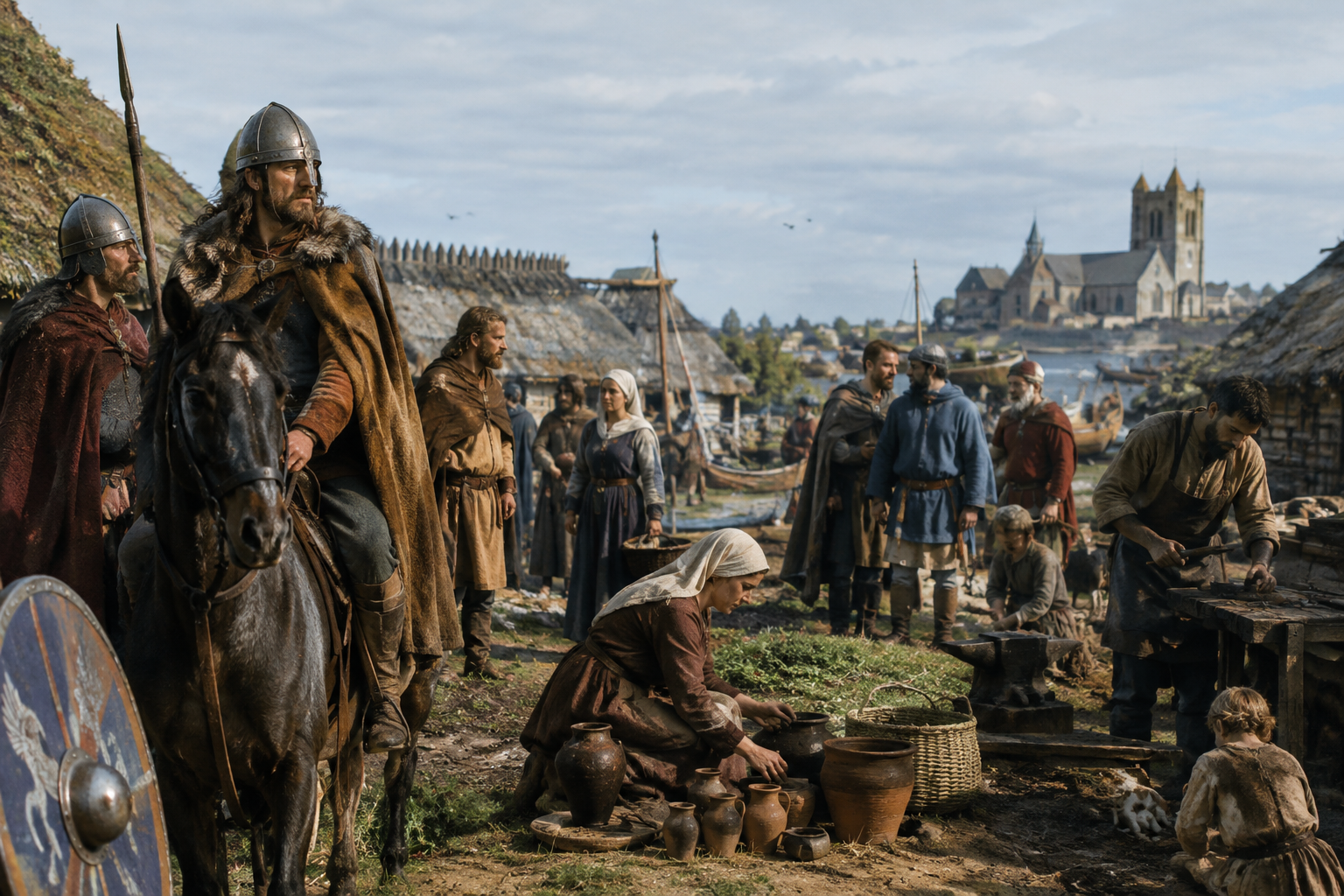
Some Y-chromosome lineages sit quietly in the background of European history until ancient DNA drags them into the light. Haplogroup R1b1a1b1a1a1c3 belongs to one of those stories. It is a very specific paternal branch within the wider R1b tree, and what makes it interesting is not a single dramatic origin tale, but its repeated appearance across a striking range of archaeological settings: Bronze Age Central Europe, Iron Age communities, Roman and post-Roman frontier worlds, Anglo-Saxon England, Lombard Italy, Viking Age Scandinavia, and medieval northwestern Europe.
That breadth matters. Y-DNA haplogroups trace one narrow line only: the direct paternal line, father to son to son. They do not describe a person's whole ancestry, culture, or identity. But when a lineage turns up again and again in burials from different centuries and regions, it becomes a useful thread for following long-term patterns of male-line continuity, migration, and settlement. For a branch like R1b1a1b1a1a1c3, the story is less about a single people and more about how paternal lines moved through the changing worlds of prehistoric and medieval Europe.
Because this is such a narrow subclade, we need to be careful. The full deep history of broad R1b cannot automatically be assigned to this exact branch. Still, the sample record provided here places this lineage firmly in European contexts stretching back into later prehistory. One of the earliest appearances comes from the Late Neolithic Vlaardingen/CordedWare Netherlands Mienakker Year:2682 BC ID:I12902. That already places this paternal line in the North Sea world long before written history, in a period shaped by major shifts in population, exchange, and burial practice.
The branch also appears in the Bell Beaker and Bronze Age horizon of northwestern and central Europe, with Bell Beaker De Tuithoorn North Holland Year:2080 BC ID:I4070, Battleaxe Sweden L Beddinge 56 Year:2079 BC ID:RISE98, Bronze Age Unetice Thuringia Leubingen Sommerda Germany Year:1950 BC ID:LEU007, and Middle Bronze Age Westwoud-Binnenwijzend Netherlands Year:1410 BC ID:I11972. That is an impressive spread. It suggests that by the Bronze Age, close relatives of this paternal line were already present across the Low Countries, southern Scandinavia, and central Europe.
In other words, this is not the sort of lineage that appears out of nowhere in the early Middle Ages. It seems to have deep roots in the populations of temperate Europe that later fed into many different archaeological and historical groupings.
Explore Bell Beaker ancestry in the Low Countries
By the Iron Age, the same paternal thread turns up in places we usually discuss under very different historical labels. There is Belgic Suessiones Tribe France Bucy-le-Long Year:500 BC ID:CGG022425, Gallic France Bucy-le-Long Year:457 BC ID:CGG022419, and Belgic Suessiones Iron Age France Bucy-le-Long Year:365 BC ID:CGG022456. Add to that Celtic Iron Age Austria Hallstatt Year:550 BC ID:CGG101214 and Iron Age Hungary Kesznyeten-Szeruskert Year:150 BC ID:Hung160, and you can see the point: this is a paternal line appearing in western and central European communities that archaeologists describe as Belgic, Gallic, Celtic, and Carpathian.
That does not mean the haplogroup was "Celtic" in any simple sense. Haplogroups are older and messier than ethnic labels. But it does show that this branch was at home in Iron Age Europe across a broad belt from France to Austria to Hungary.
The Roman period adds another layer. Imperial Roman Viminacium Serbia Pecine Necropolis Year:100 AD ID:I15527 and Imperial Roman Era Isola Sacra Year:200 AD ID:R11121 show the lineage in imperial settings from the Balkans to Italy. Then we find it in men associated with frontier or Germanic contexts: Roman-period Germanic Warrior Mursa Croatia Third Century Crisis Year:260 AD ID:OSIJ003, Germanic Late Antique Pannonia Arrabona Szechenyi Square Hungary Year:425 AD ID:GYS029, and Germanic Tribe Bavaria Straubing-Bajuwarenstrasse Year:410 AD ID:STR316b and STR393b.
This is where ancient DNA becomes so useful. Written sources often divide the world into Romans and barbarians, provincials and migrants. Genetics reminds us that paternal lines ignored those neat categories. The same male-line branch could be present in communities on both sides of those political boundaries.
Read about Rome and the frontier world
If there is one historical landscape where R1b1a1b1a1a1c3 really comes alive, it is the Migration Period and early medieval North Sea world. Consider the cluster from Pannonia and Lombard-associated cemeteries: Longobard Period Pannonia Savaria Szeleste Barbaricum Hungary Year:525 AD ID:SZL050, SZL051, and Migration Period Pannonia Savaria Szeleste Barbaricum Hungary Year:525 AD ID:SZL076. Then there are the remarkable Collegno burials in northern Italy: Lombard Warrior Elite Collegno Northern Italy Year:580 AD ID:COL_069, Lombard Era Collegno Northern Italy Year:580 AD ID:COL_069b, and Lombard Warrior Elite Collegno Northern Italy Year:580 AD ID:COL_069x.
These are not just names on a spreadsheet. They represent the movement of people through the shattered western empire and into new post-Roman kingdoms. The Lombards, whatever mixture of ancestry they carried, left behind cemeteries that make male-line mobility visible in a way medieval chroniclers never could.
The same pattern appears further north and west. In England we find Early Anglo Saxon Period Buckland Dover England Year:400 AD ID:BUK007, BUK012, BUK060, BUK064, and BUK070; Anglo Saxon Oakington England Year:470 AD ID:OAI006 and Germanic Oakington England Year:470 AD ID:OAI013; Anglo-Saxon Edix Hill Cambridgeshire Year:545 AD ID:EDI064c; and the rich early cemetery evidence from Yorkshire at West Heslerton, including I11583, I11584, I20644, I20652, I20671, and I20677.
Across the Channel and North Sea, the line turns up in Saxon Migration Period Saxony-Anhalt Bruecken Year:500 AD ID:BRC006x, Migration Period Germany Rathewitz Saxony-Anhalt Year:500 AD ID:RTW012, Migration Period Lower Saxony Germany Hiddestorf Year:400 AD ID:HID003 and HID004, and later at Dunum in Lower Saxony with DUN006, DUN009, and DUN011 dated to 840 AD.
By the Viking Age and after, the branch remains visible in Scandinavian and trading settings: Viking Age Sigtuna Sweden Year:935 AD ID:urm160x, Post Viking Age Hedeby Schleswig Rathausmarkt Southern Jutland Year:1140 AD ID:SWG001, and even Danii Tribe Denmark Sjaelland Kalundborg Simonsborg Year:175 AD ID:CGG106724 pushing the Scandinavian connection much earlier.
Explore Anglo-Saxon migration DNA
By the high Middle Ages, this paternal branch is still visible in northwestern Europe. There is Carolingian Belgium Sint-Truiden Groenmarkt Year:795 AD ID:ST2969, Medieval Belgium Sint-Truiden Onze-Lieve-Vrouwekerk Year:900 AD ID:ST0323, ST0786, and Year:1090 AD ID:ST0024, plus Post Carolingian Flanders Wulpen Year:1162 AD ID:WPK005. There is also Norman Invasion Medieval Lincolnshire Lincoln Castle Year:1100 AD ID:S3044. What these samples suggest is persistence across the same broad northern European zone rather than a single short-lived migration event.
That is the right setting in which to place the House of Pelham. We are not entitled to say that every Pelham male belonged to R1b1a1b1a1a1c3, nor that any ancient sample here proves descent from the family. But historically the association is interesting. The Pelhams were rooted in southeastern England, and their seat at Laughton Place in East Sussex began as a medieval manor house of the family, built mainly in the fifteenth century on the site of an earlier home. It became a grand brick courtyard house with gatehouse and chapel, the sort of residence that advertised status at a moment when brick itself still carried social meaning.
Laughton Place is especially evocative because it also shows how aristocratic landscapes change. Altered in the seventeenth and eighteenth centuries, partially decayed, and largely vanished, it survives as a fragment of a much larger ambition. That makes it a good metaphor for Y-DNA history too. The surviving lineage is only a fragment of the once much wider population story, but it still gives us a vivid glimpse of how medieval and early modern male lines were anchored in place.
In geographic terms, East Sussex sits within the wider zone where early medieval Germanic and Anglo-Saxon settlement profoundly shaped local populations. That does not prove a Pelham paternal origin of any particular kind, but it does mean that a lineage found repeatedly in Anglo-Saxon England, Lower Saxony, Flanders, and the North Sea coast belongs in the same broad historical landscape as later English gentry houses.
Discover the history of the House of Pelham
R1b1a1b1a1a1c3 is a good reminder that paternal ancestry can be both specific and stubbornly untidy. Its ancient DNA record links the Netherlands, Germany, Scandinavia, France, Hungary, Italy, Belgium, and England. It appears in Bronze Age communities, Iron Age groups, Roman provincial settings, Migration Period burials, Lombard elites, Anglo-Saxon cemeteries, Viking Age towns, and medieval churchyards. That is not evidence for one uninterrupted dynasty. It is evidence for a durable male-line branch moving through many societies over a very long time.
And that is precisely why ancient DNA is so useful beside archaeology and family history. Written genealogies may take you back a few centuries; graves like LEU007, COL_069, EDI064c, or S3044 push the context much further back. They do not tell you that an ancient Lombard warrior or a Bronze Age man from Thuringia was your ancestor. But they do show the kinds of paternal worlds in which your lineage once circulated.
If you want to follow those wider connections across medieval towns and changing populations, the Sint-Truiden evidence is well worth a look.
Explore medieval DNA from Sint-Truiden
Upload your DNA to MyTrueAncestry to explore how your results compare with ancient individuals, archaeological cultures, and historical populations connected to lineages like R1b1a1b1a1a1c3. These matches do not by themselves prove direct descent or noble ancestry, but they can open an extraordinary window onto the long human story behind your paternal line.






Comments