Haplogroup R1b1a1b1a1a1c2d

– 6 min read


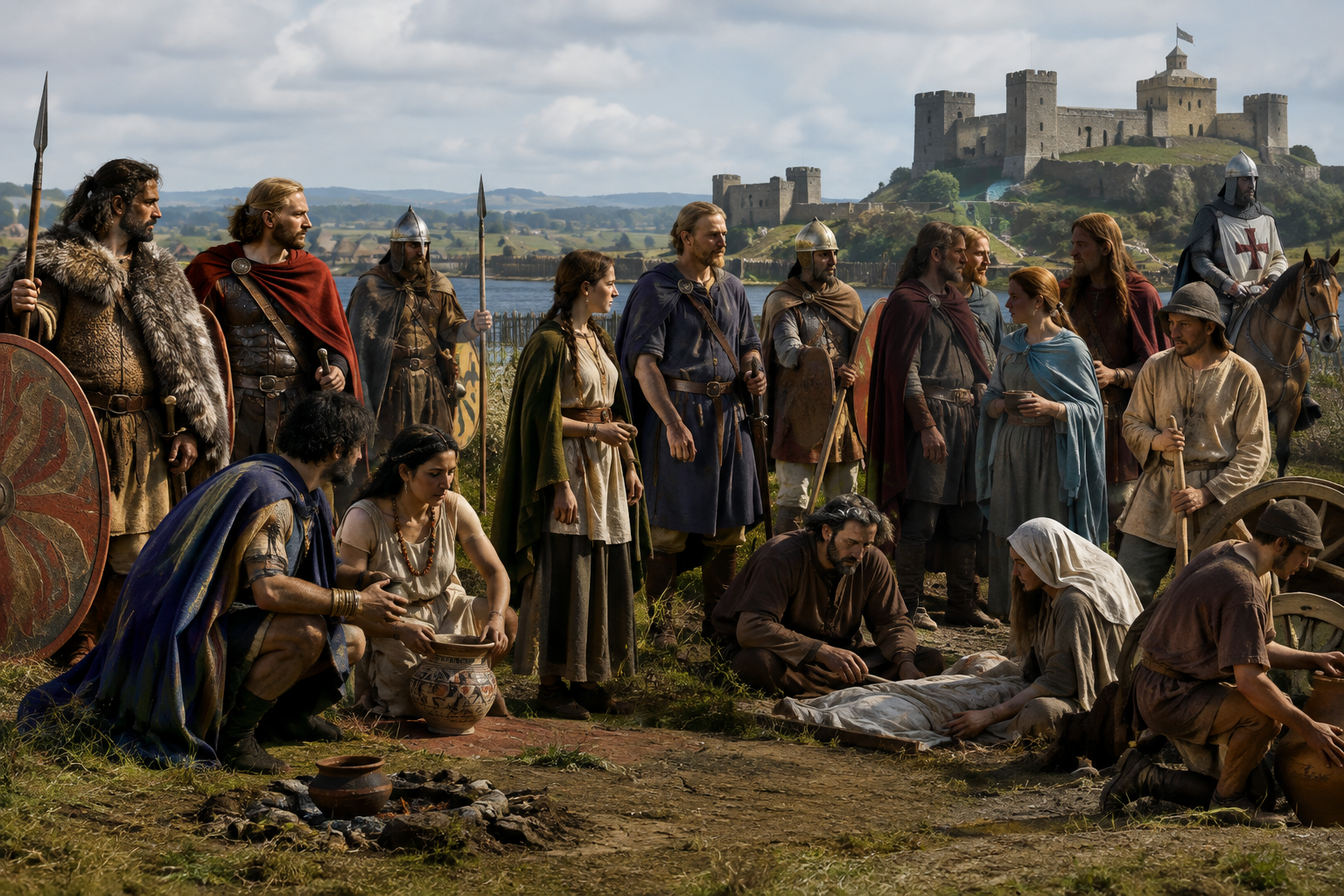
Some Y-chromosome lineages announce themselves with a very long technical label, and R1b1a1b1a1a1c2d is certainly one of them. But behind that formidable string lies a very human story: fathers and sons, burials and battlefields, migrations across North Sea coasts and continental plains, and the slow accumulation of history from the Bronze Age to the late medieval Mediterranean. What makes this lineage especially interesting is not that it can be reduced to one people or one kingdom - it cannot - but that its ancient appearances cluster in places central to the making of later western and central Europe.
As ever with Y-DNA, a note of proportion matters. A Y-haplogroup traces only one narrow line of descent: the direct paternal line. It does not describe a person's whole ancestry, culture, identity, or family history. Still, paternal lineages can be remarkably informative. In the case of this branch within the wider haplogroup R1b, the ancient DNA record points us toward a story spread across Bell Beaker North Holland, Bronze Age Netherlands, Iron Age Gaul, early Anglo-Saxon Yorkshire, Lombard-period Germany and Italy, and even Norman-era Lincolnshire. That is not a dynasty in itself. It is something better for the historian: a pattern.
This haplogroup belongs within the wider R1b family, one of the major paternal lineages in western Eurasia and especially well known in later European population history. For a very specific subclade such as R1b1a1b1a1a1c2d, however, we must be careful. The grand story often told about broad R1b expansions cannot simply be pasted wholesale onto a much narrower descendant branch. What we can say more responsibly is that this lineage appears in archaeological settings tied to long-term developments in northwestern and central Europe, and that ancient DNA helps us see its persistence across many centuries.
The earliest clues in the supplied evidence come from the Low Countries. The Bell Beaker individual I4070 from De Tuithoorn, North Holland, dated to 2080 BC, places this paternal line's deeper ancestry in a region often discussed in connection with major Bronze Age transformations. Another early appearance, I11972 from Middle Bronze Age Westwoud-Binnenwijzend in the Netherlands, dated to 1410 BC, suggests that related paternal lines were still present there long after the Bell Beaker horizon itself had passed into archaeology's rear-view mirror.
That matters because it hints at continuity as well as movement. Lineages do not only sweep dramatically across maps; they also stay put, reproduce, and become part of local populations whose identities change over time.
By the Iron Age, the same broad paternal thread appears farther southwest in what is now France. At Bucy-le-Long we find CGG022425, described as a Belgic Suessiones tribe individual from France dated to 500 BC; CGG022419, a Gallic individual dated to 457 BC; and CGG022456, another Belgic Suessiones individual dated to 365 BC. This is a useful reminder that genetic lineages do not respect the tidy labels later historians prefer. "Belgic" and "Gallic" are cultural and political descriptions from the Iron Age world, not genetic containers. Yet the recurrence of this paternal branch in northern France suggests that it had become part of populations living in the very zone where continental connections, warfare, and exchange with Britain were routine.
Then the pattern jumps the Channel. Three early Anglo-Saxon samples from West Heslerton in Yorkshire - I20644, I20671, and I20677, all dated to 550 AD - carry this branch into one of the most discussed episodes of early medieval history: the reshaping of post-Roman Britain. These burials do not prove that everyone bearing this haplogroup was "Anglo-Saxon," nor that the lineage arrived in Britain only in the 5th or 6th century. But they do show that this paternal line was present among communities associated with the early Anglo-Saxon archaeological horizon.
That makes the haplogroup especially interesting for anyone trying to understand the web of North Sea connections linking the Low Countries, northern Germany, and eastern Britain. The old story of migration is no longer told as a simple replacement. Ancient DNA has made it much more complicated and much more interesting.
The lineage also appears in contexts associated with the Lombards, and here the archaeology becomes particularly vivid. Sample HVN005, described as Longobard Haeven Mecklenburg-Vorpommern and dated to 250 AD, places the line in the southern Baltic world before the famous Lombard movement into Italy. Later, in northern Italy at Collegno, we encounter three closely dated samples from 580 AD: COL_069, COL_069b, and COL_069x, including individuals described as Lombard Warrior Elite.
Now, one must not overstage this. A shared haplogroup does not prove a neat chain of direct descent from HVN005 to the Collegno men. But the geographical sequence is striking. It fits a wider historical picture in which groups associated with the Lombards moved from central and northern Europe into Italy during the turbulence of the post-Roman centuries. Ancient DNA cannot simply read the Lombard migration off a chromosome, but it can show that paternal lines found in northern Europe also turn up in elite-associated Lombard-era burials in Italy.
The later medieval and early modern samples are equally revealing in a quieter way. S3044, from Norman Invasion Medieval Lincolnshire Lincoln Castle, dated to 1100 AD, shows the lineage still present in England after the Norman Conquest. Petersberg, a medieval Upper Bavaria individual dated to 1068 AD, places it in the German-speaking lands as well. And ELW003, a post-medieval plague victim from Ellwangen, Germany, dated to 1550 AD, reminds us that paternal lines continue through the ordinary catastrophes of history too, not just through famous migrations and military elites.
Explore post-Roman central Europe
How, then, do we connect such a lineage to later noble history without becoming silly? By being cautious. The supplied noble association is with the House of Crispo and Naxos Castro, the Venetian castle at Chora on Kythera. Its story begins after 1204, when the island passed into Frankish and then Venetian hands. A fortified town rose on a high rock above the sea, guarding the straits between the Aegean and the Ionian. Under Venice, the castle became the island's political heart, crowded with houses, churches, stores, and defensive works. Pirate raids and Ottoman attacks shaped its life, and its importance waned only with changing rulers and changing military realities.
This is not evidence that the Crispo family, still less every male in its orbit, can be genetically identified with R1b1a1b1a1a1c2d. That would be far too much to claim. But the castle is a useful reminder of how lineages travel through history: not only with prehistoric expansions or Migration Period warbands, but through feudal lordship, maritime empire, and Mediterranean politics. Families ruling places like Kythera were often heirs to several older worlds at once - Latin, Greek, Venetian, and crusader. The stones of Naxos Castro preserve political memory; ancient DNA preserves biological fragments of the much longer human background behind that world.
And there is an additional geographical pleasure here. This haplogroup's supplied ancient samples are concentrated in northwestern and central Europe, while the Crispo stronghold stands in the southeastern Mediterranean. That contrast is precisely the point. Medieval states and noble houses often stitched together regions whose deeper population histories were very different. Genetics and castles do not tell the same story, but when placed side by side they illuminate how Europe was assembled.
Read about the House of Crispo
What emerges from R1b1a1b1a1a1c2d is not a single ethnic label but a chronology of presence: Bell Beaker North Holland, Bronze Age Netherlands, Iron Age northern France, early medieval Yorkshire, Lombard Italy, medieval England and Bavaria, and post-medieval Germany. That spread makes it a fine example of how paternal lineages can persist through changing archaeological cultures and political identities.
It also shows why ancient DNA is so valuable. Written genealogy rarely reaches beyond the medieval period, and even then it is patchy, biased, and obsessed with the privileged. Ancient DNA gives us a different archive. A Bell Beaker burial such as I4070 or an early Anglo-Saxon cemetery sample like I20644 is not a named ancestor in the family-tree sense. But these individuals are part of the human background from which later European populations emerged.
For readers interested in the wider Mediterranean setting, especially the long interaction between islands, migration, and identity, the MyTrueAncestry community also has useful reading on related regional questions.
Explore ancient Italian islands
If your own Y-DNA or autosomal results point toward lineages like this one, MyTrueAncestry can help place them in a richer historical setting. You may discover similarities to ancient individuals from Bell Beaker cemeteries, Iron Age France, Anglo-Saxon England, or Lombard Italy. Those matches do not prove direct descent from a named warrior or noble house, but they can offer a wonderfully concrete sense of where one slender ancestral thread appears in the archaeological record.
Upload your DNA to explore how ancient samples, historical populations, and the long paternal history of Europe may intersect with your own results.






Comments