Haplogroup R1b1a1b1a1a1c2b2b1a2

– 6 min read


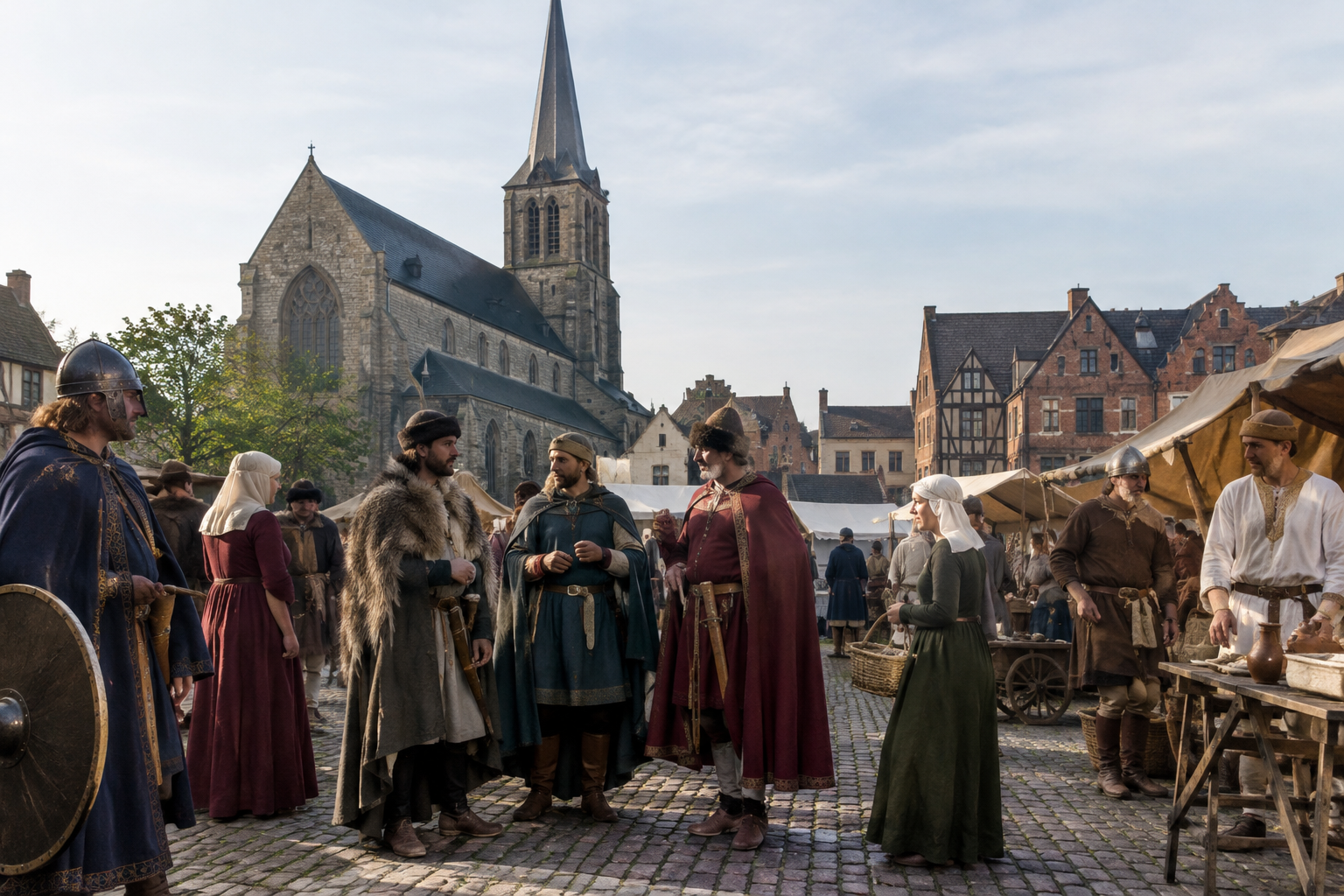
Some Y-DNA haplogroups are so broad that they cover vast swathes of Eurasian history. Others are narrower, more like a track in the mud than a whole road system. Haplogroup R1b1a1b1a1a1c2b2b1a2 belongs to that second category: a very specific paternal branch whose importance lies not in grand slogans, but in the way it appears across a striking set of early medieval and medieval contexts from England to Italy, from Belgium to Denmark, and even among the Hungarian conqueror elite.
That alone makes it historically interesting. Y-DNA traces one direct paternal line only - father to son to son across generations - so it never represents a person's full ancestry. But precisely because it follows that narrow line, it can reveal continuities and movements that written history only partly records. In this case, the supplied evidence places this branch, or closely related paternal lines, in the mobile, mixed, and politically restless world of post-Roman and medieval Europe.
Explore How Ancient DNA Reconstructs History
The first duty with a lineage this specific is restraint. The haplogroup begins with the broader family of R1b, one of the best-known Y-chromosome lineages in western Eurasia. But it would be careless to pour the entire history of broad R1b directly into this much narrower downstream branch. What we can say responsibly is that this paternal line sits within a major western Eurasian Y-chromosome framework and appears, in the evidence supplied here, in early medieval and medieval settings strongly tied to the North Sea world, the former Roman frontier, and the migration-era networks of continental Europe.
That pattern matters. It suggests not a single tribe or nation, but a lineage circulating through zones where peoples moved, intermarried, fought, traded, settled, and resettled. In other words, the history of this haplogroup is not a tidy ethnic label. It is part of the untidy human story of Europe after Rome.
The sample list is unusually revealing because it stretches across both geography and time. One of the earliest is ADN004, from a Saxon grave in Lower Saxony at Hannover-Anderten in Germany, dated to 400 AD. Not far behind comes OBM053, associated with the Thuringii Tribe at Obermoellern in Germany, dated to 500 AD. These are not incidental finds from the fringes of Europe. They sit squarely in the old heartlands of migration-period Germanic history.
Then there is COL_034x, from Lombard Era Collegno in northern Italy, dated to 580 AD. That is a splendid reminder that post-Roman Italy was not some sealed classical afterlife. It was a place of movement, military power, and resettlement. A paternal lineage turning up in both Germany and Lombard-era northern Italy fits neatly into that wider story of people crossing the Alps and remaking Roman provinces into early medieval kingdoms.
The English evidence is equally suggestive. LAK013, from Early Medieval Suffolk England Lakenheath, dated to 650 AD, places this lineage in eastern England during the centuries when the Anglo-Saxon world was taking shape. That does not prove a simple one-to-one "Saxon haplogroup" label - history is never so obedient - but it does place the lineage in the very regions most closely tied to continental North Sea migration.
Read About Anglo-Saxon Genetic History
By the Viking Age, the picture broadens again. CGG107386, a Viking Age Denmark Outlier Bilidt sample dated to 800 AD, and VK468 from Viking Age Gotland Kopparsvik Sweden, dated to 975 AD, place the lineage in Scandinavian contexts. SWG012, from Post Viking Age Hedeby Schleswig Rathausmarkt Southern Jutland, dated to 1105 AD, is especially evocative. Hedeby was one of the great trading nodal points of the Viking and post-Viking world, where merchants, migrants, and mariners crossed paths between the Baltic and the North Sea.
These finds do not mean that everyone carrying this line was "Viking" in any narrow cultural sense. But they do show this paternal branch, or its immediate kin, circulating within the Scandinavian and North Sea world over centuries. That helps explain why the same wider pattern reaches England, northern Germany, Denmark, and southern Jutland.
The Belgian material adds another layer. At Sint-Truiden Onze-Lieve-Vrouwekerk, three samples appear: ST2326 dated to 990 AD, ST2638 dated to 1030 AD, and ST0062 dated to 1300 AD. The interest here is not just repetition, but duration. A lineage present at the same broad site across several centuries hints at regional persistence within an urbanizing medieval society. It speaks less of a dramatic one-off migration than of paternal continuity embedded in local community life.
For readers interested in how medieval town populations can preserve and blend lineages over time, Sint-Truiden is particularly valuable.
Discover Medieval Sint-Truiden DNA
Then comes a rather different context: TCS-5, from the Hungarian Conqueror Elite at Tiszanana-Cseh tanya in Hungary, dated to 950 AD. This is the sort of find that warns us against overly tidy regional assumptions. The conquest-period Carpathian Basin drew together lineages from multiple directions, shaped by steppe connections, local populations, and incoming elites. A paternal line appearing there as well as in North Sea and western continental settings is not a contradiction. It is a reminder of how interlinked early medieval Europe really was.
In fact, the Hungarian evidence makes this haplogroup more interesting, not less. It places the branch in a world where power, prestige, and mobility could carry paternal lines far beyond any supposed homeland.
Explore the Hungarian Conquest
How, then, do we connect such ancient and medieval DNA evidence to a later noble family like the House of Cecil? Carefully. Very carefully.
The Cecils belong to a much later political world: Tudor and early modern England. Their great monument is Burghley House, near Stamford in Lincolnshire, a grand Elizabethan country house built mainly between 1555 and 1587 for William Cecil, chief minister to Queen Elizabeth I. It was designed on a huge scale to proclaim power, learning, and royal favour. Over time it remained in Cecil hands, became famous for its towers, courtyards, painted rooms, and collections, and later saw its gardens and parkland reshaped in the 17th and 18th centuries, with work linked to Capability Brown. Today it remains associated with the Marquesses of Exeter and survives as one of the greatest prodigy houses of Tudor England.
Now, Burghley House does not provide genetic proof of anything by itself. Nor does a historical association with this haplogroup prove that every Cecil male carried exactly this Y-line. But there is a genuine historical point to be made. The ancient samples discussed above cluster repeatedly around the North Sea, low countries, eastern England, and the wider Germanic and post-Roman zone from which much of medieval and later English society was formed. The Cecils, rooted in that later English world, stand at the far end of a long historical process in which paternal lines moved through Saxon, Scandinavian, Frankish, and English landscapes before entering the written genealogies of noble houses.
That is where genetics and aristocratic history meet: not in a fantasy of direct proof from grave to great house, but in shared geography, long-term regional continuity, and the survival of paternal lines through changing regimes and social orders.
Read More About the House of Cecil
Haplogroup R1b1a1b1a1a1c2b2b1a2 is a good example of how a narrow paternal lineage can illuminate a broad historical world. In the evidence supplied here, it appears among Saxon-era Germany, Thuringian settings, Lombard Italy, early medieval England, Viking and post-Viking Scandinavia, medieval Belgium, and conquest-era Hungary. That is an extraordinary range.
But the lesson is not that one haplogroup "belongs" to one people. Quite the reverse. This lineage seems at home in the mobile societies of the first and second millennia AD, where identity was shaped by language, law, politics, religion, and allegiance as much as by ancestry. Ancient DNA gives us a new way to trace one thread through that complicated fabric, while archaeology and history tell us what sort of worlds those men lived in.
If your own Y-DNA points toward a branch like this one, the fascination lies in context. Your direct paternal line may intersect with the same historical corridors that linked Saxon graves, Lombard cemeteries, Viking trading towns, medieval churches, and later noble households. That does not prove descent from any one ancient individual, nor membership in any noble family. But it does place your paternal story within one of the great connected landscapes of European history.
MyTrueAncestry lets you explore whether your DNA shows similarities to ancient individuals such as LAK013, OBM053, COL_034x, VK468, or the medieval Sint-Truiden samples. Those matches cannot by themselves prove direct genealogical descent or noble status, but they can offer a remarkable perspective on where your ancestral lines may have intersected the real populations of the past.
Upload your DNA and see how your ancestry fits into the deeper history of migrations, kingdoms, and families that written records only partly preserve.






Comments